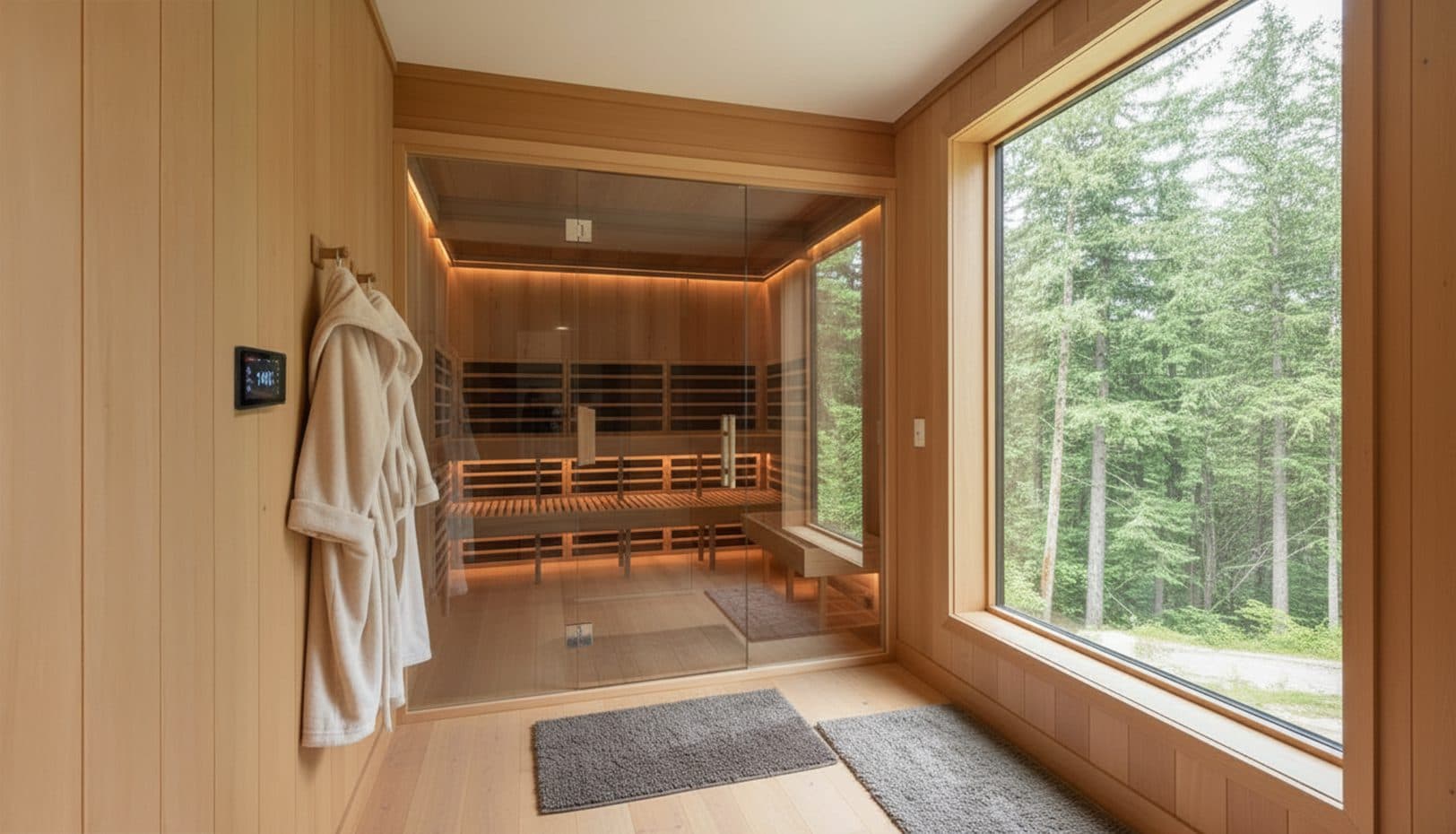
John Harvey Kellogg radiant heat bath history: The 1891 invention
Key Takeaways
- John Harvey Kellogg's 1891 radiant heat bath at the Battle Creek Sanitarium functioned as the first true infrared sauna by using incandescent bulbs inside a body-enclosing cabinet to warm skin directly via radiant energy rather than heating surrounding air.
- Kellogg's hardware program grew out of Seventh-day Adventist "laws of health" doctrine and operated inside a destination resort charging $10 to $20 per day in the 1890s, where guests like President William Howard Taft and Henry Ford helped carry his ideas to elite estates worldwide.
- While Kellogg's core radiant heating physics and seasonal phototherapy for "the blues" held up, his broader record mixed prescient microbiome and anti-tobacco work with counterproductive ultraviolet exposure, relentless yogurt enemas, and dark eugenics rhetoric about "race poisons."
In This Article
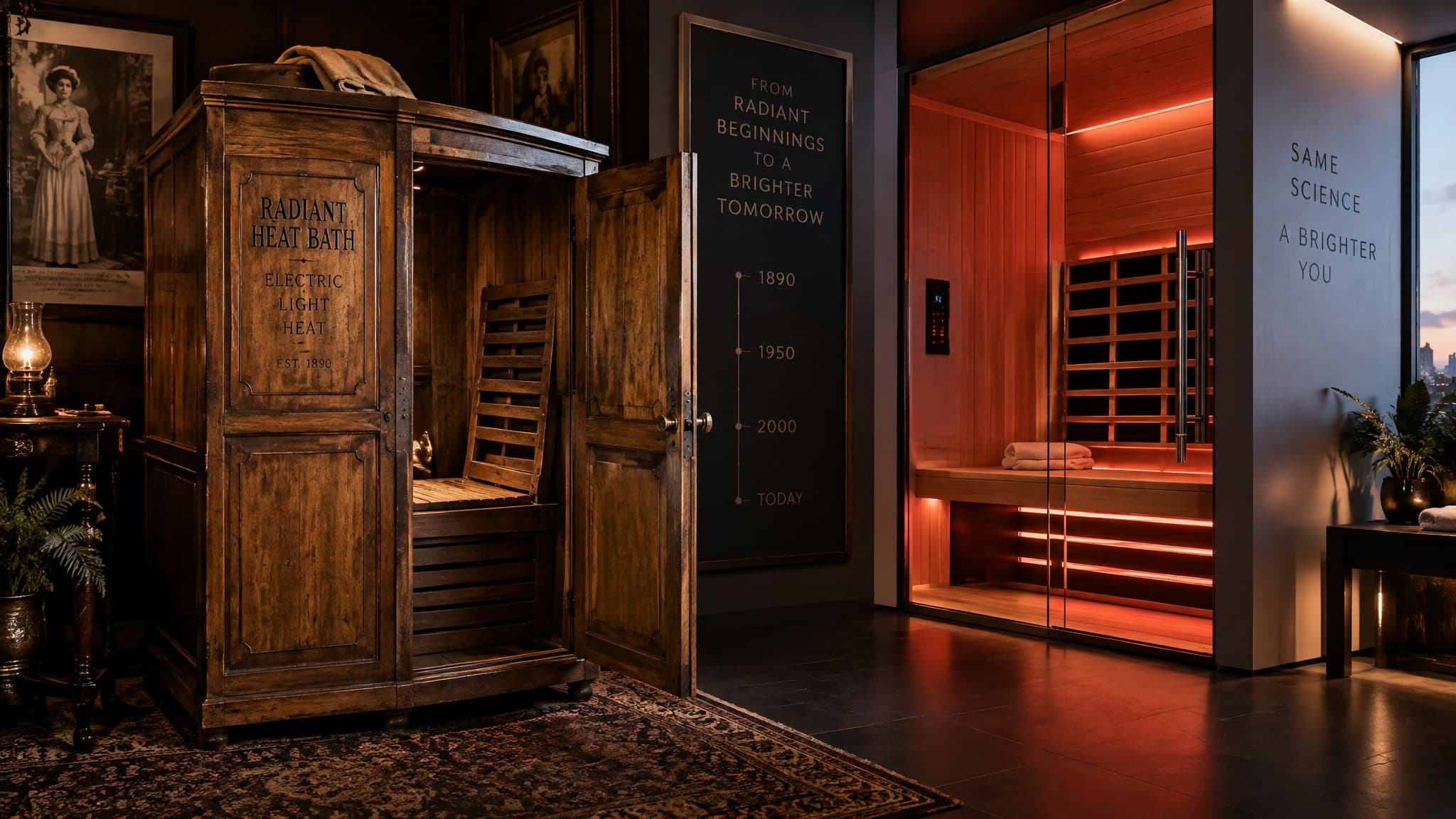
Walk down the cereal aisle and the Kellogg name means toasted grain and sugar. Step back to 1891 in Battle Creek, Michigan, and the same name belonged to a wooden cabinet wired with incandescent bulbs that cooked the occupant with direct light rays instead of steam. John Harvey Kellogg built that 1891 radiant heat bath at the Battle Creek Sanitarium, and it functioned as the first true infrared sauna. If you strip away the digital controllers and modern heater enclosures on a present-day infrared cabin, the core mechanism is identical.
Rather than boiling the air inside a box and waiting for the room to roast the bather, Kellogg's cabinet used radiant energy to warm the body directly inside an enclosed wooden frame. He wasn't chasing gadgetry for its own sake. Kellogg believed that abusing the body violated the "laws of life" and personally offended God, a conviction that drove him to engineer wellness hardware for decades at what was then the world's most famous health destination.
What was John Harvey Kellogg's radiant heat bath?
John Harvey Kellogg's radiant heat bath at the Battle Creek Sanitarium was an 1891 body-enclosing therapeutic cabinet that used incandescent light rays to heat a patient's tissues directly and trigger perspiration at lower air temperatures than steam rooms. While period bathhouses relied on Turkish or Russian steam baths that surrounded bathers in stifling, superheated air, Kellogg's Michigan apparatus applied thermal energy straight to the skin. That direct-heating build separated the radiant heat bath from Kellogg's sibling electric light cabinet and light therapy bed, which used artificial sunlight to treat seasonal mood drops ("the blues") rather than driving deep thermal perspiration.
The apparatus: a cabinet that heated the body, not the air
Reverse-engineering Kellogg's 1891 hardware shows how intentionally it broke from 19th-century bathhouse architecture. Instead of sealing a patient inside a room full of scalding vapor, the apparatus worked like a personal thermal chassis:
- Head-out cabinet enclosure: The wooden cabinet surrounded the seated or reclining patient's body while leaving the head outside in cool room air, preventing the suffocating breathing common in steam rooms.
- Incandescent radiant emitters: Arrays of incandescent light bulbs inside the cabinet served as the heat source, throwing off substantial infrared radiation alongside visible light.
- Direct skin absorption: The radiant energy traveled across the air gap and warmed the skin directly, inducing heavy sweating before the ambient cabinet air could climb to traditional sauna temperatures.
- Preventive clinical integration: The bath didn't operate as a standalone novelty; it sat inside Kellogg's wider Battle Creek regimen alongside vegetarian nutrition, calisthenics, and hydrotherapy.
Electric light cabinet vs radiant heat bath: what is the difference?
Kellogg's electric light cabinet and light therapy bed acted as artificial-sunlight phototherapy for mood and skin exposure. The radiant heat bath, by contrast, operated as a thermal sauna designed to warm body tissue and induce sweat. Mainstream histories routinely mash the two machines together because both used incandescent bulbs inside Battle Creek enclosures during the same era.
Under the hood, they solved different problems in Kellogg's clinical program. The electric light cabinet and light therapy bed looked remarkably like the first tanning bed. Kellogg built them to replace missing natural sunlight during gloomy Michigan autumns for patients diagnosed with "the blues." The radiant heat bath focused instead on the bulbs' infrared thermal output, driving core sweating and circulation without convective steam.
Radiant heat vs convective heat: how the 1891 bath worked
How modern infrared saunas heat the body directly comes down to radiant heating transferring thermal energy straight to the skin at lower ambient temperatures, whereas traditional saunas and Turkish or Russian bathhouses rely on convective heat from superheated air or suffocating steam. Because early incandescent light bulbs emitted heavy infrared radiation alongside visible light, Kellogg's 1891 cabinet worked as the direct physical ancestor of modern infrared emitters. Anyone reconstructing 19th-century bath cabinets usually assumes they were just hot-air boxes until that direct-to-skin radiant physics mechanism clicks.
Theology made physical: why Kellogg built heat and light machines
Kellogg built his heat and light machines to turn Seventh-day Adventist moral physiology into physical hardware for patients seeking preventive wellness, supplying external conditions like heat, light, a vegetarian diet, and exercise so the human body could heal itself. As Western Michigan University scholar Brian C. Wilson (author of Dr. John Harvey Kellogg and the Religion of Biologic Living) notes, Kellogg insisted that the body cures disease on its own, dismissing doctors and external remedies as childish toys next to the human body's own mechanism.
That engineering brief started with Seventh-day Adventist prophetess Ellen ("Sister") White, whose health revelations taught that a pure soul required a pure body. Under Kellogg's holistic mind-body-spirit framework, violating the "laws of life" (or "laws of health") through a poor diet, meat, alcohol, or smoking physically damaged the body and offended God. Building a radiant heat cabinet or prescribing vegetarian meals wasn't lifestyle coaching; it was religious duty rendered in wood and wiring, though that same moralized biology carried severe ideological dark sides when Kellogg applied it to heredity.
Battle Creek Sanitarium: the incubator that made the device possible
A custom thermal cabinet needed a serious R&D budget and thousands of willing test subjects. Kellogg had both inside a massive Michigan clinical complex that operated like a hybrid of a luxury hotel, a university lab, and a church camp.
From Health Reform Institute to The San: 1866-1876
The Battle Creek Sanitarium ("The San") was a purpose-built preventive-wellness resort and clinical laboratory in Michigan that incubated Kellogg's wellness apparatus across roughly 250,000 patients. Following Ellen White's presentation on Christian biblical healthy living on May 20, 1866, the Seventh-day Adventist General Conference approved the facility, which opened on September 5, 1867 as the Western Health Reform Institution.
After the church paid for his medical education, a 23- or 24-year-old John Harvey Kellogg (1852-1943) returned to Battle Creek in 1875 as the best-qualified physician the Adventists had, took over as medical director on October 1, 1876, and ran it until his death in 1943. On September 15, 1910, he officially renamed the facility the Battle Creek Sanitarium, coining "sanitarium" for a place where people learn how to stay well rather than a traditional "sanatorium" for treating the sick.
The 1890s resort-laboratory hybrid
Receiving heat therapy at The San required a preliminary physician consultation that diagnosed the guest and assigned a custom multi-week routine combining a strict vegetarian diet, exercise, hydrotherapy, and sessions inside the electric light or radiant heat cabinets. No two guests got a one-size-fits-all script. By the 1890s, the facility had scaled into a grand hotel-like complex charging $10 to $20 per day, complete with a large gymnasium, tennis courts, a full laboratory, and a pharmacy.
Kellogg's light therapy cabinets and 'the blues'
Kellogg placed patients suffering from "the blues" inside electric light cabinets and on light therapy beds because he viewed light as an essential biological input that could compensate for southeastern Michigan's gloomy autumn weather. Fascinated by the properties of natural sunlight, Kellogg engineered what amounted to the first tanning bed and clinical phototherapy unit decades before modern psychiatry formally named seasonal affective disorder (SAD).
If you look at the Battle Creek hardware lineup as a single codebase, the mood-targeted electric light cabinets and the sweat-targeted radiant heat bath weren't random inventions. They sat on one unified light-and-heat research continuum that treated incandescent wavelengths as tunable biological inputs. That experimental boldness cut both ways: while using bright artificial light to beat back Michigan's fall gloom was years ahead of its time, Kellogg's enthusiasm for sunlight properties also led him to promote ultraviolet (UV) light exposure, a practice later proven harmful to human skin.
From Battle Creek to European royalty: diffusion by design
Wealthy guests carried Kellogg's radiant heat baths to European royalty and aristocratic estates, turning into international hardware evangelists who commissioned residential units after trying them in Michigan. Although founded by Adventists for Adventists, the Sanitarium opened its doors to the general public and became internationally famous, drawing President William Howard Taft, Henry Ford, explorers, and movie stars who paid $10 to $20 per day in the 1890s for multi-week stays.
Kellogg courted the rich and famous on purpose because he knew high-profile guests would spread his biologic living ideas far faster than church pamphlets ever could. High-status wellness hardware almost always travels this exact adoption path. An affluent guest checks into a destination clinic, spends three weeks sweating inside a custom wooden light cabinet, and decides they want that same vitality setup back home at their private estate or royal court. Decades before consumer sauna companies existed, Kellogg used celebrity word-of-mouth as his global distribution network.
Prescient or flawed: judging Kellogg's health record
Kellogg's heat and light therapies delivered real physiological effects when used for direct thermal warming and seasonal mood support, though his sweeping belief that his clinic's regimen could fix almost any ailment grew out of improvised trial and error. As Brian C. Wilson points out, the portly, 5'4" Kellogg treated medicine as art as much as science.
Where Kellogg was decades ahead
When Kellogg's instincts lined up with human biology, his hits were astonishingly early:
- Microbiome and fiber: Noticing that yogurt-eating countries had longer lifespans, he credited living bacterial cultures and manipulated gut flora decades before mainstream microbiome science, alongside developing psyllium seeds as bulk fiber (the direct ancestor of Metamucil) and patenting Soy Acidophilus Milk in 1934 for ulcer, colitis, constipation, and infant-formula patients (topping 200 gallons consumed weekly by 1935, often served with ripe bananas).
- Precision nutrition and fitness: Patients received meal cards tracking exact calorie, protein, carbohydrate, and fat ratios (preserved on a May 19, 1916 card) that were unheard of at the time, plus brass-band calisthenics released in 1923 by Columbia Gramophone Company on ten 78-RPM shellac discs as John Harvey Kellogg's HEALTH LADDER.
- Anti-tobacco campaigning: His 1922 book Tobaccoism, or How Tobacco Kills linked smoking to heart disease, lung disease, ulcers, liver and kidney strain, and neurological damage, alongside Henry Ford's The White Slaver, the Committee of Fifty (which produced the first anti-tobacco motion picture), and the Michigan Anti-Cigarette Society more than 40 years before the January 11, 1964 Surgeon General's Report on Smoking and Health.
Where the medicine failed
His misses were just as dramatic. Obsessed with early 19th-century "autointoxication" theory, the belief that undigested food lingering in the colon poisons the entire body, Kellogg subjected guests to relentless water and yogurt enemas. He also forced surgery patients out of bed for early ambulation and graded deep-breathing exercises when the standard of care was weeks of bed rest. Early movement and breathing exercises eventually became the uncredited backbone of modern post-op recovery, even though some of Kellogg's specific implementations proved counterproductive, much like his promotion of UV light.
'Race poisons' and the 1907 Adventist rupture
The most dangerous element of Kellogg's health program wasn't an overzealous yogurt enema or UV lamp, but the eugenics-aligned degeneration ideology baked into the same moralized physiology that inspired his wellness machines. Taking Adventist teachings that human lifespans had decayed since Adam and Eve in the Old Testament, Kellogg argued that abusing the body passed defective genes down to children. He labeled meat, alcohol, and tobacco "race poisons" that were degrading the human species over generations, warning that these habits would trigger a "biological apocalypse" ending in human extinction unless society steered reproduction toward people with "good genetics."
That attempt to merge Darwinian evolutionary biology with religious health laws eventually blew up his institutional home. As the Seventh-day Adventist Church grew increasingly fundamentalist and rejected evolution, Kellogg refused to look anti-science. In 1907, the church disfellowshipped (expelled) him over the schism, the exact same year his brother's Corn Flakes hit the public market.
The cereal split that erased the wellness machine
John Harvey Kellogg refused to commercialize Sanitarium inventions out of fear that retail sales would hurt his medical reputation, so his brother Will K. Kellogg's cereal empire defined the family name while the radiant heat bath faded from public memory. In the 1890s, John Harvey, his wife Ella Eaton Kellogg, and his brilliant business-manager brother Will (1860-1951) flattened and baked pre-cooked grains for dyspeptic patients. The team filed Patent No. 558,399 on May 31, 1895 (granted April 14, 1896) and debuted Corn Flakes at the summer 1895 Adventist General Conference.
Soon after, digestive patient C.W. Post walked out with the manufacturing secrets to launch the Post Cereal Company. Will responded by founding the Battle Creek Toasted Corn Flake Company in 1906, renaming it the Kellogg Toasted Corn Flake Company in 1907 and debuting Corn Flakes publicly in late summer and early fall of that year. The company posted a $6 million gross profit in 1933 (roughly $110 million today) before Will retired in 1939, while the commercialization split ignited a bitter trademark war over the Kellogg name that never healed before John Harvey died in 1943.
to today: what changed in the infrared cabinet
Modern infrared saunas and Kellogg's 1891 radiant heat bath differ in solid-state emitter engineering, electromagnetic shielding, and digital thermal controls while running on the exact same core physical mechanism of heating the body directly inside an enclosed cabinet at lower ambient air temperatures. Browse a dozen glossy wellness brochures and you'd think direct-to-skin radiant bathing was invented five minutes ago alongside smart-home voice assistants. In reality, the physical architecture, sitting inside a compact wooden enclosure while radiant energy warms your tissues without superheating the room air, hasn't changed in over a century of infrared sauna history.
Where the hardware actually evolved is in how we generate and control those invisible rays after the 1800 discovery of infrared radiation and Japan's clinical Waon therapy revival. Buyers comparing 1891 Battle Creek descriptions against modern sauna pitches are usually shocked that the core value proposition, tolerable air temperatures, direct tissue warming, and compact wooden footprints, is identical. A century of sauna progress comes down to swapping crude incandescent bulbs for purpose-built emitters.
| Hardware & Clinical Feature | Kellogg's 1891 Radiant Heat Bath | Modern Custom Infrared Cabins (SaunaCloud) |
|---|---|---|
| Heat transfer mechanism | Yes (direct radiant energy to skin) | Yes (direct radiant energy to skin) |
| Ambient air heating required | No (heats body at lower air temps than steam) | No (heats body directly without steam) |
| Enclosure architecture | Yes (body-enclosing wooden cabinet) | Yes (handcrafted cedar cabin enclosure) |
| Emitter technology | Partial (incandescent bulbs emitting visible + infrared light) | Yes (proprietary low-EMF VantaWave infrared heaters) |
| Integrated phototherapy | Partial (separate electric light cabinets for "the blues") | Yes (integrated medical-grade red light therapy systems) |
At SaunaCloud, across more than 3,000 home and clinical installations in North America since Christopher Kiggins founded the company in 2014, that historical continuity shapes how we build every cabin. We don't need to reinvent Kellogg's 1891 thermal physics because direct radiant absorption already works. Instead, our engineering focuses on what 19th-century wiring couldn't do: replacing glaring incandescent bulbs with proprietary low-EMF VantaWave heaters inside handcrafted cedar enclosures, and folding dedicated red light therapy arrays into the same cabin. That last upgrade brings Kellogg's two separate Battle Creek machines, the radiant heat bath and the phototherapy light cabinet, back together inside a single piece of hardware, minus the yogurt enemas and 19th-century cure-all mythology.
Frequently Asked Questions
What was John Harvey Kellogg's radiant heat bath and how did it work?
Built in 1891 at the Battle Creek Sanitarium, the radiant heat bath was a wooden enclosure lined with incandescent bulbs that acted as the first real infrared sauna. Instead of trapping a person in a room full of scalding steam, the cabinet kept the bather's head outside in cool air while infrared radiation from the bulbs crossed the air gap to warm the skin directly. That direct energy transfer triggered heavy sweating before the surrounding air could get uncomfortably hot.
Kellogg electric light cabinet vs radiant heat bath: what is the difference?
Although both machines placed patients inside bulb-lined Battle Creek enclosures, they targeted completely different biological responses. The electric light cabinet and light therapy bed worked like early tanning beds, delivering bright artificial sunlight to lift mood and skin exposure during dreary Michigan autumns. The radiant heat bath harnessed the bulbs' infrared output as a thermal sauna to warm tissue directly, boost circulation, and induce deep sweating without steam.
How did Kellogg use heat therapy at the Battle Creek Sanitarium?
Heat sessions were never standalone novelty treatments; every guest started with a physician consultation to map out a tailored, multi-week protocol. Doctors paired time in the radiant heat or electric light cabinets with hydrotherapy, calisthenics, and strict vegetarian meals tracked down to exact calorie and macronutrient ratios. Under Kellogg's philosophy of biologic living, these external tools simply gave the human body the right physical conditions to heal itself.
How similar are modern infrared saunas to Kellogg's 1891 radiant heat bath?
The core thermal physics haven't budged since 1891: both place you inside a compact wooden enclosure and use direct radiant energy to warm your tissues at much lower air temperatures than traditional steam rooms. Where modern builds like our handcrafted cedar SaunaCloud cabins evolve the concept is in solid-state emitter engineering, electromagnetic shielding, and digital controls. By swapping crude incandescent bulbs for proprietary low-EMF VantaWave heaters and adding medical-grade red light systems, we combine Kellogg's separate heat and phototherapy machines into a single cabin.

Founder & Lead Designer, SaunaCloud®
SaunaCloud: 3,000+ installations since 2014 · Author of The Definitive Guide to Infrared Saunas · Featured in Forbes, Inc., and MSN
Christopher designs every SaunaCloud sauna. His work brings the room, heaters, controls and installation plans together so you can review the project before committing. His professional expertise is sauna design and construction, not clinical medicine.
Custom 3D renderings and a proposal in 24-48 hours.
Continue Reading

Ready to Design Your Sauna?
Every project starts with a conversation. Tell us about your space and we'll create your custom plan — free, no obligation.
Custom 3D renderings and a proposal in 24-48 hours.