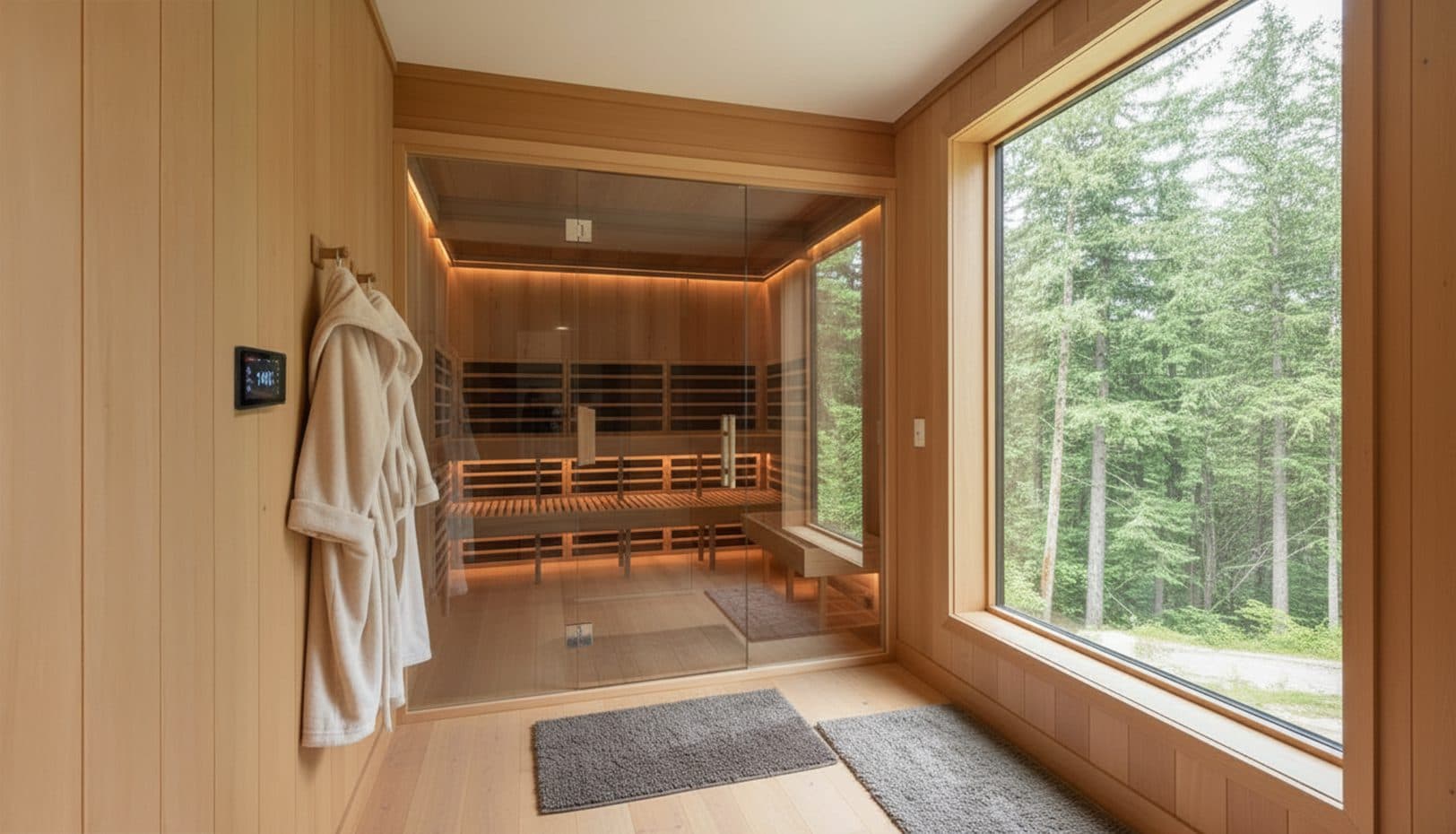
Waon Therapy Japan History: Gentle 140°F Heat for Heart Failure
Key Takeaways
- Japanese physician Dr. Shu A. Tei and colleagues developed Waon therapy ("soothing warmth") around a gentle 60°C (140°F) far-infrared dry sauna protocol designed to raise core body temperature by 1.0 to 1.2°C in fragile chronic heart failure patients.
- The clinical protocol pairs 15 minutes of uniform 60°C heat with 30 minutes of resting under warm blankets and weighed water replacement, repeated several times per week or daily rather than as a single intense session.
- In a 41-patient American Journal of Cardiology trial, 3 weeks of daily Waon therapy alongside standard heart medication raised heart pumping efficiency (LVEF) from 30% to 33%. Patients also saw drops in two blood markers of cardiac stress and walked farther in six-minute tests.
In This Article
Two infrared sauna tabs can sit open on your laptop at the exact same time: one promising you'll torch 600 calories and sweat out vague toxins, and the other a forum thread where someone brags that any cabin under 200°F is a waste of cedar. If you're trying to dig up actual clinical research, the noise gets frustrating fast. For decades, researchers in Japan quietly studied a specific, controlled far-infrared protocol called Waon therapy (often misspelled online as "wayon therapy"), yet it remains barely known in the United States. Instead of testing brutal heat endurance, Japanese doctors put fragile cardiovascular patients inside hospital chambers set to a gentle 60°C (140°F) and tracked what repeated warmth did to their blood vessels.
After years of testing infrared cabins, that 140°F clinical benchmark is the exact reason to be skeptical when someone writes off a home sauna for only reaching 140°F. Plenty of home units operate right around that mark. Still, creating a similar heat environment and sweat response in your spare room isn't the same as receiving a monitored medical treatment, nor is it a blank check for wild showroom claims. As sauna researcher Matt Justice outlines in his review of this research, Waon therapy belongs in its own clinical category rather than the generic "sauna benefits" bucket.
What Waon therapy is and where the name comes from
Dr. Shu A. Tei and his colleagues developed Waon therapy in Japan decades ago as a controlled clinical heat protocol whose name translates to "soothing warmth," capturing a medical philosophy that rejects the "hotter is better" mindset. Rather than tossing patients into a sweltering room to see how much heat they could tolerate, Dr. Tei's team codified a precise, repeatable thermal dose that Japanese researchers have studied across clinical trials for decades.
That design philosophy is baked right into the name. In clinical trials, patients sat inside compact, single-person far-infrared dry chambers inside a hospital room, not a group spa. Because it grew out of cardiology wards and lab protocols, this medical research lineage is completely separate from the broader commercial history of infrared sauna cabins.
Why gentle 60°C heat: fragile heart patients shaped the protocol
Japanese researchers used a gentle 60°C (140°F) chamber because their primary study population had chronic heart failure (CHF, a condition where a weakened heart struggles to pump blood effectively), and no doctor would ever clear those fragile patients for a punishing, extreme hot room. When your heart is already strained, sudden thermal stress is dangerous. Instead of cranking the heat, the research teams engineered a mild, repeatable exposure inside a far-infrared dry sauna held uniformly at 60°C.
According to coverage from the American College of Cardiology Video Archive and Heart Minute's "Sauna Rx for CHF" report, that 60°C exposure warms the whole body to about 1.0 to 1.2°C above baseline core temperature. That modest internal shift is the real physiological target, not an intimidating number on a wall controller. When your body warms up by that degree, your blood vessels dilate and your circulation speeds up even while you sit completely still. Because we aren't doctors, you should always talk to a licensed physician for medical advice before applying any heat protocol to a health condition.
The Waon therapy protocol: 15 minutes of heat, 30 minutes of rest
Waon therapy is a three-part clinical heating, blanket-recovery, and fluid-replacement sequence performed several times a week or daily to build vascular adaptation over time. In Japanese hospital studies on chronic heart failure, researchers treated the post-sauna rest and hydration as part of the active medical dose rather than an optional cooldown, proving its impact in trials where patients completed daily sessions for 3 weeks alongside their regular heart medications. Every supervised session follows three strict steps:
- Heating phase (60°C / 140°F for 15 minutes): In the standard Waon therapy protocol, patients rest for 15 minutes in a far-infrared dry sauna chamber set to 60°C (140°F).
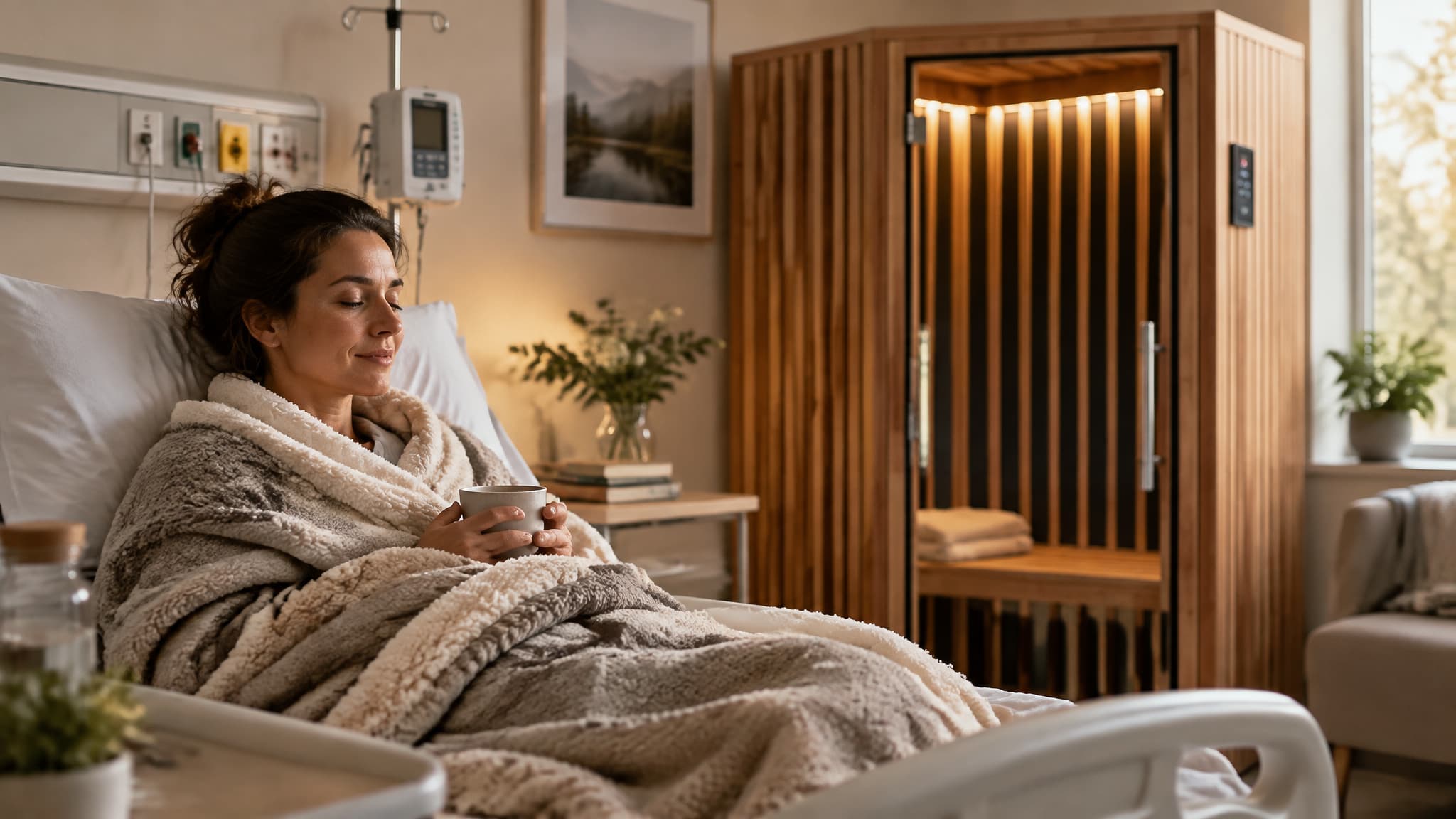
- Recovery phase (30 minutes): Patients then rest outside the sauna for 30 minutes wrapped in blankets.
- Rehydration: Staff weigh patients before and after each session so they can drink water to replace the fluids lost through sweating.
The heating phase
During the first 15 minutes, the patient sits in a compact, single-patient far-infrared dry chamber held evenly at 60°C (140°F). Uniform heat matters here. The goal is to gently warm the deep tissues and raise core temperature by 1.0 to 1.2°C without triggering the cardiovascular strain that comes with high-heat cabins.
The blanket rest and rehydration
Stepping out of the chamber after 15 minutes doesn't end the session; the next 30 minutes under warm blankets is the second half of the treatment. Wrapping up keeps your gentle core warmth elevated and extends the time your blood vessels stay dilated without putting extra heat stress on your heart. If you do a 15-minute sauna soak and walk straight into a cold shower, you aren't doing the studied intervention. Right after the blanket rest, staff weigh the patient and give them water matching their sweat loss so dehydration doesn't thicken the blood or strain the heart.
How often sessions were repeated
One session isn't the protocol. Every observed benefit in the Japanese literature came from repeated thermal stimulus over time, scheduled several times per week up to daily. In the American College of Cardiology report, patients completed daily Waon therapy for 3 weeks while continuing their prescribed heart failure drugs. In a larger randomized clinical trial, 188 chronic heart failure patients received standard medical treatment for at least 1 week before researchers randomized 112 patients to add Waon therapy and 76 patients to remain in the standard-care control group.
How gentle heat reaches the blood vessels: the proposed mechanism
Sitting in a 60°C (140°F) chamber widens your blood vessels and boosts blood flow while you sit completely still. That faster stream of blood rubs along the endothelium (the delicate inner lining of your vessels) to create a helpful mechanical friction called shear stress. In chronic heart failure patients, repeated exposure to that gentle friction may positively influence how the vessel lining works and nudge it to release nitric oxide, a natural chemical messenger that tells blood vessels to relax and open up, which is the exact same effect people chase with beet supplements or prescription medications.
What the American Journal of Cardiology study found
In a trial of 41 chronic heart failure patients published in the American Journal of Cardiology, adding 3 weeks of daily 60°C Waon therapy to standard heart medication raised left ventricular ejection fraction (LVEF, the percentage of blood the heart's main chamber pushes out with each beat) from 30% to 33%.
At the same time, two blood markers that signal heart stress and strain, plasma norepinephrine and brain natriuretic peptide, both dropped after the 3-week protocol. Six-minute walk distance improved too, tracking closely with gains in both LVEF and flow-mediated dilation (how well the blood vessel lining opens up). In multivariate analysis, improved flow-mediated dilation was the only independent predictor of the walking gains, showing that healthier blood vessel function drove the physical improvement. Separately, American College of Cardiology coverage noted that over five years of follow-up, re-hospitalization and death rates were cut in half among Waon-treated patients compared to patients who didn't get the therapy.
Decades of Japanese research: breadth and its limits
Japanese researchers kept studying Waon therapy for decades beyond chronic heart failure, reporting improvements in endothelial function, hemodynamics (the mechanics of blood flow), symptoms, and quality of life in certain patient populations, alongside claims of effectiveness in fibromyalgia and peripheral artery disease. That multi-decade persistence shows the physiological signals were strong enough to hold scientists' attention, though findings in specific hospital groups don't mean an infrared sauna cures heart disease or that buying a home cabin hands you a clinical trial result.
Is 140°F hot enough? Temperature versus physiological response
A 140°F (60°C) infrared sauna is hot enough to produce a meaningful cardiovascular and sweat response for anyone who uses it consistently, because your body reacts to heat absorption, circulation, and core temperature rise rather than the air temperature printed on the wall controller. If you spend five minutes in a sauna Facebook group, you'll see members bragging about cranking their cabins to 220°F as if surviving a toaster oven is the goal. Plenty of consumer infrared units run between 150°F and 170°F or higher, yet the clinical trials got measurable vascular changes at a calm 140°F by prioritizing daily or near-daily consistency over occasional weekend punishment.
The clinical trials used far-infrared dry saunas built to warm the body's tissues, which is a completely different goal from red light panels and photobiomodulation. When you look at the lab photos from the Japanese studies, you can see that heater placement and uniform cabin output mattered even in those compact hospital booths. Across our 3,000+ custom installations at SaunaCloud since 2014, we've seen that getting an even, repeatable sweat in that gentle temperature range comes down to heater layout and cabin build, using our low-EMF VantaWave heaters inside handcrafted cedar walls, rather than chasing a bragging-rights number on the thermostat.
Waon therapy at home: what you can and cannot replicate
Home infrared sauna use is not medical Waon therapy, because clinical Waon therapy is a hospital-supervised intervention that pairs uniform 60°C far-infrared chambers with a mandatory 30-minute blanket recovery, weighed fluid replacement, and medical monitoring of seriously ill patients. While you can create a similar thermal environment and gentle sweat response in a residential cabin, clinical trials tested fragile cardiovascular patients under strict medical oversight where equipment, daily frequency, post-sauna wrapping, and ongoing prescription drugs were all controlled variables.
What home use can replicate
If you are a healthy adult looking to borrow habits from the clinical lineage, a home cabin lets you dial in the temperature and cadence that the researchers actually used. Most people who read a summary of far-infrared hyperthermia protocols jump in for a quick sweat and skip the rest, but you can easily practice the full time commitment at home. Set your cabin to a comfortable 140°F for 15 minutes, step out and wrap up in warm blankets or a heavy robe for 30 minutes to let that mild core warmth linger, and weigh yourself before and after so you drink back the exact water weight you sweated out. Showing up several times a week at a gentle temperature aligns much closer to the research than roasting yourself once a month on a Saturday afternoon.
What it cannot, and who should talk to a doctor first
No, someone with chronic heart failure or cardiovascular disease cannot safely try Waon-style sauna heat on their own without consulting their licensed physician first, because the clinical protocol was only ever tested inside supervised hospitals alongside ongoing heart medication. We build saunas, we aren't doctors, and a garage or spare-bedroom cabin doesn't come with cardiac nurses checking your vitals or adjusting your fluid balance. If you're searching for supervised clinical Waon therapy near your area, those medical programs remain concentrated in Japanese hospitals and cardiac rehabilitation centers rather than everyday American wellness spas. If you have any heart or blood vessel condition, have an honest conversation with your doctor before stepping into any heat routine.
What the clinical lineage says about modern sauna marketing
Infrared sauna detox, 600-calorie burn, hormone-balancing, and libido claims are not supported by the Japanese clinical Waon research, so shoppers evaluating a home cabin should match any sales pitch against the actual parameters tested in human studies. It's common to see wellness-spa promo videos like Age Gracefully toss out weight-loss and hormone promises, or watch online marketers stretch a single 41-patient heart failure trial into broad claims that saunas prevent heart attacks. Companies also routinely blur terminology, taking research done on far-infrared thermal heating and using it to sell near-infrared, mid-infrared, full-spectrum, or red-light photobiomodulation panels.
Before you trust a showroom pitch, weigh the actual science by checking seven concrete study details against what you're being sold:
- Temperature (60°C / 140°F, not extreme heat)
- Session length (15 minutes of heating)
- Weekly frequency (several times a week or daily over weeks)
- Sauna type (uniform far-infrared dry heat, not red light panels)
- Post-sauna care (30 minutes under warm blankets plus weighed water replacement)
- Study participants (monitored hospital patients on medication, not healthy spa-goers)
- Measured outcomes (blood vessel function, heart pumping efficiency, and walking distance, not toxin sweat or calorie burn)
Frequently Asked Questions
What does the word Waon mean in Japanese heat therapy?
The term translates to "soothing warmth," which sums up the entire medical approach behind the treatment. Pioneered in Japan by Dr. Shu A. Tei and his colleagues, the regimen ditches extreme heat endurance in favor of a mild, repeatable thermal dose inside single-person hospital chambers.
Why did Japanese researchers use gentle 60°C heat for heart failure patients?
Patients with chronic heart failure have weakened hearts that cannot safely handle the sudden cardiovascular strain of a blistering hot room. By keeping the far-infrared chamber at a calm 60°C (140°F), doctors could gently lift a patient's core temperature by 1.0 to 1.2°C without overtaxing their system. That mild internal warming is enough to widen blood vessels, speed up circulation, and create beneficial shear stress along the vessel lining so it releases nitric oxide.
What did the American Journal of Cardiology study find about Waon therapy for chronic heart failure?
In a 41-patient trial, pairing 3 weeks of daily 60°C sessions with standard heart failure medications bumped left ventricular ejection fraction from 30% to 33%. Participants also showed lower levels of two cardiac stress blood markers, plasma norepinephrine and brain natriuretic peptide, and covered more ground during six-minute walk tests. Multivariate analysis confirmed that better flow-mediated dilation in the blood vessels was the single independent driver behind those walking improvements.
Is it safe to try Waon-style sauna heat if I have chronic heart failure?
No, anyone with chronic heart failure or any other cardiovascular condition should never experiment with sauna heat on their own without explicit clearance from a licensed physician. Every clinical trial that showed benefits for heart patients took place inside a hospital alongside ongoing heart medications, where medical staff closely tracked vitals and fluid balance.
Founder & Lead Designer, SaunaCloud®
SaunaCloud: 3,000+ installations since 2014 · Author of The Definitive Guide to Infrared Saunas · Featured in Forbes, Inc., and MSN
Christopher designs every SaunaCloud sauna. His work brings the room, heaters, controls and installation plans together so you can review the project before committing. His professional expertise is sauna design and construction, not clinical medicine.
Custom 3D renderings and a proposal in 24-48 hours.
Continue Reading
Health
Infrared Saunas and Chronic Infections: How Heat Therapy Supports Your Immune System Against Lyme, MRSA, Candida, and More
Read article
Health
Infrared Sauna Therapy and Cystic Fibrosis: Potential Benefits, Critical Safety Considerations, and Protocols
Read article
Health
11 Foods That Maximize Your Infrared Sauna Detox: The Nutrition Science Behind Deeper Cleansing
Read articleReady to Design Your Sauna?
Every project starts with a conversation. Tell us about your space and we'll create your custom plan — free, no obligation.
Custom 3D renderings and a proposal in 24-48 hours.