Infrared Sauna vs Steam Sauna Sweat Differences: 10 Numbers That Decide
Key Takeaways
- Infrared saunas heat your body directly with light at 100-140°F, triggering sweat at a much lower air temperature than traditional saunas, which heat the air around you to 150-195°F.
- The strongest research divides cleanly: traditional saunas carry the evidence for cardiovascular and cognitive outcomes (a 2015 Finnish study found a 63% lower risk of sudden cardiac death), while infrared leads on chronic pain conditions like arthritis and ankylosing spondylitis.
- Installation flips the cost script: infrared draws 1.5-2.5 kW on a standard 120V plug-in and preheats in 10-20 minutes, while traditional units need a 240V circuit with 6-9 kW draw and take 30-45 minutes to warm up.
In This Article
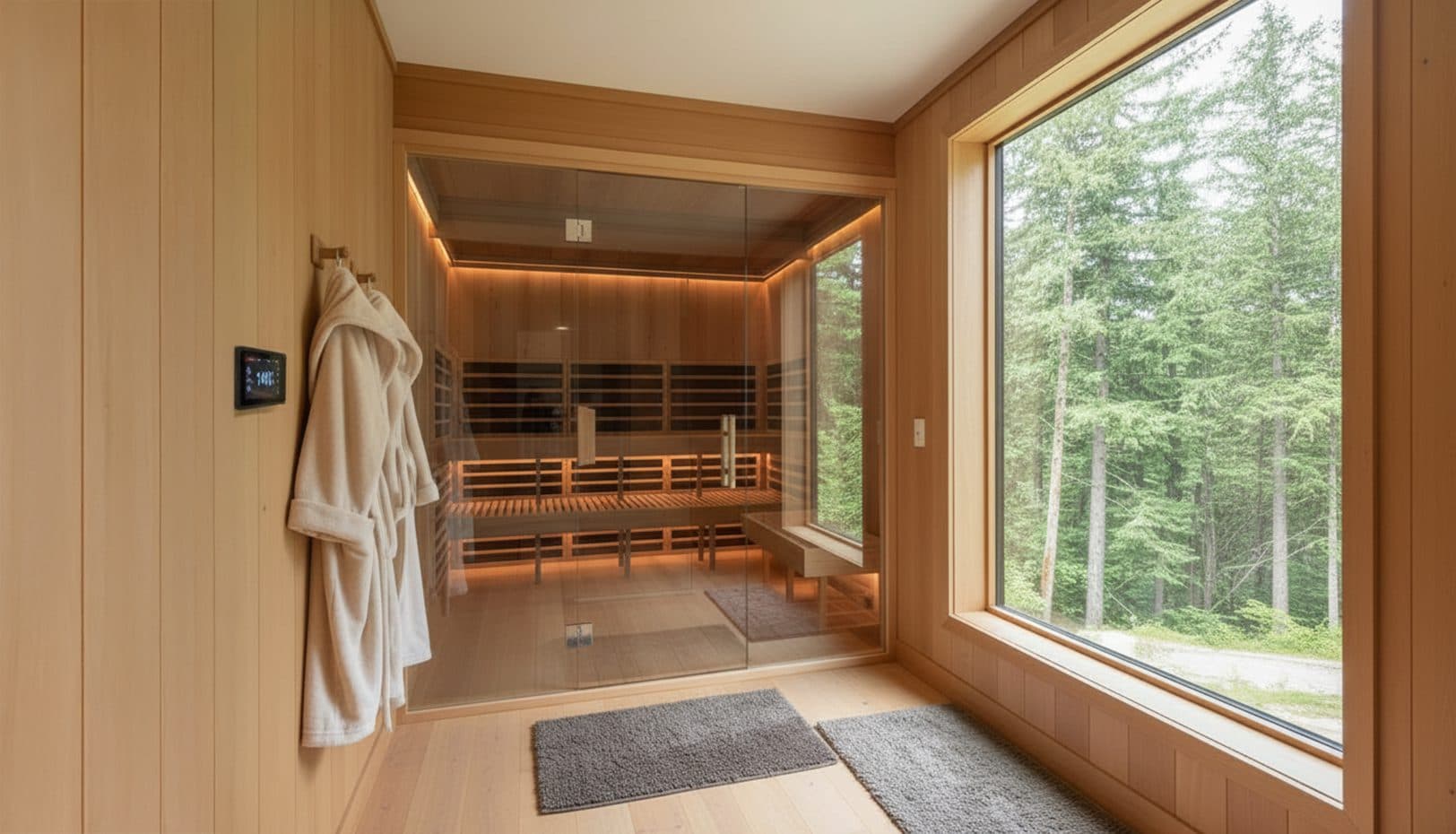
If you're weighing an infrared sauna against a traditional steam sauna, the first surprise is usually the temperature. One room feels like a gentle, dry warmth that creeps up on you; the other hits like a wall of heat. The numbers tell the story: infrared cabins run at 100-140°F, while the classic hot room blasts 150-195°F. That temperature gap changes how you sweat, how you time your session, and what you'll feel when you walk out. But the heat is only part of the story; how each one delivers it matters more. And once you get the mechanism straight, the rest of the comparison falls into place.
Setting the terms straight: what "steam sauna" actually means
The confusion starts here. When most people say "steam sauna" in a comparison with infrared, they're actually talking about the traditional Finnish-style hot room. That's the one with the electric or wood-fired heater, the low ambient humidity, and the optional bursts of steam you throw onto hot stones, what the Finnish call löyly. That is not the same as a true steam room, which is a separate device entirely: an enclosed space filled with 100% humidity at 110-120°F via a steam generator.
So the comparison you're actually making is between three things, not two:
- Infrared sauna, the gentle, tech-forward option. Panels emit light absorbed directly by your body.
- Traditional sauna, the classic, high-heat, ritual-driven experience. Heated air, low humidity, optional löyly.
- True steam room, the humid, skin-friendly cousin. 100% humidity, enveloping warmth, often cited for respiratory comfort.
The third type is worth keeping in mind because it explains why the humidity conversation gets confusing. But the main event is the first two.
The heating mechanism: light vs. air
The core difference is how the heat gets into you, not the temperature.
Infrared saunas use panels that emit light absorbed directly by the body. That light penetrates the skin roughly 1.5 inches deep, heating you from the surface inward. The air around you stays relatively cool. This is why infrared feels milder even while you sweat, the warmth is going straight into you, not coming at you from every angle. The light spectrum spans near-infrared (NIR) to mid-infrared, and each range interacts with tissue a bit differently.
Traditional saunas flip this. The heater warms the air to 150-195°F, and that hot air surrounds you. It's a different sensation entirely, denser, more enveloping, more intense on the skin before the heat "gets inside." That's why the two rooms feel different even when you're sweating the same amount. Researchers including Dr. Sam Setareh and Dr. Christopher T. Minson have studied how these distinct heating mechanisms affect your body's thermoregulatory response.
A persistent claim you'll hear is that infrared penetrates muscles or has specific deep-tissue therapeutic effects. The research doesn't support that. It penetrates the skin and soft tissue, but claims about reaching muscle tissue specifically lack evidence. For context on how deeply sauna culture runs, Finland, a country of about 5.5 million, has roughly 3 million saunas.
Temperature, humidity, and the sweat environment: a three-way comparison
Here's the full picture, with real numbers.
| Temperature | Humidity | |
|---|---|---|
| Infrared | 100-140°F | under 10% (effectively dry) |
| Traditional sauna | 150-195°F | 10-40%, löyly bursts briefly spike to 20-40% |
| True steam room | 110-120°F | 100% |
The humidity column matters more than most people expect. In a traditional sauna, the low humidity means your sweat can evaporate off your skin, which helps cool you. That's why a traditional sauna at 180°F can feel more tolerable than a steam room at 115°F. When you throw löyly on the stones, the humidity spikes, sweat stops evaporating as efficiently, and that's the moment the heat suddenly feels more oppressive.
The steam room is the extreme version of this. At 100% humidity, the air is already saturated, your sweat simply cannot evaporate. It sits on your skin, and your body's cooling system short-circuits. That's why a steam room feels heavier and more suffocating than its modest temperature suggests.
Infrared sits at the other extreme. With humidity under 10%, sweat evaporates readily, which makes the 100-140°F range feel manageable, even easy to sustain for longer sessions.
How the sweat actually differs session to session
The sweat itself is broadly similar across all three formats. It's mostly water with electrolytes, plus trace heavy metals and some environmental pollutants. There's no solid evidence that one type produces "better" sweat or more of it in a way that matters.
What does differ is when you sweat and how it feels.
In infrared, you're heating the body directly. That means you start sweating at a lower air temperature, often within the first few minutes, and you can keep sweating steadily for 25-45 minutes because the room isn't overwhelming you with ambient heat. The sweat tends to come on gradually and evenly.
In a traditional sauna, the heat is coming at you from the air. You feel the intensity before you feel the sweat. Sessions are shorter, 10 to 20 minutes, and you typically do 2-3 rounds with a rest between. The sweat comes in waves, especially when you hit the room with löyly and the humidity spikes.
The steam room is where people get confused. Because the air is 100% saturated, your sweat can't evaporate, so you might feel like you're not sweating. You are. It's sitting on your skin. That's why a 10-minute steam room session can leave you dripping in a way that a 30-minute infrared session doesn't, even though the infrared session may have produced more actual sweat.
Session length and warm-up time: fitting them into your day
The practical rhythm differences:
- Infrared preheats in 10-20 minutes, and a session runs 25-45 continuous minutes. Warm up, sit, sweat, done.
- Traditional takes 30-45 minutes to preheat, and sessions run 10-20 minutes, repeated 2-3 times with rests between rounds. It's a ritual, not a one-shot.
This matters more than it seems. If you have 45 minutes on a weekday, an infrared session is realistic, 10-15 minutes to heat, 30 minutes in the room. A traditional sauna in the same timeslot means 30 minutes of waiting just to get the room hot, then a rushed 10-minute session, and since infrared home sauna types warm your body directly at a gentler 110-150°F, they don't demand that lengthy preheat. If you're pairing your session with cold therapy, an immersion tub for contrast therapy can be a natural complement to either format.
The tradeoff flips on the weekend. The traditional sauna's multi-round rhythm with löyly and cool-downs becomes the experience, almost social, meditative, unhurried. Infrared can feel like a shorter, hotter spa appointment.
A common miscue when people switch between the two: they bring their traditional-sauna expectations (short, intense rounds) into an infrared unit (longer, steadier) and cut their session short, or they bring their infrared pacing into a traditional room and cook themselves. Both are mistakes. Match the session to the format.
What the research actually supports: an honest division of evidence
The two formats don't have equal research libraries. And that's okay, it tells you where each one genuinely shines.
Traditional sauna: the long-term evidence leader
The strongest study in sauna research is a 2015 Finnish cohort study led by Jari Laukkanen, published in JAMA Internal Medicine. Men who used the sauna 4-7 times per week had a 63% lower risk of sudden cardiac death and a 40% lower all-cause mortality compared to once-a-week users. A 2017 follow-up found a 66% lower risk of dementia and a 65% lower risk of Alzheimer's among the frequent users. Additional research in Mayo Clinic Proceedings and Age and Ageing has reinforced these cardiovascular and cognitive associations.
The mechanism is straightforward. Sauna use drives your heart rate to 120-150 bpm, comparable to brisk walking, and this repeated cardiovascular load is what underlies most of the cardiac and cognitive benefits.
Infrared: the pain-relief and chronic-condition specialist
Infrared's strongest research leans toward pain conditions. The 2009 Oosterveld study showed short-term improvement in pain and stiffness for people with rheumatoid arthritis and ankylosing spondylitis. A 2015 study on Waon-style infrared therapy(the Japanese term for far-infrared sauna treatment) found that infrared sauna produces thermal effects including core temp elevation, cardiovascular response, and HSP activation, which improved mood and symptoms in people with ME/CFS(chronic fatigue syndrome). Research published in Biology of Sport has also examined infrared's effects on recovery and performance.
The verdict so far
Neither side wins overall. The cardiovascular and cognitive evidence leans traditional. The pain-condition evidence leans infrared. If your goal is heart health over the long term, the traditional room has the receipts. If you're dealing with joint pain or stiffness, infrared's evidence is the stronger match.
Detox and weight loss: the uncomfortable letdown
Let's address the claim that follows saunas around like a loyal dog: detoxification.
Because you sweat, it's natural to assume your body is flushing impurities. But your body's actual detox system is your liver and kidneys. Sweat carries only trace amounts of heavy metals and some environmental pollutants.
Sweating is not a meaningful detox pathway. The journal research on this, like the 2012 review by Sears et al. in the Journal of Environmental and Public Health, states: the liver and kidneys are doing the real work, and sweat is a minor side channel.
Weight loss runs into the same wall. A session does shed water weight, but it returns as soon as you rehydrate. Calorie burn is modest, not a meaningful driver of fat loss. If a sauna feels like a weight-loss tool, that's the marketing working, not the physiology.
None of this makes saunas worthless. It means you shouldn't buy one expecting it to replace your liver or your gym membership.
Cost, installation, and what your space actually needs
This is the section where dreams meet electrical reality.
The electrical reality
A traditional sauna needs a dedicated 240V circuit, typically 30-50 amps depending on the heater size. A 6kW heater draws a 30-amp circuit; a 9kW heater draws 40-amps. That requires a licensed electrician, a dedicated breaker, and usually a new run from the panel. Install costs add up.
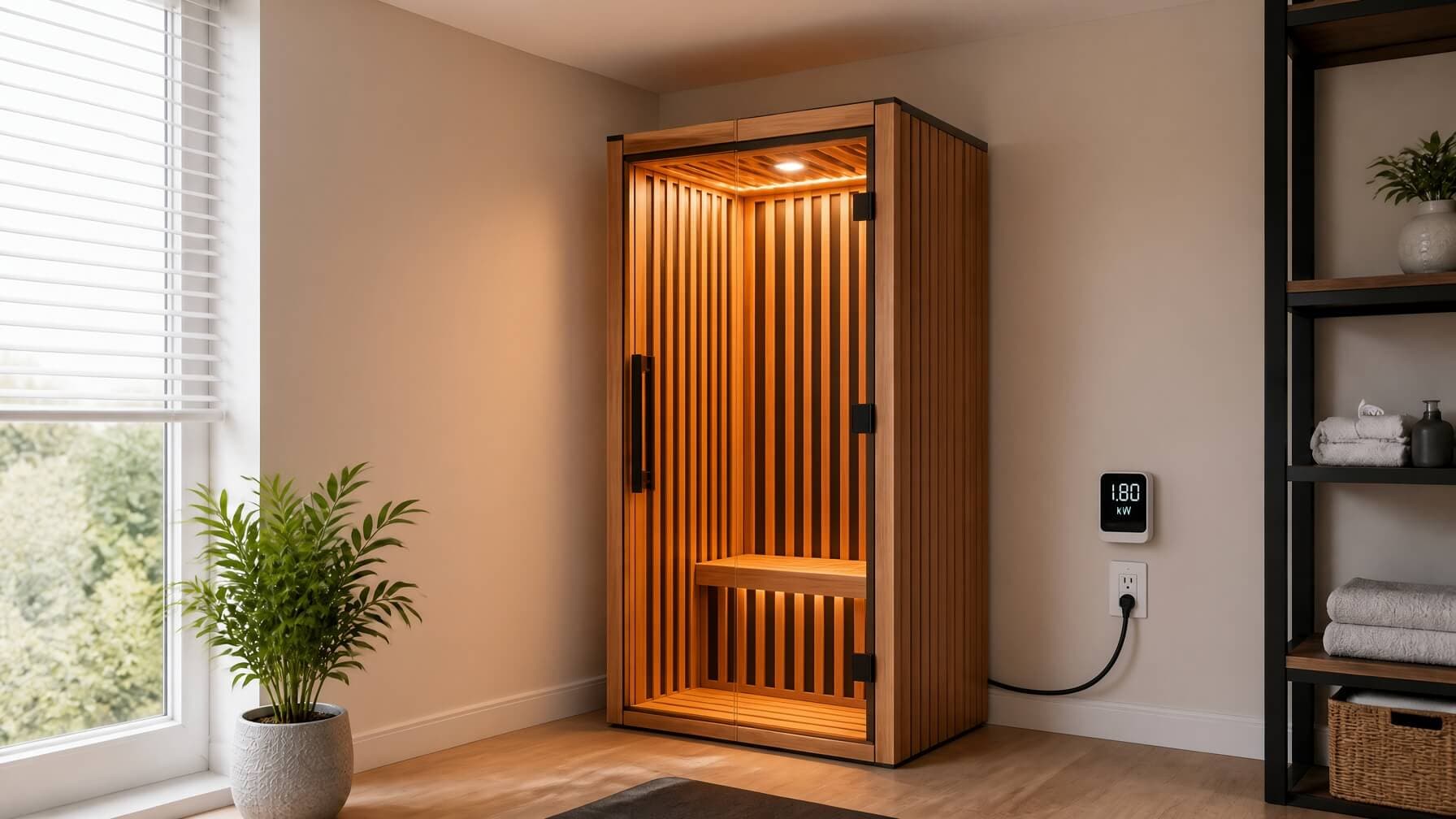
Infrared units, by contrast, typically draw 1.5-2.5 kW on a standard 120V outlet. Most are plug-and-play, DIY, no electrician required.
First-time buyers often get blindsided here. They fall in love with a traditional unit's rustic look, get it home, and discover they need a dedicated 240V circuit they don't have. The installation cost can rival the unit price.
The real ownership cost
Running costs follow the same pattern. Infrared runs around $10/month at three sessions per week. A traditional unit runs roughly $20-35/month at the same frequency, the bigger heater draws more power and takes longer to heat the space.
Traditional units also cost more upfront. Infrared entry prices start around $2,000, with mid-market units running $7,000-10,000. Full traditional saunas, especially the well-built Finnish-style cabins with western red cedar interiors and quality heaters from brands like HUUM or Harvia, start higher and climb fast.
The durability tradeoff
Before you write off traditional on cost, consider what you're buying. Traditional saunas are tanks. Well-built Finnish-style cabins routinely last 20+ years, and they hold resale value. The heaters are serviceable, the structure is simple, and there's nothing in the room that's going to wear out because it's just hot air and heat.
The löyly experience, throwing water on the stones and watching the steam roll off and hit you, is part of the draw. There's nothing quite like it.
Infrared units are more affordable and easier to install, but they have a shelf life. The panels are electronic components. They work, but they're not going to outlast a cedar cabin and a quality heater.
Space constraints
Ceiling height matters. Traditional saunas typically need around 7 feet of clearance. Infrared units can fit in tighter spaces, around 6 feet will do. That 12-inch difference is usually the difference between "we have a spot" and "we don't."
Safety, risks, and who should check with a doctor first
Both formats share the same core risks: dehydration, overheating, and blood-pressure drops. The universal rules exist for good reason: hydrate before and after, avoid alcohol, begin with 5-10-minute sessions, rest between rounds, exit if you feel dizzy, and skip the sauna when you're ill.
For most healthy adults, 3-5 sessions per week at 15-30 minutes per session is reasonable.
Talk to your doctor first if you have:
- Unstable angina or a recent heart attack
- Severe aortic stenosis
- Advanced heart failure
- Low blood pressure
- A pregnancy (use caution or avoid with medical guidance)
- Skin conditions affected by heat
One more thing to check for infrared: electromagnetic field (EMF) exposure varies by manufacturer. Infrared cabins aren't uniform on this front. If it matters to you, look for published third-party test results on the specific model you're considering.
How to choose: a practical guide
The decision rule that matters: pick the one you'll realistically use 3-5 times a week. The best-evidence format is worthless if you skip it because it's too hot, too slow to heat up, or too expensive to operate.
Use the decision factors that matter for you:
Heat tolerance. If the thought of 180°F of ambient heat makes you nervous, infrared is the gentler entry point. Its 100-140°F direct warmth is easier to ease into. If you want the high-heat experience, go traditional.
Session style. Do you want a 25-45 minute continuous sweat with minimal prep? That's infrared. Do you want the 10-20 minute multi-round rhythm with löyly and cool-downs, the ritual? That's traditional.
Installation constraints. Infrared is 120V plug-and-play. Traditional needs a 240V circuit and a licensed electrician. If you're a renter or don't want an electrical project, that decision is already made.
Health goals. Pain, arthritis, or stiffness conditions lean infrared, that's where its evidence is strongest. Cardiovascular and longevity goals lean traditional. Be honest with yourself about your actual priorities.
Space and ceiling height. 7 feet for traditional, 6 feet for infrared. Measure your space before you fall in love with a unit.
Contrast therapy. If you want the hot-cold recovery protocol, a cold plunge afterward pairs naturally with either format. A beginner's cold session is 2-3 minutes, progressing slowly. Both formats pair with immersion therapy, including cold plunges and contrast therapy.
There's no universally "better" choice. There's only the choice that fits your constraints, and that you'll actually show up for, three to five times a week, for the months and years it takes for the benefits to compound.
The best evidence-backed sauna in the world is the one you'll actually use. Figure out which format that is, and you've already solved the hardest part.
Frequently Asked Questions
Is an infrared sauna better for you than a steam sauna?
It depends on your health goals. Traditional saunas have stronger evidence for cardiovascular and cognitive benefits, while infrared shows better results for chronic pain conditions like arthritis. Infrared operates at lower temperatures, making it more accessible for some, but neither is universally 'better'.
Do you sweat more in an infrared sauna?
Not necessarily more, but differently. Infrared heats your body directly, so you may start sweating sooner at a lower air temperature. In a steam room, sweat can't evaporate due to 100% humidity, so you might feel wetter even if you're not producing more sweat.
What are the downsides of using an infrared sauna?
Infrared saunas have a few drawbacks: they don't have the long-term cardiovascular evidence that traditional saunas do, and the electronic panels have a shorter lifespan than a traditional heater. They also may not provide the intense, enveloping heat that some people seek.
What's the difference between an infrared sauna and a traditional sauna?
Infrared saunas use light to heat your body directly at 100-140°F, while traditional saunas heat the air to 150-195°F. This means infrared warms up faster and runs on a standard outlet, while traditional saunas need a 240V circuit and take longer to preheat.
How much does it cost to run an infrared sauna vs. a traditional sauna?
Infrared saunas cost about $10 per month to run at three sessions weekly, while traditional saunas run $20-35 per month due to higher power draw. Installation also differs: infrared is plug-and-play, while traditional units require a dedicated 240V circuit.

Founder & Lead Designer, SaunaCloud®
SaunaCloud: 3,000+ installations since 2014 · Author of The Definitive Guide to Infrared Saunas · Featured in Forbes, Inc., and MSN
Christopher designs every SaunaCloud sauna. His work brings the room, heaters, controls and installation plans together so you can review the project before committing. His professional expertise is sauna design and construction, not clinical medicine.
Custom 3D renderings and a proposal in 24-48 hours.
Continue Reading
Buying & Comparison Guides
Steam Room vs Infrared Sauna: Humidity, Heat Transfer, and Which One Fits Your Life (2026)
Read article
Buying & Comparison Guides
Custom Infrared Sauna Buying Guide: What I’ve Learned Building 3,000+ Saunas
Read article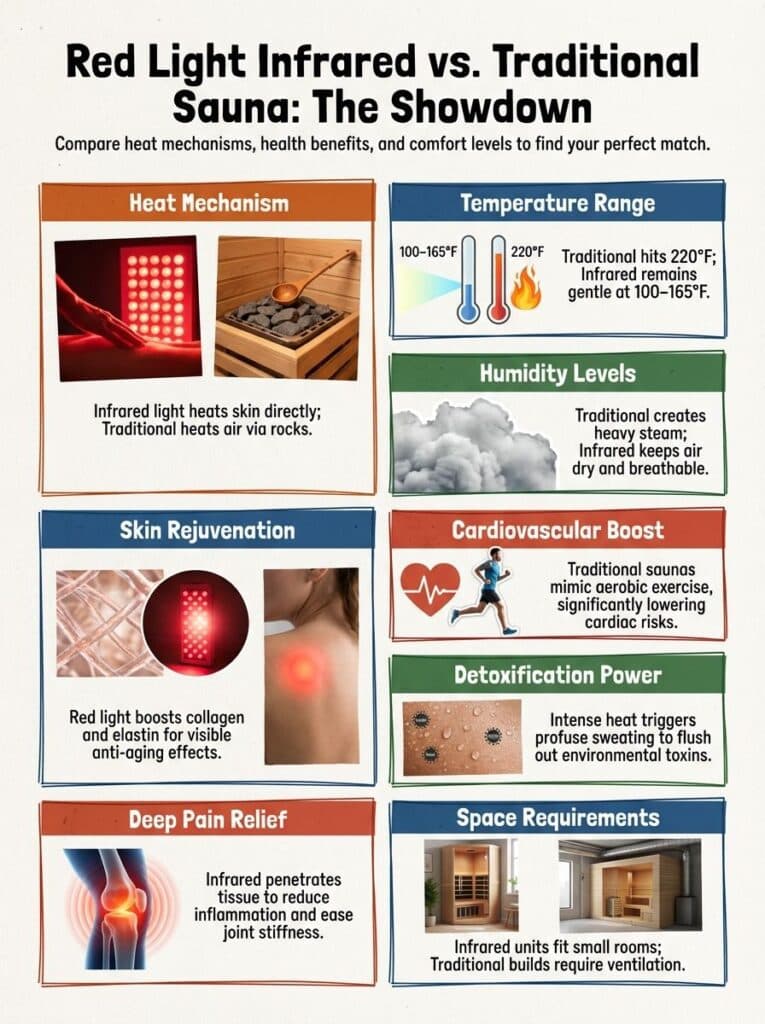
Buying & Comparison Guides
The Infrared Sauna Buying Guide: 10 Things to Know Before You Buy (2026)
Read articleReady to Design Your Sauna?
Every project starts with a conversation. Tell us about your space and we'll create your custom plan — free, no obligation.
Custom 3D renderings and a proposal in 24-48 hours.