How to Evaluate Any Red Light Sauna: The 5 Specs That Matter
Key Takeaways
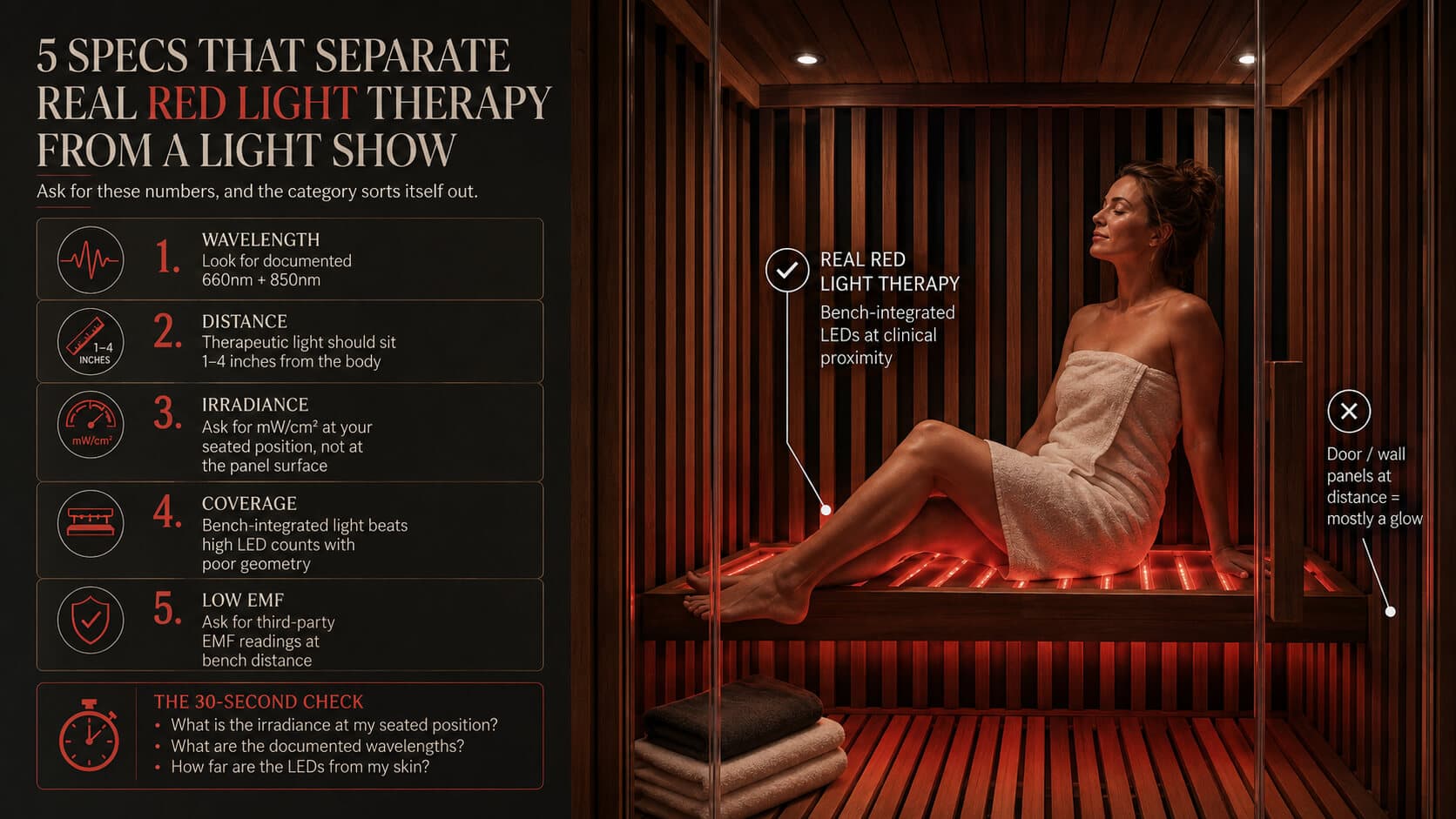
- Five specs separate real red light therapy from a light show. Wavelength, distance, irradiance, coverage, and EMF tell you far more about performance than LED count, wattage, or how impressive the sauna looks.
- Distance and irradiance should be measured where you actually sit. A powerful panel can still deliver very little useful light if it is mounted too far from the body, so seated-position measurements matter more than surface specs.
- Good manufacturers should be able to answer three questions immediately. Ask for the documented wavelengths, irradiance at your seated position, and the distance between the LEDs and your skin. If those answers are vague, the marketing is probably doing more work than the hardware.
In This Article
Red light is now everywhere in the sauna market: panels bolted to doors, glowing strips behind benches, "chromotherapy" packages, saunas advertising heat and light in a single session. Some of it is real. Much of it is a glow with a story attached.
The good news is that you do not need to trust anyone's marketing, including ours. Five specifications, all of them physics, determine whether any red light sauna delivers a therapeutic dose or a light show. Ask for these five numbers and every product in the category sorts itself out.
Spec 1: Wavelength (the right numbers are 660nm and 810–880nm)
Red light therapy works through an enzyme called cytochrome c oxidase, which absorbs photon energy efficiently only in specific windows: around 660 nanometers in the red and roughly 810 to 880 nanometers in the near-infrared (de Freitas & Hamblin, 2016). Photons outside those windows mostly pass through tissue or get absorbed by things that do not matter.
What to ask: "What are the exact LED wavelengths, and can you document them?"
What a good answer looks like: Specific numbers, in writing. 660nm and 850nm is the standard therapeutic pairing.
Red flag: A product page that just says "red light." A 630nm hardware-store LED looks identical to your eye and does meaningfully less at the molecular target. Wavelength precision is physics, not marketing.
Spec 2: Distance (the spec that quietly decides everything)
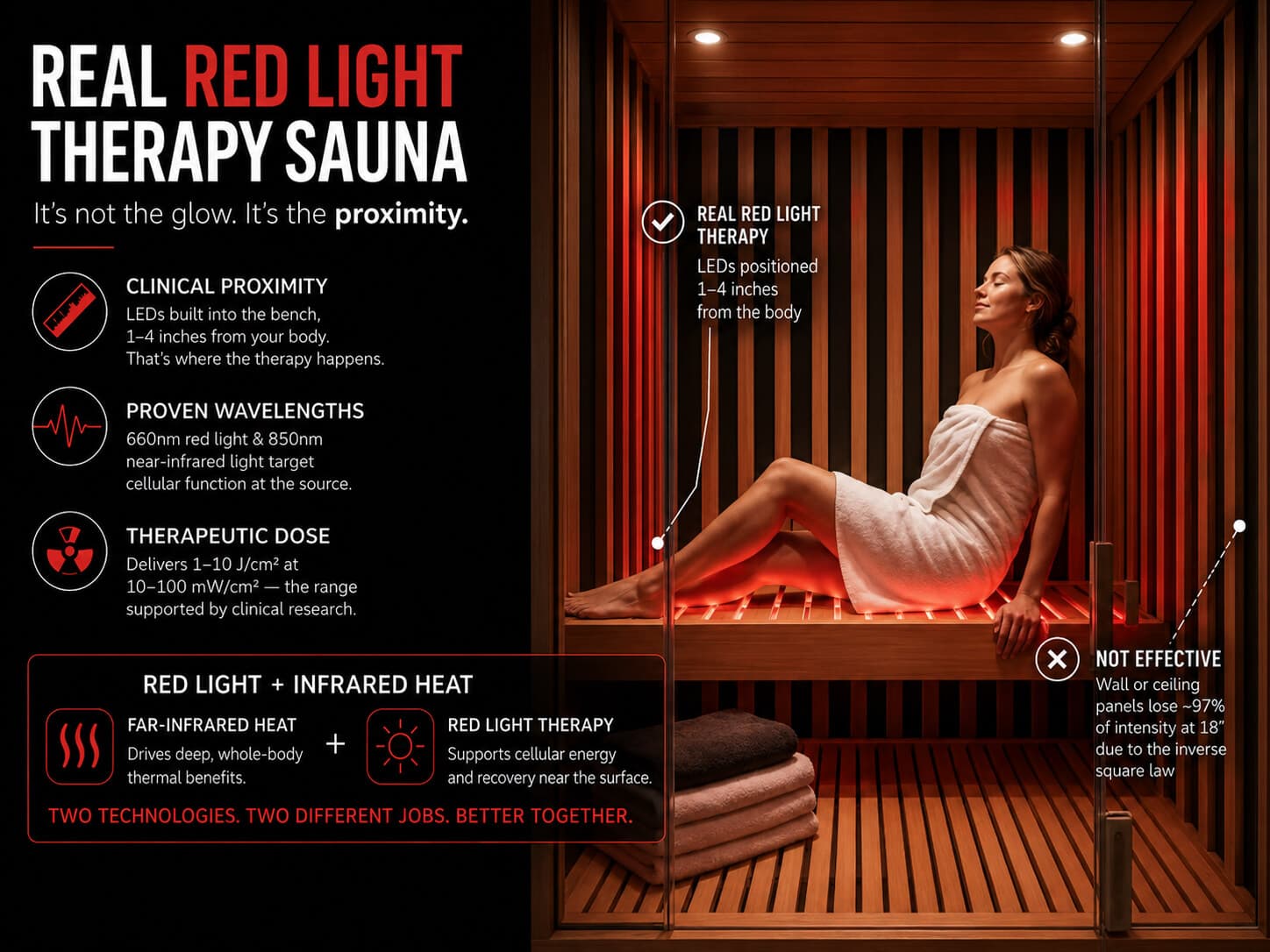
Light intensity falls with the square of the distance from the source. Move a light from 3 inches to 18 inches from your skin, roughly where a door-mounted panel sits relative to a person on the bench, and the intensity arriving at your body is on the order of 3 percent of what left the panel.
This is why the same LED panel can be a therapy device at 2 inches and a mood light at 2 feet, and it is the reason we state the following in every piece of content we publish: Red light therapy requires clinical proximity, within about 2 inches of the skin, to deliver therapeutic benefit. Ceiling and wall-mounted red light at distance is decorative.
What to ask: "How far are the LEDs from my skin when I am seated normally in the sauna?"
What a good answer looks like: Inches, not feet. Bench-integrated systems that put the light 1 to 4 inches from the body.
Red flag: Panels on the door, the far wall, or the ceiling. Beyond about 6 inches the inverse square law is already taking large bites; beyond a foot, the dose reaching most of your body is unlikely to be therapeutic.
Spec 3: Irradiance at your position (not at the panel surface)
Dose is what reaches your tissue, and most positive clinical studies deliver roughly 1 to 10 joules per square centimeter at irradiances of about 10 to 100 milliwatts per square centimeter (Hamblin, 2017).
Manufacturers love to quote irradiance measured at the panel surface, because the number is biggest there. It is also irrelevant there, because your skin is not pressed against the panel. The honest spec is irradiance at the user's actual position.
What to ask: "What is the irradiance in milliwatts per square centimeter at my skin, at the distance I will actually sit?"
What a good answer looks like: A number measured at the seated position, and a seller who understands why you asked.
Red flag: Surface-of-panel specs, or no answer at all. Sellers who can answer are selling equipment. Sellers who cannot are selling light bulbs.
Spec 4: LED count and coverage (more is not automatically better)
LED count matters only in service of coverage: light landing on the parts of your body you actually want treated, at proximity. A hundred LEDs on a door panel pointed at the far wall treat nothing. Forty LEDs integrated along a bench, inches from your back and legs, deliver a real dose where your body actually is.
Also worth knowing: light follows a biphasic dose response. Too little does nothing, a moderate dose stimulates, and too much begins to inhibit the processes you are trying to support. A wall of LEDs is a marketing photo, not a therapeutic upgrade.
What to ask: "Where do the LEDs sit relative to my body, and what body areas receive light at close range?"
What a good answer looks like: A layout answer, not just a count. Light positioned for the bench, where sessions actually happen.
Red flag: Raw LED counts or wattage figures with no geometry attached.
Spec 5: EMF at sitting distance
Low electromagnetic field readings at the seated position are less a proven health threshold than a proxy for engineering quality: shielded wiring, proper DC power delivery, and a manufacturer that measures its own product. Look for third-party-tested EMF figures at sitting distance, ideally under 3 milligauss.
What to ask: "What are the EMF readings at the bench, and who tested them?"
What a good answer looks like: Third-party numbers at the seated position. Our red light runs on low-voltage DC from the control system, which keeps EMF at the bench low by design.
Red flag: No EMF data, or readings taken somewhere other than where you sit.
The 30-second version
Before you buy any red light sauna, ask three questions. They compress the five specs into one conversation:
- What is the irradiance at my actual seated position, in mW/cm²?
- What are the documented LED wavelengths?
- How far are the LEDs from my skin in normal use?
A seller who answers all three crisply understands their own product. A seller who reaches for the brochure does not. The criteria do the work; you never have to argue with anyone's marketing.
Where to go deeper
For the full explanation of the mechanism and the category, start with What Is a Red Light Therapy Sauna? The Complete Guide. For the head-to-head comparison that trips up most buyers, read Red Light Sauna vs. Sauna with a Red Light Panel. And to see how we build clinical-proximity red light into a custom far-infrared sauna, see our red light infrared sauna page and the Atlas One. I also wrote about serving informed buyers honestly in Fast Company; this checklist is that philosophy in practice.
Frequently asked questions
Frequently Asked Questions
What is a good irradiance for red light therapy?
Most positive clinical studies use roughly 10 to 100 milliwatts per square centimeter at the tissue, delivering a total dose of about 1 to 10 joules per square centimeter per session. The number that matters is measured at your skin, not at the panel surface.
How close does red light need to be to work?
Within about 2 inches of the skin for full therapeutic effect. Intensity falls with the square of distance, so a panel at 18 inches delivers on the order of 3 percent of its 3-inch intensity. Beyond a foot, the dose is unlikely to be therapeutic for most of your body.
Does more LEDs mean better red light therapy?
No. Coverage at proximity beats raw count. Light also follows a biphasic dose response, so past the optimal range, more intensity can inhibit rather than stimulate. Judge geometry and dose, not the LED count on the spec sheet.
Is EMF from red light saunas dangerous?
The honest answer is that low EMF is best understood as a proxy for build quality rather than a proven health threshold. Well-engineered systems run the LEDs on low-voltage DC and test under 3 milligauss at the seated position. Ask for third-party numbers.
Should red light in a sauna be on the ceiling?
No. Ceiling-mounted red light sits far too distant from the body to deliver a therapeutic dose. It is ambient lighting. Therapeutic red light belongs at the bench, inches from the skin.
Founder & Lead Designer, SaunaCloud®
SaunaCloud: 3,000+ installations since 2014 · Author of The Definitive Guide to Infrared Saunas · Featured in Forbes, Inc., and MSN
Christopher designs every SaunaCloud sauna. His work brings the room, heaters, controls and installation plans together so you can review the project before committing. His professional expertise is sauna design and construction, not clinical medicine.
Custom 3D renderings and a proposal in 24-48 hours.
Continue Reading
Sauna Design & Technology
What Is a Red Light Therapy Sauna? The Complete Guide
Read article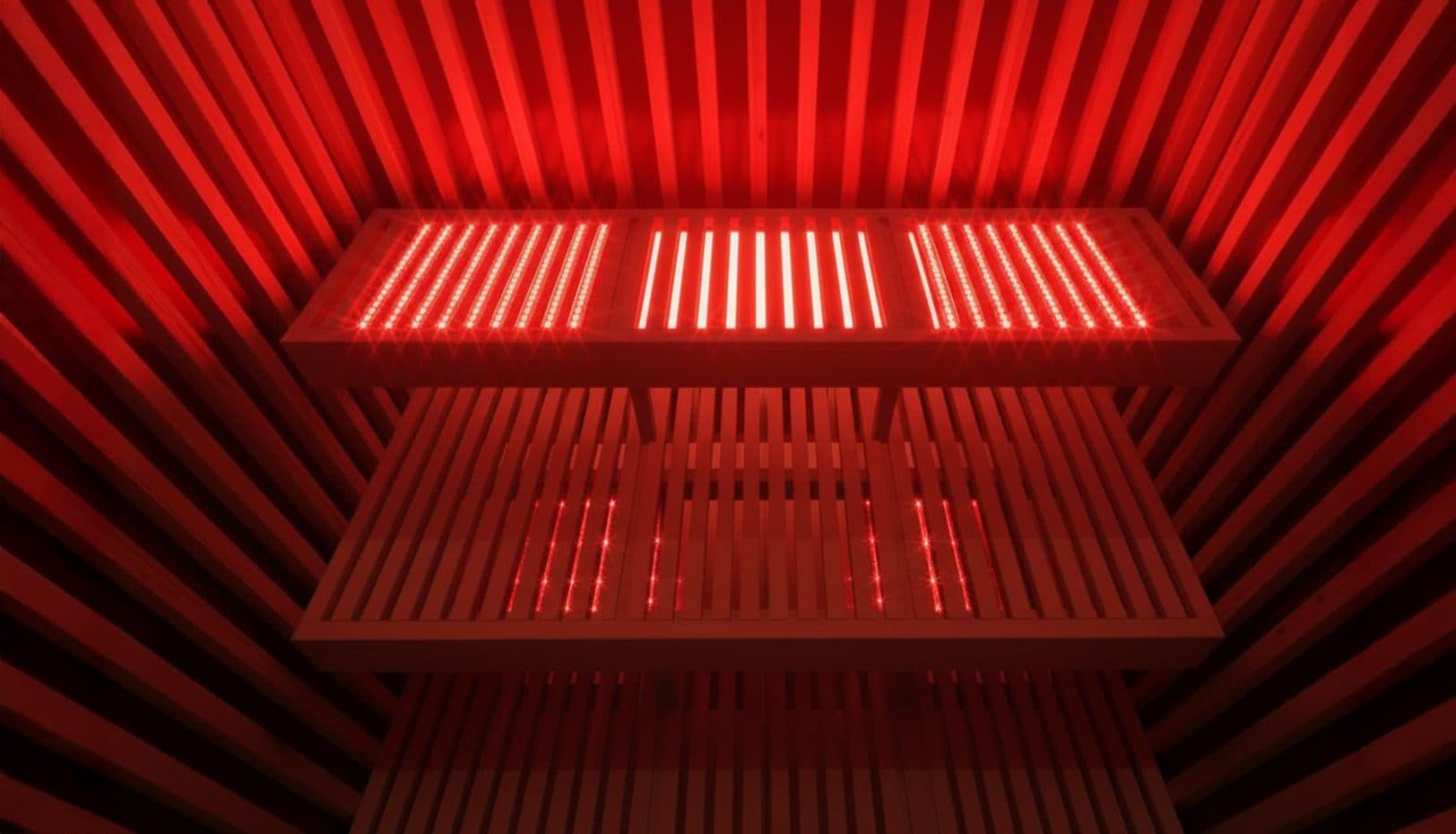
Infrared Sauna Benefits
Red Light Therapy + Infrared Sauna: The Complete Guide to Combined Therapy (They're Not the Same Thing)
Read article
Buying & Comparison Guides
Infrared Sauna Heater Comparison: Carbon vs Ceramic vs Halogen vs VantaWave® (2026)
Read articleReady to Design Your Sauna?
Every project starts with a conversation. Tell us about your space and we'll create your custom plan — free, no obligation.
Custom 3D renderings and a proposal in 24-48 hours.