Red Light Sauna vs. Sauna with a Red Light Panel: What's the Difference?
Key Takeaways
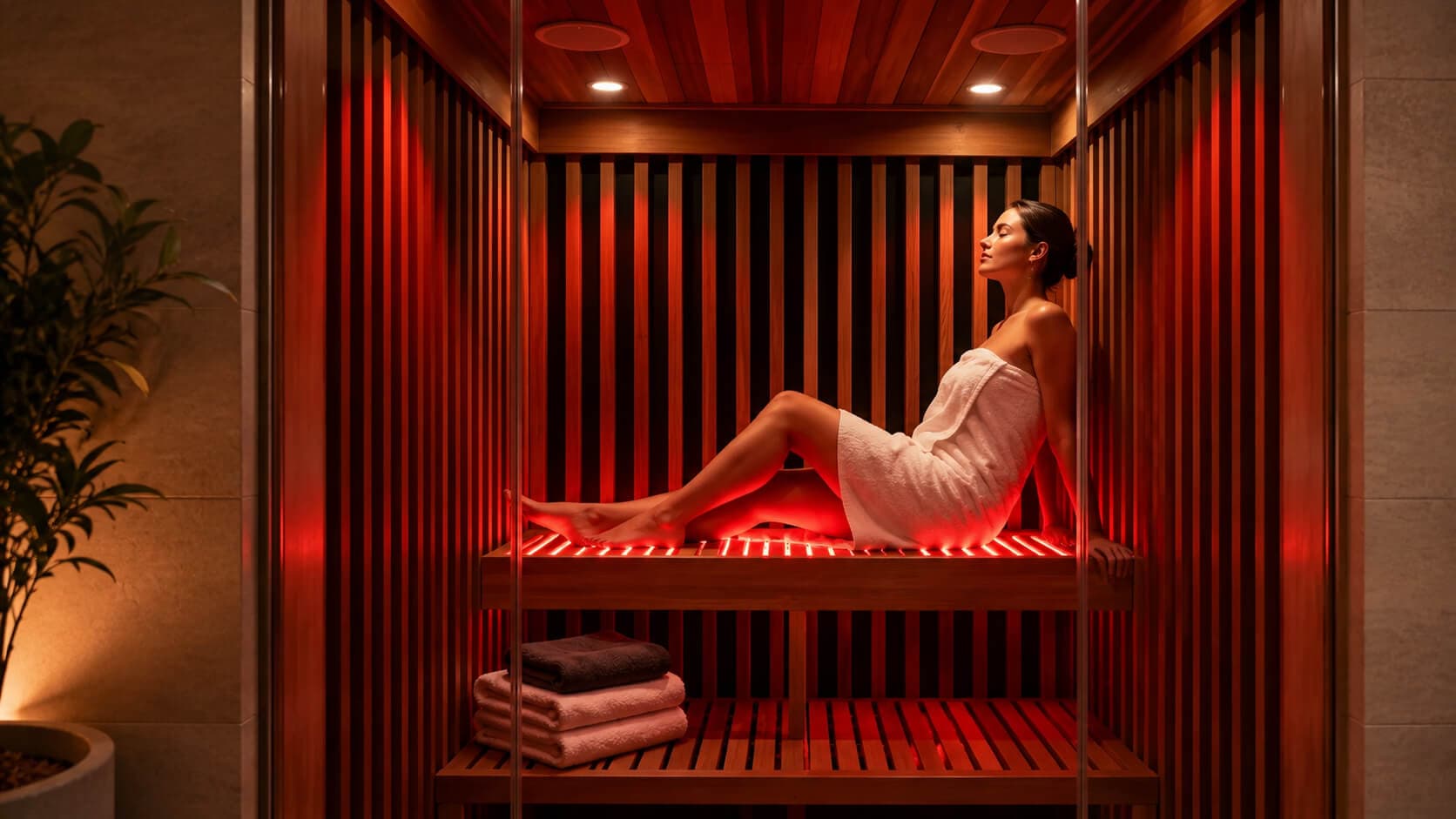
- The difference between a true red light therapy sauna and a sauna with a red light panel comes down to placement. LEDs positioned within a few inches of the body can deliver a meaningful dose; panels mounted across the cabin mostly deliver a glow.
- Correct wavelengths are not enough if the geometry is wrong. Even 660nm and 850nm LEDs lose most of their intensity when they sit 18 to 24 inches away from the user.
- Heat and red light therapy are best handled by separate technologies. Far-infrared heaters provide thermal benefits, while purpose-built LEDs at close range provide photobiomodulation. A well-designed sauna uses each technology for the job it actually does.
In This Article
These two products look nearly identical in photos. Both are infrared saunas. Both glow red. Both are marketed as "red light saunas." But one delivers a therapeutic dose of light to your body during every session, and the other delivers a therapeutic dose to the opposite wall.
The difference is not the LEDs. It is where they sit. This article defines the two categories precisely, so you know which one you are actually looking at, whatever the brochure calls it.
The one-sentence version
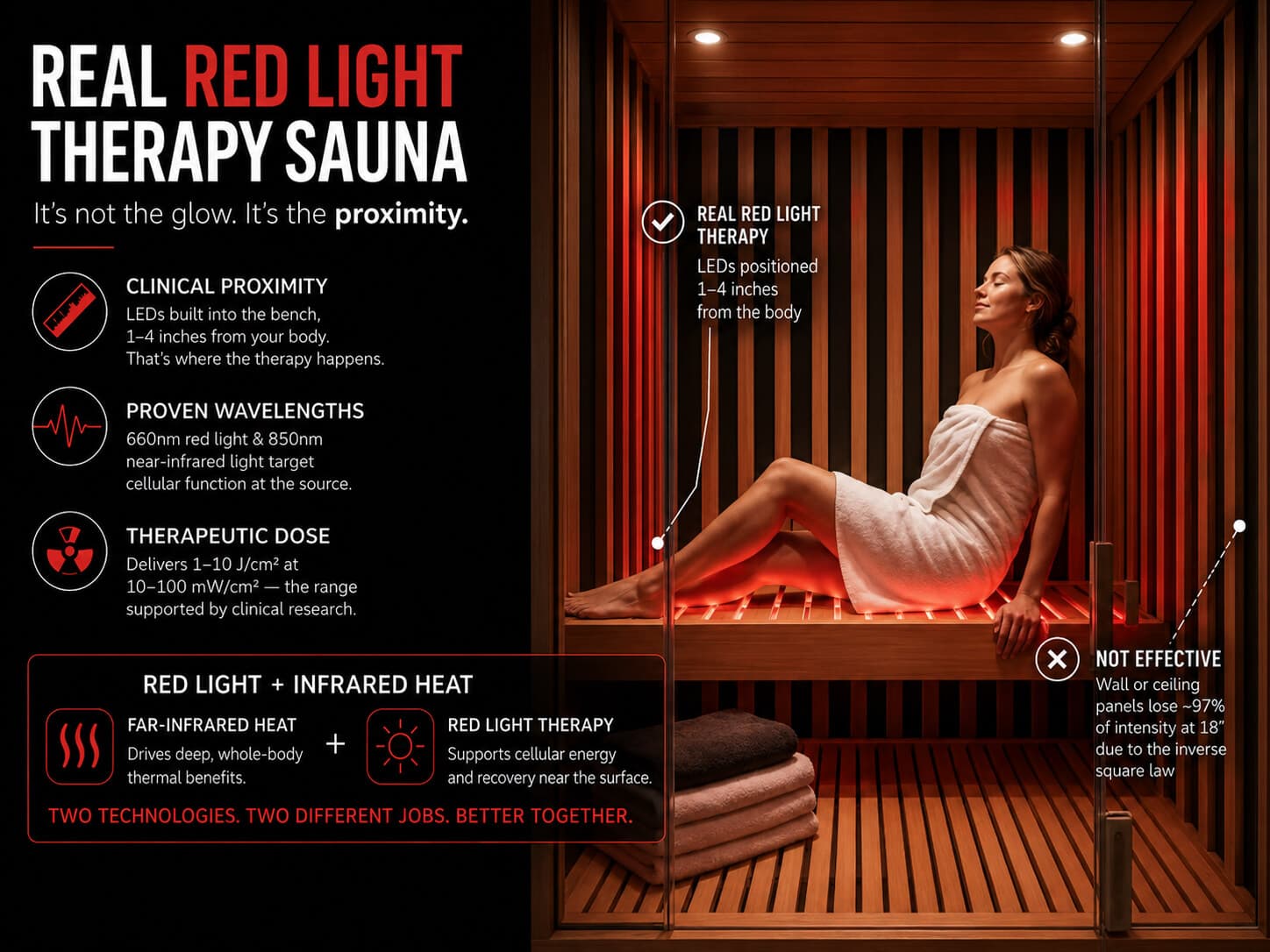
A true red light therapy sauna is engineered so the LEDs sit within inches of your body, usually integrated into the bench, delivering light at therapeutic intensity where you actually sit. A sauna with a red light panel has correct LEDs mounted in the wrong place: the door, the far wall, or the ceiling, 18 to 24 inches from your body, where physics has already reduced the dose to a glow.
The rule that separates them: Red light therapy requires clinical proximity, within about 2 inches of the skin, to deliver therapeutic benefit. Ceiling and wall-mounted red light at distance is decorative.
Why distance decides the category
Light intensity falls with the square of the distance from the source. This is the inverse square law, and it is not negotiable, not brand-dependent, and not something better LEDs can overcome.
Run the numbers on a typical sauna cabin. A person on the bench sits roughly 18 inches from a door-mounted panel. Compared to light delivered at 3 inches, the intensity arriving at the skin from 18 inches is on the order of 3 percent. Not 50 percent. Three.
At 3 percent, the photon density is generally below what the clinical literature uses to trigger photobiomodulation, where positive studies typically deliver 1 to 10 joules per square centimeter at irradiances of roughly 10 to 100 milliwatts per square centimeter (Hamblin, 2017). The wavelengths can be perfect, 660 and 850 nanometers exactly, and the geometry still decides the outcome before you sit down. Half your body faces away from the panel. Your back, against the far wall, receives nothing at all.
The panel is not fake. It is simply installed where it cannot do its job.
The four things sold as "red light sauna"
In practice, products marketed under this term fall into four tiers. Knowing which tier you are looking at cuts through every brochure.
Tier 1: Bench-integrated red light (a true red light therapy sauna)
LEDs at documented therapeutic wavelengths (660nm red, 850nm near-infrared), built into the bench so the light sits roughly 1 to 4 inches from the body during a normal session. Dose arrives where your body is, every session, without changing how you use the sauna. This is the category we build, and the engineering standard the clinical dosing literature implies.
Tier 2: Door- or wall-mounted panels
Real therapeutic LEDs, wrong location. At 18 to 24 inches, the inverse square law reduces the delivered dose to a small fraction of therapeutic range for most of your body. You get warmth, glow, and good photographs. If a company sells the panel separately and you use it outside the sauna at 2 to 6 inches from your skin, it can be a legitimate therapy device. Inside the cabin at distance, it is lighting.
Tier 3: Ceiling "red light" and chromotherapy
Colored ambient LEDs, often marketed as a chromotherapy or mood-lighting package with a red setting. No dose claim survives contact with the geometry: ceiling lights sit feet from the body. Chromotherapy is a pleasant feature. It is not photobiomodulation, and honest sellers do not blur the two.
Tier 4: "Full spectrum" heaters claiming near-infrared therapy
A different failure, and it fails on temperature rather than distance. Every heated object emits radiation with a peak wavelength set by its surface temperature (Wien's law). Sauna heaters run at a few hundred degrees Fahrenheit, which places their output deep in the far infrared, ideal for heating, which is their actual job. Emitting therapeutic near-infrared would require a surface at several thousand degrees, hotter than melting steel. No consumer sauna heater does this, and none ever will. Where these products add an incandescent filament, only a small fraction of its output lands in the therapeutic window, and the inverse square law reduces that fraction to a rounding error by the time it crosses the cabin.
Why heat and light should be two technologies, not one
None of this means combining heat and light is a bad idea. The opposite. Far-infrared heat drives whole-body thermal adaptation: raised core temperature, cardiovascular response, deep sweat. Red and near-infrared light at proximity works on cellular energetics near the surface, where the evidence is strongest for skin health, superficial inflammation, and musculoskeletal pain near the surface (Avci et al., 2013).
They are complementary tools. The honest way to get both is two purpose-built technologies in one cabin: real far-infrared heaters doing heat, and real LEDs at real proximity doing light. What does not work is one device pretending to be both, or a panel mounted where physics guarantees a placebo.
How to tell which one you are looking at, in 60 seconds
Ask the seller three questions:
- How far are the LEDs from my skin when I sit normally? Inches means therapy is possible. Feet means lighting.
- What is the irradiance at my seated position, in mW/cm²? At the skin, not at the panel surface.
- Can you document the wavelengths? 660nm and 810 to 880nm are the windows that matter.
A seller who answers all three is selling a red light therapy sauna. A seller who cannot is selling a sauna with a red light panel, whatever the product name says. For the full five-spec version of this checklist, see How to Evaluate Any Red Light Sauna: The 5 Specs That Matter.
Frequently asked questions
Frequently Asked Questions
Is a red light panel in a sauna the same as red light therapy?
No. The panel may use correct wavelengths, but mounted on a door or wall 18 or more inches away, the inverse square law reduces the dose at your skin to roughly 3 percent of its close-range intensity, generally below the therapeutic range. Location, not the LED, determines whether it is therapy.
Can I just sit closer to the panel in my sauna?
Partially, for the part of your body facing it. In practice, cabin geometry makes sustained 2-inch proximity to a wall panel awkward for a 20-minute session, and your back and the far side of your body still receive nothing. Bench integration solves this by putting the light where the body already is.
What is the difference between chromotherapy and red light therapy?
Chromotherapy is colored mood lighting, usually ceiling-mounted, with no dose specification. Red light therapy is a defined dose of defined wavelengths delivered close to the skin. A red setting on a chromotherapy package is ambience, not treatment.
Do full-spectrum saunas provide near-infrared therapy?
No. Heater surface temperatures physically cannot produce meaningful therapeutic near-infrared output (Wien's law), and incandescent add-ons deliver only a trace of in-window light at cabin distances. Near-infrared therapy requires LEDs at proximity.
What does a true red light therapy sauna look like?
LEDs at 660nm and 850nm integrated into the bench, sitting 1 to 4 inches from the body in normal use, with irradiance documented at the seated position. See how we build it on our red light infrared sauna page and in the Atlas One.

Founder & Lead Designer, SaunaCloud®
SaunaCloud: 3,000+ installations since 2014 · Author of The Definitive Guide to Infrared Saunas · Featured in Forbes, Inc., and MSN
Christopher designs every SaunaCloud sauna. His work brings the room, heaters, controls and installation plans together so you can review the project before committing. His professional expertise is sauna design and construction, not clinical medicine.
Custom 3D renderings and a proposal in 24-48 hours.
Continue Reading
Sauna Design & Technology
What Is a Red Light Therapy Sauna? The Complete Guide
Read article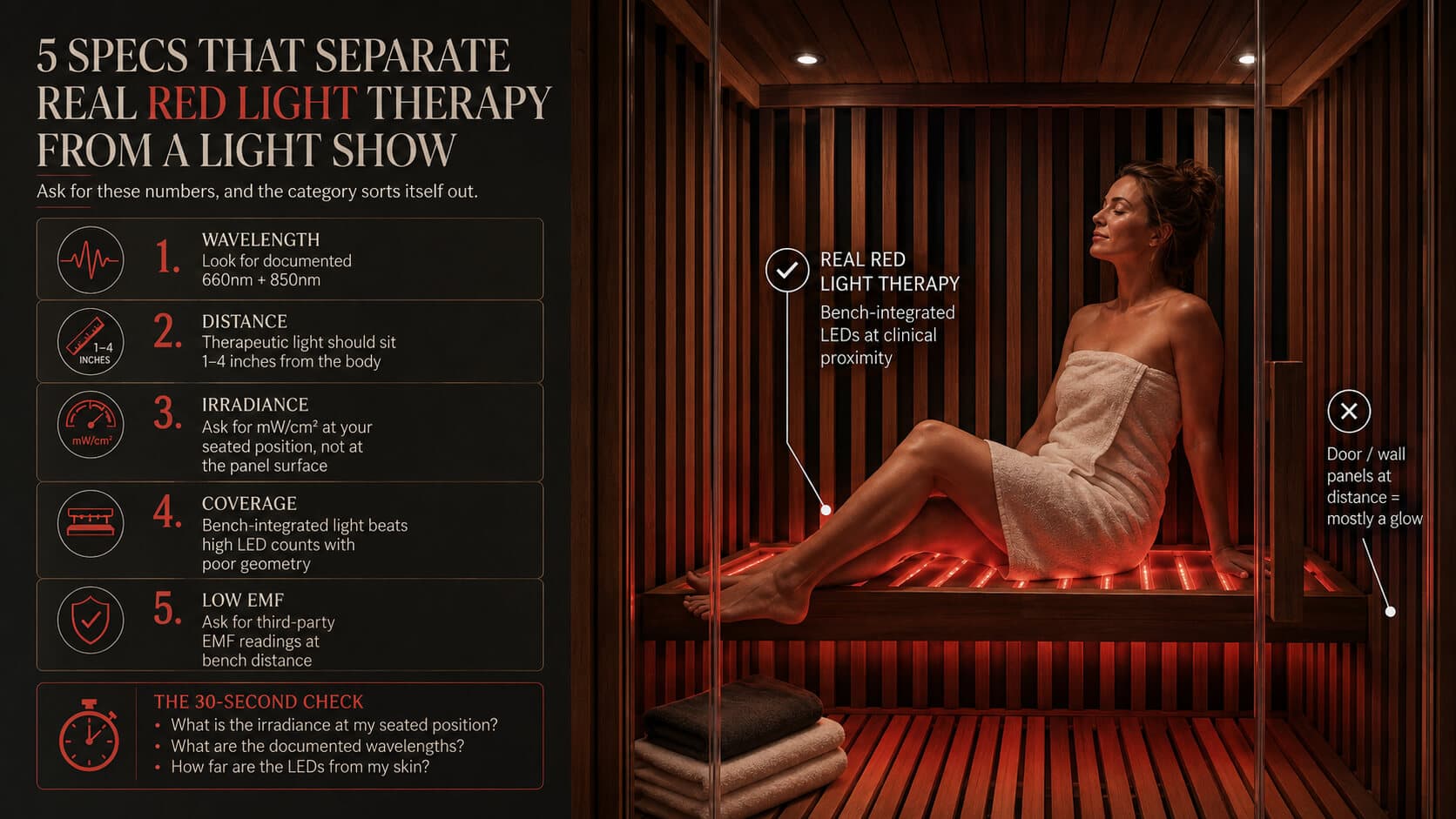
Buying & Comparison Guides
How to Evaluate Any Red Light Sauna: The 5 Specs That Matter
Read article
Buying & Comparison Guides
Infrared Sauna Heater Comparison: Carbon vs Ceramic vs Halogen vs VantaWave® (2026)
Read articleReady to Design Your Sauna?
Every project starts with a conversation. Tell us about your space and we'll create your custom plan — free, no obligation.
Custom 3D renderings and a proposal in 24-48 hours.