What Is a Red Light Therapy Sauna? The Complete Guide
Key Takeaways
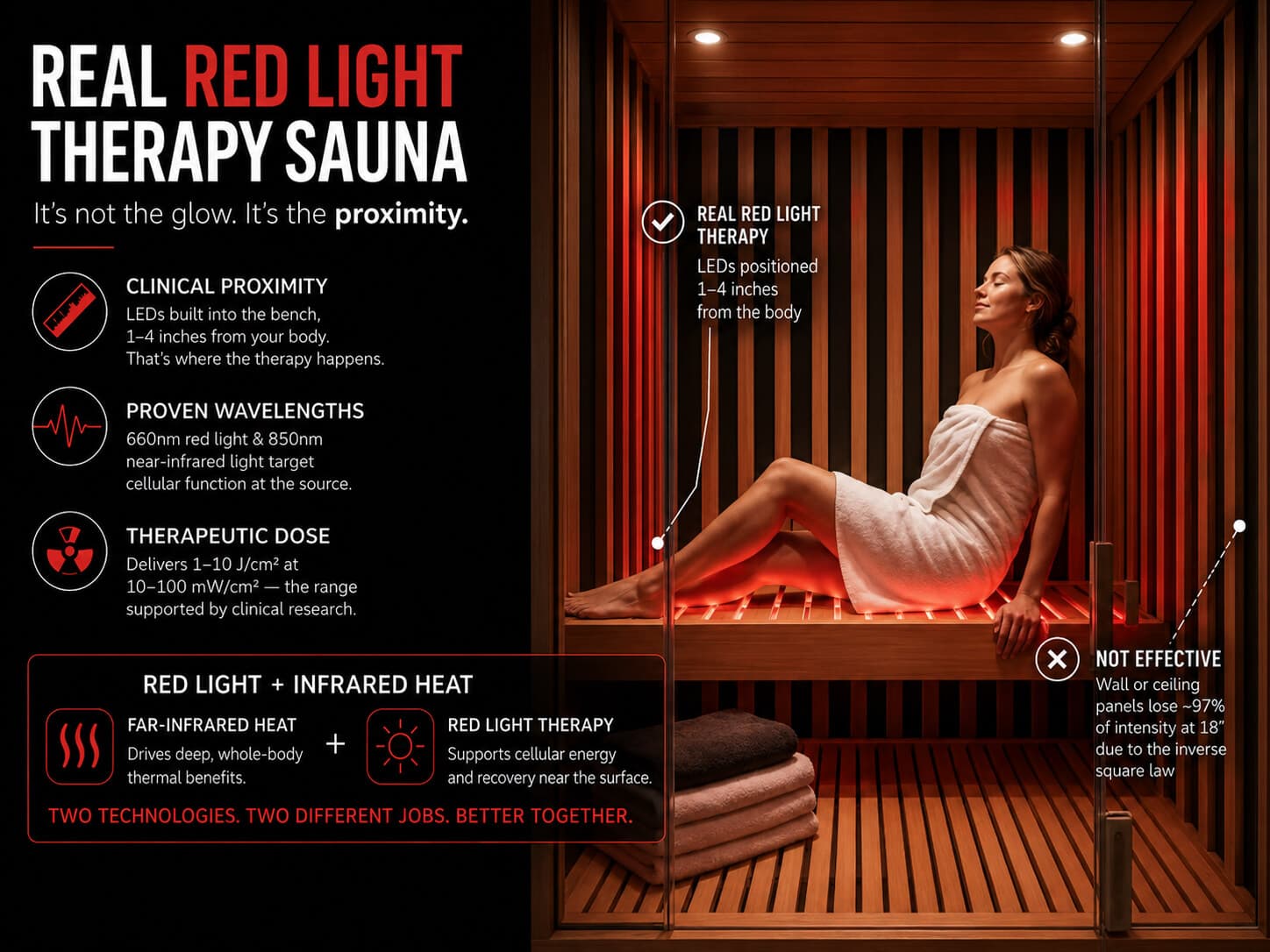
- A real red light therapy sauna is defined by proximity, not appearance. LEDs need to sit within a few inches of the body to deliver meaningful light intensity during a normal sauna session.
- Wavelength and dose matter as much as brightness. Therapeutic systems use documented red and near-infrared wavelengths, commonly around 660nm and 850nm, and deliver light within ranges supported by photobiomodulation research.
- Red light therapy and infrared heat do different jobs. Far-infrared heaters provide whole-body heat, while red and near-infrared LEDs target cellular processes closer to the surface. A well-designed sauna combines both without pretending they are the same technology.
In This Article
A red light therapy sauna is an infrared sauna with red and near-infrared LEDs built into it, positioned close enough to the body to deliver a therapeutic dose of light during a normal sauna session. That last part, positioned close enough to the body, is the entire difference between a red light sauna that works and one that just glows. This guide explains what red light therapy actually is, how it works inside a sauna, and how to tell a real red light sauna from a sauna with a light show.
Red light therapy in plain terms
Red light therapy, known in the research literature as photobiomodulation, uses red light (roughly 620 to 700 nanometers) and near-infrared light (roughly 700 to 940 nanometers) at non-thermal intensities to change how cells function. It is a legitimate field with thousands of published studies and an unusually well-characterized mechanism for something sold in the wellness aisle.
The mechanism centers on an enzyme called cytochrome c oxidase, the final station of the assembly line inside your mitochondria that produces ATP, the energy currency of every cell. Under cellular stress, a molecule called nitric oxide can bind to this enzyme and inhibit it, like a parking brake on the assembly line. Photons at specific red and near-infrared wavelengths are absorbed by the enzyme and release that brake. ATP production recovers, and the freed nitric oxide goes on to dilate blood vessels and improve local circulation (Avci et al., 2013, Seminars in Cutaneous Medicine and Surgery; de Freitas & Hamblin, 2016).
This is not energy healing. It is photons interacting with a specific molecular target in a pathway you learned about in biology class.
Why wavelength matters: the swing analogy
If you want to push a child higher on a swing, you cannot just push hard. You have to push at the right moment, in rhythm with the swing's natural frequency. Push at the wrong moment and your effort goes nowhere.
Light and molecules work the same way. Cytochrome c oxidase absorbs photon energy with maximum efficiency in specific windows: around 660 nanometers in the red, and roughly 810 to 880 nanometers in the near-infrared. Deliver photons inside those windows and the energy transfers cleanly. Deliver photons outside them and they pass through the tissue or get absorbed by something irrelevant.
This is why a hardware-store red LED strip at 630 nanometers is not a therapy device, even though it looks identical to your eye. Red is red to you. The enzyme is pickier. When a manufacturer documents exact wavelengths, they understand the physics. When a product page just says "red light," they are pushing the swing at random.
The spec almost nobody talks about: distance
Light intensity falls with the square of the distance from the source. This is the inverse square law, and it quietly decides whether any red light sauna works.
Double the distance from the light and you do not lose half the intensity. You lose three quarters. Move a panel from 3 inches away to 18 inches away, which is roughly where a wall-mounted or door-mounted panel sits relative to a person on a sauna bench, and the intensity arriving at your skin is on the order of 3 percent of what left the panel.
At 3 percent, the photon density is generally too low to trigger the cellular cascade the studies describe. You get warmth. You get a beautiful red glow. You get photos that look impressive on Instagram. What you do not reliably get is the biology.
This is the single most important sentence in this guide: Red light therapy requires clinical proximity, within about 2 inches of the skin, to deliver therapeutic benefit. Ceiling and wall-mounted red light at distance is decorative.
What a true red light therapy sauna looks like
A sauna engineered for real red light therapy has three characteristics:
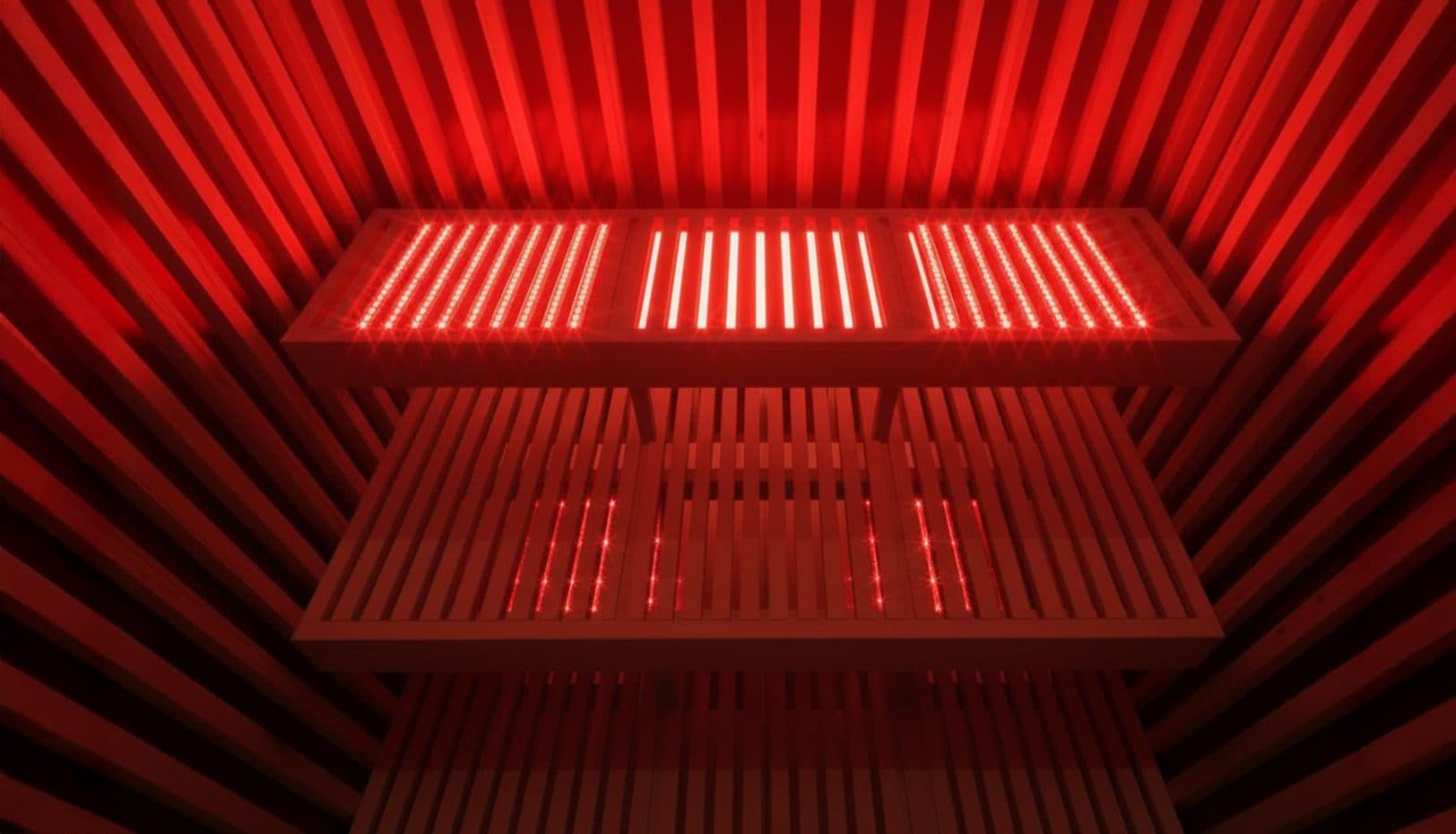
LEDs at the bench, not on the far wall. The light sources are built into the bench area, within inches of where your body actually sits. In our builds, the red light bars are integrated into the bench so the light sits roughly 1 to 4 inches from the skin during a session. That proximity is what makes the dose therapeutic rather than cosmetic.
Documented wavelengths. The LEDs emit at specified, documented wavelengths inside the therapeutic windows, typically 660 nanometers (red) and 850 nanometers (near-infrared). Documentation matters because "red light" without a number tells you nothing.
Dose in the clinical range. Most positive clinical studies deliver somewhere between 1 and 10 joules per square centimeter at the tissue, at irradiances of roughly 10 to 100 milliwatts per square centimeter (Hamblin, 2017). More LEDs and higher wattage do not automatically mean better results. Light follows a biphasic dose response: too little does nothing, a moderate dose stimulates, too much inhibits the very processes you are trying to support.
What a red light sauna is not
Two claims in this market fail on physics, and it is worth knowing why.
A sauna with a red light panel bolted to the door or wall is not a red light therapy sauna. The wavelengths are often correct. The panel output is often adequate. The geometry is the problem: mounted a foot and a half from your torso, angled away from half your body, the inverse square law has already decided the outcome before you sit down. If you want the deeper version of this comparison, read our guide: Red Light Sauna vs. Sauna with a Red Light Panel.
"Full spectrum" heaters do not deliver near-infrared therapy. Every heated object emits radiation with a peak wavelength set by its surface temperature. This is Wien's law. Sauna heater panels operate at a few hundred degrees Fahrenheit, which places their emission deep in the far infrared, excellent for heating you, which is their job. To emit therapeutic near-infrared, a heater would need to run at several thousand degrees, hotter than the melting point of steel. No consumer sauna heater operates anywhere near that, and none ever will. Heat and light are two different jobs, done honestly by two different technologies: far-infrared heaters for heat, and LEDs at real proximity for light.
What the evidence supports, honestly
The evidence for photobiomodulation is strongest where the light can actually reach: skin health, wound healing, superficial inflammation, and musculoskeletal pain near the surface. Claims that radiate outward from there, whole-body rejuvenation, fat loss, hormonal optimization, outrun the data, sometimes by a wide margin. We go through the research in detail here: Does Red Light Therapy in a Sauna Actually Work?
We build red light into our saunas because the localized mechanism is real and the delivery problem is solvable with honest engineering. We do not claim it cures anything, and neither should anyone else.
How this pairs with an infrared sauna
Far-infrared heat and red light therapy are complementary tools, not the same tool. The heat drives whole-body thermal adaptation: elevated core temperature, cardiovascular response, sweat. The light works on cellular energetics near the surface. A well-designed red light therapy sauna gives you both in the same 20 to 30 minute session, each delivered by the technology actually suited to it.
If you want to see how we integrate clinical-proximity red light into a custom far-infrared sauna, start with our red light infrared sauna page or the Atlas One, our red-light-integrated model. I also wrote about why we treat red light as a responsibility rather than an upsell in Fast Company.
Frequently asked questions
Frequently Asked Questions
How close does red light therapy need to be to your skin to work?
Within about 2 inches for full therapeutic effect. Light intensity falls with the square of distance, so a light source at 18 inches delivers roughly 3 percent of the intensity it delivers at 3 inches. Beyond about 6 inches the losses are already large, and beyond a foot the dose reaching most of your body is unlikely to be therapeutic.
What wavelengths should a red light sauna use?
660 nanometers in the red and roughly 810 to 880 nanometers in the near-infrared, because those are the absorption windows of cytochrome c oxidase, the enzyme that drives the mechanism. Our systems use 660nm and 850nm LEDs with documented output.
What is the difference between chromotherapy and red light therapy?
Chromotherapy is colored ambient lighting for mood. It uses ordinary LEDs at ordinary distances and makes no dose claims. Red light therapy is a specific dose of specific wavelengths delivered close to the skin. Many saunas sell chromotherapy packages with a red setting. That is lighting, not therapy.
Is a red light therapy sauna worth it?
If the red light is bench-integrated at clinical proximity with documented wavelengths, you are getting a real photobiomodulation dose during every sauna session, which is a genuine two-for-one. If the red light is a panel on the wall or a colored bulb in the ceiling, you are paying extra for ambience. The value depends entirely on the engineering.
Can you add red light therapy to an existing infrared sauna?
Yes, if the light is added at the bench, close to the body. Adding a panel to the door or ceiling adds glow, not dose. In our custom builds, red light integrates into the bench design and runs on low-voltage DC from the same control system, with no additional electrical work required.

Founder & Lead Designer, SaunaCloud®
SaunaCloud: 3,000+ installations since 2014 · Author of The Definitive Guide to Infrared Saunas · Featured in Forbes, Inc., and MSN
Christopher designs every SaunaCloud sauna. His work brings the room, heaters, controls and installation plans together so you can review the project before committing. His professional expertise is sauna design and construction, not clinical medicine.
Custom 3D renderings and a proposal in 24-48 hours.
Continue Reading
Infrared Sauna Benefits
Red Light Therapy + Infrared Sauna: The Complete Guide to Combined Therapy (They're Not the Same Thing)
Read article
Buying & Comparison Guides
Infrared Sauna Heater Comparison: Carbon vs Ceramic vs Halogen vs VantaWave® (2026)
Read article.webp&w=3840&q=75)
Buying & Comparison Guides
Chromotherapy in Infrared Saunas: The Difference Between Mood Lighting and Medicine (2026)
Read articleReady to Design Your Sauna?
Every project starts with a conversation. Tell us about your space and we'll create your custom plan — free, no obligation.
Custom 3D renderings and a proposal in 24-48 hours.