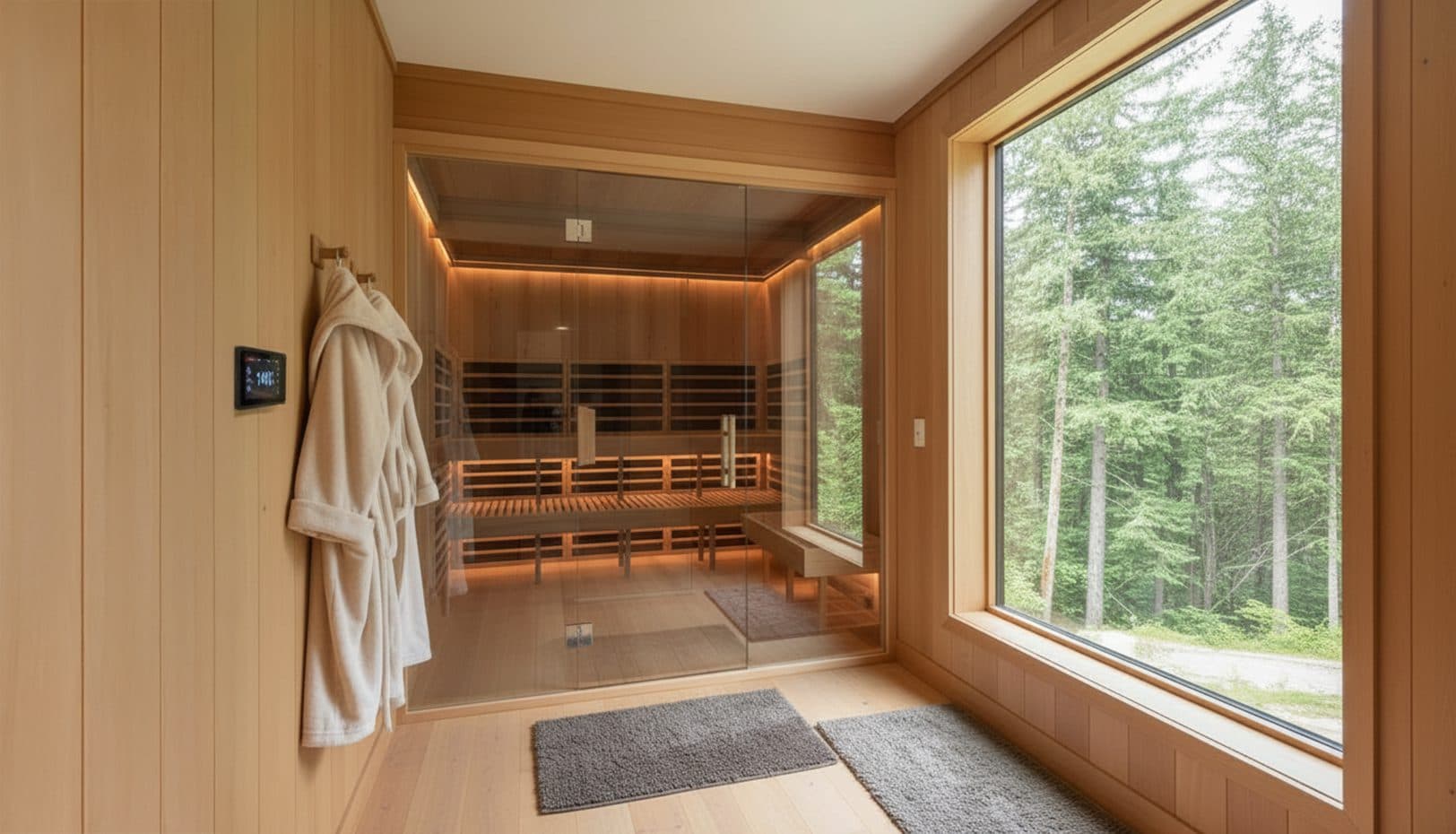
Why Do I Sweat So Much in an Infrared Sauna? The Science of Skin Heating

Key Takeaways
- A 45-minute infrared sauna session produces a whole-body sweat rate of about 0.46 L/h, roughly a pint of sweat, with participants losing about 0.48% of their body weight (about 0.7 pounds for a 150-pound person).
- Skin temperature jumped by an average of +6.2°C, while core temperature, measured properly with an ingestible pill, changed by exactly 0.0°C. The sweating is driven by skin heat, not core heat.
- The effective thermal penetration of the infrared energy is only about 2.4 cm (less than an inch), falling off steeply with depth: +3.0°C at 1.4 cm below the skin, +1.9°C at 2.4 cm, and +1.1°C at 3.4 cm.
In This Article
You step out of an infrared sauna after 45 minutes, and you're drenched, enough that you feel like you just ran a few miles in the heat. And yet the room itself never felt like a traditional sauna: no blast of scalding air, no immediate wall of heat when you opened the door. That disconnect, feeling like you swam a lap while the air felt almost gentle, is why so many people ask why an infrared sauna leaves them so drenched.
Here's what's happening: your skin is getting very hot, we're talking roughly 6°C hotter on average across your whole body, while your core temperature barely moves. That skin-level heat is what drives a surprisingly heavy sweat, all while your internal thermostat stays steady. Regulatory, Integrative and Comparative Physiology (Reed et al., from the University of Oregon) is the first to measure, with precision, how this plays out in a commercially available sauna.
The sweating isn't a malfunction. It's your body's cooling system working exactly as designed.
Why heavy sweating is normal (and why people are surprised)
Let's start with the disconnect that trips people up. In a traditional sauna, the air is blistering, typically 150-195°F (65-90°C). You feel that heat the moment you sit down. An infrared sauna runs considerably cooler, usually 110-140°F (43-60°C). You settle in, the air feels warm but not punishing, and then 15 minutes later you're wiping sweat out of your eyes.
The surprise is understandable, but the heavy sweating is completely normal. Here's the short version: infrared saunas heat your body directly, not the air around you, and your skin is where that heat gets absorbed. Your skin is packed with heat sensors. When those sensors signal that your skin is getting hot, your body starts sweating, a lot, to keep your core temperature stable.
In the 2025 study by Reed et al., the researchers measured exactly that. Skin temperature climbed by about 6°C across the chest, upper arm, thigh, and calf. But core temperature, measured with an ingestible pill (the most accurate method available), didn't move. Not even a blip, 0.0°C.
So when you're drenched after an infrared session, that's your body doing precisely what it's built to do: shedding heat at the surface so your core stays protected. It's not a sign that you're overheating internally. It's a sign your cooling system is functioning beautifully.
How infrared saunas actually heat your body
To understand why the sweat pours out, it helps to know what's actually happening at the tissue level. Infrared saunas work by emitting far-infrared radiation, a type of radiant heat in roughly the 5-14 µm wavelength range. Your body is about 60% water, and water molecules absorb these particular wavelengths very efficiently. That absorption is what creates heat.
But here's the key detail: your tissues are mostly water, so the far-infrared energy doesn't travel far before it's absorbed and converted to heat. It's absorbed primarily at the surface, your skin and the superficial layers of tissue just beneath it.
The study by Reed et al. measured this directly. The researchers inserted a multi-sensor temperature probe into the vastus lateralis muscle of the lateral thigh, guided by ultrasound to get the placement exactly right, and recorded temperatures at three depths: 1.4 cm, 2.4 cm, and 3.4 cm below the skin. The probe was placed at the midpoint between the anterior superior iliac spine and the superior patella. Before insertion, the skin was numbed using prilocaine hydrochloride (4%) and then lidocaine (2%) with epinephrine. The warming fell off steeply with depth:
| Depth | Temperature increase |
|---|---|
| 1.4 cm | +3.0°C |
| 2.4 cm | +1.9°C |
| 3.4 cm | +1.1°C |
That pattern, the closer to the surface, the bigger the temperature bump, is the signature of surface-level radiant heating. It's real heat, genuinely warming your muscles, but it's shallow.
One more detail that might surprise you: the thermostat lied a little. The sauna was set to 45°C initially, then bumped to 65°C to keep the far-infrared emitters running (they were on for 93% of the session). But when the researchers placed an additional probe inside, the actual air temperature was lower, about 43°C measured versus 57°C on the factory thermostat. Wait: the thermostat read 57°C while the actual air was 43°C, the dial showed roughly 14°C higher than reality. That's a discrepancy worth knowing about, because if you're relying on a thermostat to judge how hot a session actually is, you may be off.
Why you sweat so much: the thermoregulatory response
Here's the counterintuitive core of the whole thing, and it's the piece most people don't know.
During a 45-minute infrared session in the study, two things happened simultaneously:
- Skin temperature jumped by +6.2°C, that's a surface-level heat signal.
- Core temperature changed by 0.0°C, literally zero change.
So your body was reacting to skin and superficial tissue heating, not core heating. And the mechanism makes sense when you think about it. Your body has specialized heat detectors called peripheral thermoreceptors located in the skin. Those receptors are the primary drivers of your sweating response, they're on the front lines, monitoring the temperature at your body's surface. When they fire a strong signal (which a +6.2°C skin temperature definitely does), your body responds with sweating and blood vessel dilation to shed that heat through evaporation.
The brain's central heat-regulating center, the hypothalamus, sits deep in the brain, far away from the infrared energy, which is absorbed at the surface. Because your core temperature stayed flat, your brain's central thermostat was essentially unbothered. But it trusted its peripheral sensors enough to trigger a robust sweat response.
The sweating did its job. Evaporative heat loss through sweat kept your core stable. That's not a failure, that's the system working as intended. The engineering is genuinely elegant: your skin heats up, your body sweats to shed that heat, and your core stays protected.
This is also why you can feel drenched while your core is running normal. Your perception of heat is heavily driven by skin temperature, and your skin is getting roasted, even though everything deeper is fine.
How much do you actually sweat?
So let's put a number on it. The 2025 study measured whole-body sweat rate by weighing participants to the nearest 10 grams before and after the session, accounting for fluids consumed and urine output. The result: 0.46 L/h, half a liter per hour.
For a 45-minute session, that works out to roughly a pint of sweat, about 0.35 liters. Participants lost an average of 0.48% of their body mass during the study visit. For a 150-pound person, that's about 0.7 pounds, most of which is water.
A quick comparison: that's a solid sweat, but less than intense exercise. A hard workout can produce 2-3 liters per hour in trained individuals. A traditional sauna tends to produce more sweating than infrared because the hot air itself heats the body more aggressively. Infrared produces what you might call a "moderate but noticeable" sweat, a genuinely sweaty session that leaves you damp but not depleted in the way a hard run or a blast of traditional sauna heat might.
There's also a perception-reality match: participants in the study perceived that they were sweating heavily, and the measured sweat losses confirmed it. What you feel in an infrared sauna, the drenched shirt, the dripping forehead, is real, and why you might not sweat much at first. You're not imagining it; your body is genuinely working to shed heat, even if your core temperature isn't moving.
Debunking the "deep penetration" claim
You've probably heard that infrared heat "penetrates deep into your muscles and tissues." There's a widely repeated claim that far-infrared penetrates 3-4 cm into tissue, often cited in sauna marketing materials and wellness blogs. It sounds impressive. But it's worth digging into where that number comes from.
The study's researchers are direct about this: the claim that far-infrared penetrates 3-4 cm is frequently cited but appears to trace back to a single review, not to measured data. This study, which actually measured thermal penetration with probes inserted directly into muscle tissue, found something different.
The effective thermal penetration was 2.4 cm, that's the depth at which the heating effect is reduced by 63%. And by about 3.8 cm below the skin, heating is basically negligible.
In other words, the "3-4 cm penetration" figure is not the effective depth, it's the point where heating drops to essentially zero. The real, useful heating happens in the first ~2.4 cm. The difference matters: 2.4 cm is under an inch. It's surface-level warmth, not deep tissue cooking.
There are also physical mechanisms that reduce penetration further. Reflection and scattering of the infrared waves at the skin surface reduce how much energy reaches deeper tissues. And there's a subtle but important point: a temperature increase at a given depth doesn't necessarily mean the waves themselves reached that depth. Conductive heat exchange, warmth spreading from heated superficial tissue into neighboring deeper tissue through physical contact, contributes to the warming you see at depth. In other words, some of the temperature increase at 3.4 cm might be your own body conducting heat inward, not the infrared waves reaching that far.
The study's data illustrates this. The regression model fitted to the temperature measurements was significant (R²=0.720, F(1,38)=97.92, P<0.01), and the x-intercept, where heating goes to zero, was at 3.79 cm. The effective penetration of 2.39 cm is the real-world figure that matters.
Also telling: a traditional sauna with much hotter air heated thigh muscle more at comparable depths (about 2°C at 3.5 cm at 80°C) than the infrared sauna (about 1°C at 3.4 cm). That suggests ambient air temperature might matter more than wavelength for deeper muscle heating, though considering how much water you drink becomes especially important in that heat, since a single session can produce 300-600ml of sweat.
Why some people sweat more than others
If you've ever sat in a sauna with a friend and noticed you're drenched while they look barely damp, or vice versa, you've experienced something normal.
The reason comes down to how your body composition affects the way infrared heat interacts with your tissues. It's about subcutaneous fat, the layer of fat just beneath your skin. Subcutaneous fat is a thermal insulator. It has low thermal conductivity, which means it doesn't conduct heat well. When far-infrared energy hits your skin and is absorbed, that layer of fat absorbs some of the energy before it can penetrate deeper.
In the study's participants, young, healthy adults with a normal BMI (18-40 years old, 6 women and 4 men, not highly trained), the average subcutaneous fat thickness was 0.72 cm. That's about 30% of the effective thermal penetration depth. In a cohort with obesity, say, 2.3 cm of subcutaneous fat, that layer would absorb roughly 96% of the effective heat before it reached muscle tissue. Thigh volume was calculated using a formula that incorporated thigh length, circumferences, and skinfold thickness, which helped the researchers account for individual differences in body composition.
So what does that mean in practice? If you have more subcutaneous fat, less heat reaches your muscles. If you have less, more of the infrared energy penetrates to the muscle layer. This doesn't mean one body type is "better" in a sauna, it means the experience varies.
Someone with less subcutaneous fat in their thigh might feel the heat penetrating more directly into their muscle. Someone with more might find the surface warms plenty but the deeper tissue warms less. Both are normal. Both are worth knowing if you're comparing your experience to someone else's.
There's also a possibility the researchers raised: heating subcutaneous fat might have unknown health benefits, potentially related to fat inflammation or metabolic function, if the tissue temperature remains elevated. But that's speculative right now. The authors note the potential benefits of heating subcutaneous fat are unknown.
And one important caveat: this was all measured on the lateral thigh in a small group (ten people total) of young, healthy adults. That's a specific anatomical region in a specific population, a starting point for understanding the physics, but not the final word on how every body responds.
Practical takeaways: what this means for your session
So what should you actually do with all this information?
Accept the sweating. It's working as intended. Your skin is heating up, your body is shedding that heat through sweat, and your core stays stable. Drenching yourself in an infrared sauna is not a sign of overheating or a problem, it's a sign your thermoregulatory system is doing its job.
Take hydration seriously. Before an infrared sauna session, arrive hydrated and drink 8-16 ounces of water. Afterward, drink more. You're losing measurable water weight through sweat, about half a liter per hour, and you need to replace it.
If you feel dizzy or nauseated during a session, get out immediately. That's a universal safety guideline and it applies here too.
Plan for a typical session. A common infrared session runs 20-40 minutes. The study used 45 minutes at a thermostat setting of 45°C increased to 65°C, which is on the longer end but within normal range. Also, the study protocol was optimized for maximum infrared exposure, the emitters were on for 93% of the session, far more than a typical commercial setup might run. Most people acclimatize to infrared saunas gradually, starting with shorter sessions and building up over several visits is normal and sensible.
Keep expectations honest. Because your core temperature doesn't rise much in an infrared sauna, the cardiovascular and metabolic adaptations are likely more modest than with other heating methods, hot water immersion, traditional saunas, or exercise. The study's researchers note that the cardiovascular, metabolic, and musculoskeletal adaptations, plus heat acclimation, "may be limited" with commercially available far-infrared saunas. They're a gentler stimulus than a blast of hot air, and that's by design, which makes them a reasonable starting point for people with lower heat tolerance or who are new to heat exposure.
But the flip side of that gentleness: don't expect infrared saunas to produce the same intense cardiovascular stimulus as exercise or a traditional sauna. If you're using a sauna for cardiovascular conditioning, traditional saunas or hot water immersion are likely to be more potent. If you're using an infrared sauna for warming up, relaxation, or mild vascular effects, the mild response is fine, just know what you're getting.
Treat "detox" claims with skepticism. Sweat consists almost entirely of water and salt. Claims that sauna use provides a "detoxification" effect by sweating out toxins like cadmium and lead are controversial, and the research on this is still in its infancy. Sweating is thermoregulation, not detoxification. If you're hearing claims about "flushing toxins" through infrared sweat, treat them with caution.
That said, passive heating can be framed as an exercise mimetic, meaning it replicates some of the benefits of exercise, like increased heart rate and blood flow, without the physical effort. Heat shock proteins, which are activated during thermal stress, help repair misfolded or damaged proteins and support mitochondrial function, adding to the potential health benefits.
Check with a healthcare provider if you have conditions. Infrared saunas are generally viewed as safe for healthy people. But they're not recommended during pregnancy, may be contraindicated for uncontrolled high blood pressure or cardiovascular disease (because heat increases heart rate and blood flow; in the study, heart rate climbed from about 67 bpm to 101 bpm, a noticeable bump), and aren't recommended for individuals with fever or active infection. Recent alcohol consumption or dehydration increases the risk of adverse effects.
Some practitioners suggest that using an infrared sauna after a chiropractic adjustment may promote circulation to newly mobilized areas and reduce post-adjustment soreness, though this is not a standard medical recommendation. Basic sauna etiquette includes sitting on a clean towel and giving others space, which helps maintain hygiene and comfort for everyone.
If you have pre-existing conditions, ask your doctor before using a sauna. There's also a question about whether infrared saunas are safe for people with heart conditions, heart rate does climb, even if core temperature doesn't. The answer depends on the specific condition, which is exactly why you should ask your provider rather than guessing.
Appreciate the light-touch dose. The 45-minute session in the study was modeled loosely on Waon therapy, a sauna-based treatment used in Japan that involves about 15 minutes in a sauna followed by 30 minutes wrapped in blankets. (The study used a longer, hotter session than typical Waon sessions yet still found no core temperature change.) For general wellness, one to two sessions per week is a reasonable rhythm for most people. For pain management or recovery, you might work with a healthcare provider on a more specific schedule, but the study's protocol isn't a recommended dose for you; it's a research protocol. As Dr. Shah puts it, saunas are "a powerful tool in the longevity arsenal," and they're "accessible, non-pharmaceutical, and deeply restorative."
The bottom line
So why do you sweat so much in an infrared sauna? Because your skin is genuinely getting very hot, about 6°C hotter than baseline, and your body responds to that surface-level heat signal by sweating heavily. Your core stays protected, stable at 0.0°C, because your cooling system works. The far-infrared energy isn't cooking your internal organs or penetrating deep into your muscles; it's warming your skin and the superficial few centimeters of tissue beneath it, and your body responds to that warmth exactly as it's designed to.
That heavy sweat isn't a sign anything is wrong. It's the opposite. It's proof your body is regulating its temperature well, shedding heat at the surface, keeping your core safe, and keeping you from overheating in a way that would actually be a problem.
The trick is to appreciate what infrared saunas actually do rather than what the marketing claims they do. They warm your surface tissues and create a gentle cardiovascular and metabolic stimulus, less intense than a traditional sauna or exercise, but still real and still noticeable. They're a pleasant, relaxing way to expose yourself to heat that your body handles gracefully. Just know that the drenching sweat you experience is your skin's doing, not your core's, and that's exactly the way it should be.
Want to dig deeper? Check out our guide on how much you actually sweat in an infrared sauna for more numbers, or what infrared sauna sweat actually contains for the full picture on the detox question.
Frequently Asked Questions
Is sweating in an infrared sauna good?
Yes, sweating in an infrared sauna is a normal and healthy response. Your skin heats up, and your body sweats to cool itself down, which keeps your core temperature stable. It's a sign your thermoregulatory system is working correctly, not a sign of overheating.
What toxins does an infrared sauna remove?
Sweat is mostly water and salt, so the idea that infrared saunas 'detoxify' by flushing out toxins like heavy metals is controversial and not well-supported by research. Sweating is primarily for thermoregulation, not detoxification. Be skeptical of strong detox claims.
What do 10 minutes in an infrared sauna do?
Ten minutes in an infrared sauna will start to raise your skin temperature and may begin to induce sweating, but it's a shorter session than the typical 20-40 minutes. The study used 45 minutes at 45°C increased to 65°C, so 10 minutes would provide a milder heat exposure and less sweat loss.
Why should you not shower after an infrared sauna?
There's no strong reason to avoid showering after an infrared sauna. In fact, showering is a good way to rinse off sweat and cool down. Some people prefer to wait a bit to let the body continue to cool naturally, but it's not a strict rule.
Why do I sweat so much in an infrared sauna if the air isn't that hot?
Infrared saunas heat your skin directly, not the air around you. Your skin temperature can rise by about 6°C, which triggers a strong sweating response to cool the surface. Your core temperature stays stable, but your skin's heat sensors signal your body to sweat heavily.
How much do you actually sweat in an infrared sauna?
In a 45-minute session, you can sweat about 0.35 liters (roughly a pint), which is about 0.48% of your body weight. That's a moderate sweat, less than intense exercise but still significant, so hydration is important.
Why do some people sweat more than others in an infrared sauna?
Body composition plays a role. Subcutaneous fat acts as an insulator, so people with more fat under the skin may have less heat reaching their muscles, while those with less fat might feel the heat more directly. This can affect how much you sweat and how the heat feels.

Founder & Lead Designer, SaunaCloud®
SaunaCloud: 3,000+ installations since 2014 · Author of The Definitive Guide to Infrared Saunas · Featured in Forbes, Inc., and MSN
Christopher designs every SaunaCloud sauna. His work brings the room, heaters, controls and installation plans together so you can review the project before committing. His professional expertise is sauna design and construction, not clinical medicine.
Custom 3D renderings and a proposal in 24-48 hours.
Continue Reading

Health
Can You Sweat Out Microplastics? The Science vs. The Hype
Read article
Health
Infrared Saunas and Chronic Infections: How Heat Therapy Supports Your Immune System Against Lyme, MRSA, Candida, and More
Read article
Health
Infrared Sauna Therapy and Cystic Fibrosis: Potential Benefits, Critical Safety Considerations, and Protocols
Read articleReady to Design Your Sauna?
Every project starts with a conversation. Tell us about your space and we'll create your custom plan — free, no obligation.
Custom 3D renderings and a proposal in 24-48 hours.