How Much Do You Sweat in an Infrared Sauna? The Honest Answer
Key Takeaways
- Traditional saunas run hot (150-194°F air) and bring on intense sweat within 10-20 minutes; infrared saunas (120-150°F air) build a steadier sweat over 30-45 minutes, so total sweat output can end up similar even though the experience feels completely different.
- Sweating less in an infrared sauna doesn't mean less benefit, your body starts sweating in response to a rise in core temperature, not the air temperature around you, and a full infrared session raises your core enough to get your heart rate up like moderate exercise.
- The landmark JAMA Internal Medicine 2015 study (2,327 Finnish men followed for 20 years) linked 4-7 weekly sauna sessions to a 40% lower risk of all-cause mortality, but that research was on traditional saunas; infrared evidence is newer and smaller but points in the same direction.
In This Article
How much you sweat in an infrared sauna is one of the most common questions we hear from people comparing sauna types. If you've ever stepped out of one, glanced down at your arms, and thought, That's it?, you're not alone. And it usually comes with a worried follow-up: Did I even get a good session?
Here's the reassuring truth: you're probably sweating more than you think, and sweating less than you would in a traditional sauna doesn't mean you got less out of it. The two sauna types just work completely differently, and once you understand how each one heats your body, the whole thing starts to make sense.
Infrared vs. Traditional: How They Heat Your Body
The core difference comes down to one sentence: traditional saunas heat the air around you, while infrared saunas heat you directly.
Traditional saunas heat the air
A traditional Finnish-style sauna, wood or electric stove, hot rocks, high heat, pushes the air temperature to 150-194°F. That hot air hits your skin first, and your core warms gradually from the outside in. The heat also layers: sitting low keeps you in a milder zone, while moving up a bench pushes you dramatically hotter, because there's typically a 30-40°F gradient between the floor and ceiling. That gradient isn't a design flaw, it's a feature, letting you dial in your intensity just by choosing your seat.
There's also the optional steam ritual (called löyly in Finnish practice), where water is thrown onto hot stones. The burst of steam makes the heat feel even more intense and enveloping.
Infrared saunas heat you directly
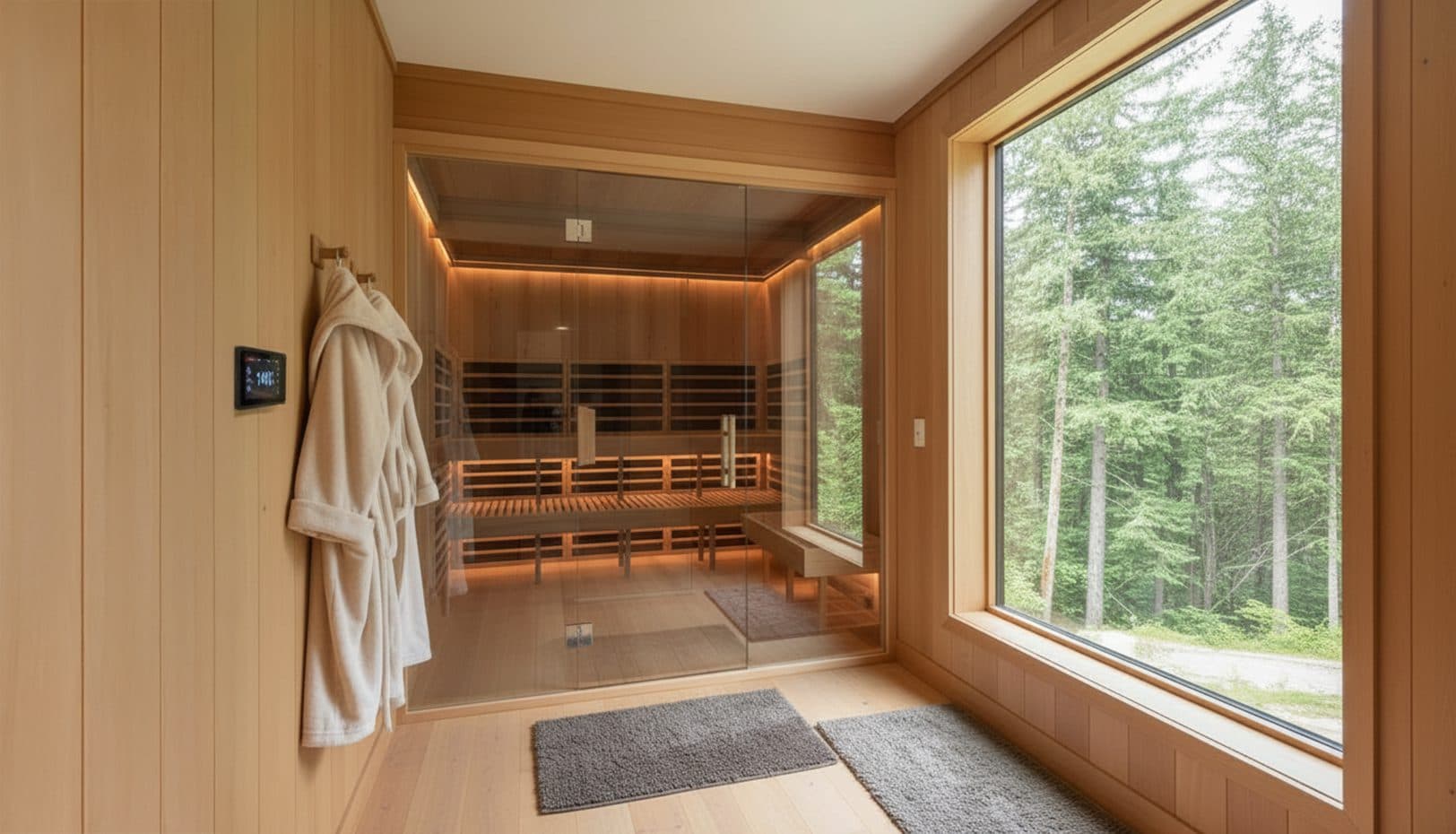
Infrared saunas work from a completely different angle. Instead of heating the air, they use infrared panels that warm your body directly, the same way sunlight warms you on a cool day. Because you're being heated directly, the air can stay much cooler, typically 120-150°F. No steam. No dramatic wall of heat hitting your skin. Just a steady, penetrating warmth.
That difference changes everything about how you sweat. A traditional sauna cooks you from the outside with scorching air, which triggers a fast, dramatic sweat response. An infrared sauna warms your body from within, so sweat comes on more gradually, often taking 10-15 minutes to really build. The air around you stays comfortable, so your body doesn't panic-sweat the way it might in a blast of 180°F air.
That's also why heater quality matters so much in an infrared sauna. At SaunaCloud, we build ours with VantaWave heating panels engineered for even distribution, because if the heat isn't consistent, some body areas run hotter than others and your session feels uneven. Good panels mean even, comfortable heating. And if you're coming from the traditional world, the difference in how it feels takes a session or two to get used to. For a backyard setup, the Backyard Discovery line offers a practical way to enjoy that even infrared warmth outdoors.
Sweat Volume: How Much Do You Actually Sweat?
Here's the honest answer to the headline question: you typically sweat less in an infrared sauna than in a traditional one, but over a full session, the total can end up surprisingly similar.
Traditional sauna sessions are short and intense: usually 10-20 minutes of heavy, rapid sweating in 150-194°F air. Infrared sessions run longer, typically 30-45 minutes, at a lower temperature. That longer session is the key. You might sweat at a gentler rate, but you're sweating for two to three times as long. A 15-minute traditional blast and a 40-minute infrared session can produce roughly comparable total sweat.
One important caveat: nobody has published a head-to-head study measuring exact sweat volume between the two types. What we have are temperature ranges, session lengths, and direct-body-heating research, which point to that "comparable total" conclusion, but it's an estimate, not a lab-measured number.
What to expect from each type
| Traditional sauna | Infrared sauna | |
|---|---|---|
| Air temperature | 150-194°F (65-90°C) | 120-150°F (49-65°C) |
| Typical session | 10-20 minutes | 30-45 minutes |
| Onset of sweat | Fast, often within minutes | Gradual, often 10-15 min in |
| Intensity | Dramatic, heavy | Steady, moderate |
| Steam ritual | Optional (löyly) | No |
Why infrared feels so different
There's a reason infrared sessions feel almost underwhelming at first: the air around you isn't hot. In a traditional sauna, 180°F air blasts you from all sides, so your body sweats to cool your skin. In an infrared sauna, you're being warmed from within while the air stays comfortable, so your body doesn't need to dump heat as aggressively. The sweat that comes tends to be steadier and less dramatic. That's not a broken sauna; that's the design working as intended.
If you're finding the opposite, that you sweat a lot in your infrared sauna, that's common too. Some people run naturally hot or have a more sensitive thermoregulatory response. It's not a sign you're doing anything wrong, but if you want to understand the mechanics, that's where do infrared saunas make you sweat comes in, it's a definitive guide to exactly how infrared heat induces sweating and how that sweat differs from a traditional steam sauna.
Less Intense ≠ Less Effective
Here's the part that surprises most people: sweating less doesn't mean your session did less. Your body's cardiovascular and thermoregulatory responses are driven by a rise in core temperature, not by how much your skin happens to be dripping.
In an infrared sauna, the direct heat raises your core temperature over 30-45 minutes, which elevates your heart rate in a way researchers have compared to moderate exercise. You're getting a genuine aerobic stimulus, it just arrives more gently than the shock of sitting in a 190°F room. One thing that often gets overlooked about infrared saunas is how much water you drink, since a single 30-40 minute session produces 300-600ml (10-20oz) of sweat, and intense sessions can hit 800-1000ml, so hydration is key. Read more about the fluid balance implications.
That said, the research is honest about the intensity difference. Chris Minson, PhD, a researcher at the University of Oregon who studies heat and cardiovascular health, has been direct about this: "The bottom line is that the far-infrared sauna, by far, showed the least [noticeable] rise in core body temperature, and therefore had the least cardiovascular impact." And on the claims about far-infrared penetrating deep into muscle: "We just published a study where we placed a participant in a far-infrared sauna and observed that the heating or stimulus of far infrared didn't go as deep into muscles as they claim it does."
So the real picture is balanced: infrared saunas deliver meaningful cardiovascular and muscle-relaxation benefits, but with a gentler stimulus than a traditional sauna. If your goal is maximum cardiovascular intensity, traditional wins. If your goal is a sustainable daily habit that you'll actually stick with, which is arguably the more important factor, infrared's lower intensity is a feature, not a bug. Researchers like Minson make exactly that point: the best sauna might just be the one you'll use regularly.
Why You Might Not Sweat in an Infrared Sauna
If you're sitting in an infrared sauna and barely sweating at all, there's almost always a fixable reason. The most common cause is simply that you're not giving it enough time, many people end their infrared sessions right around the 10-15 minute mark, which is exactly when the sweat response is just getting started.
Beyond that, the usual culprits are:
- The temperature is too low for your comfort. Your sauna should be in the 120-150°F range. If it's running at the low end and you're not feeling much heat, nudge it up.
- You're not showing enough skin. Infrared heats the body directly, so clothing literally blocks the signal. More skin exposed means a more effective session. Sports clothes might be fine for a traditional sauna; for infrared, you want as much coverage off as possible.
- You're not hydrated enough to sweat. This sounds counterintuitive, but if you're dehydrated, your body is conserving fluid, sweating less is a survival response. Drink water before your session, not just after.
- Your session is too short. Give it 30-45 minutes. The first third of the session is warm-up; the sweat typically builds in the second half.
- The sauna may not be heating properly. If the panels feel unevenly warm or the room never approaches 120°F, you may have a malfunction.
With time, consistent use actually makes this easier. Regular sauna use helps your body acclimatize, and frequent users often find they start sweating faster and more heavily than they did in their first few sessions, your body learns to anticipate the heat and starts its cooling response earlier. If you're coming from a traditional sauna, give infrared a few visits before judging it.
Detoxification: The Honest Answer
Short answer: sweating does support detoxification, but not nearly as dramatically as most marketing claims. Your body's primary detox pathways are your liver and kidneys, sweating is a supporting player, not the main event.
Sweat is mostly water and electrolytes, along with trace amounts of other substances. Studies have detected some environmental compounds and heavy metals in human sweat, which is why some clinicians use sauna therapy (often called "whole-body hyperthermia" protocols) for patients with certain toxicant exposures. So yes, you're excreting some things through sweat. But the amounts are small, and it's not a substitute for a healthy liver and functioning kidneys doing their daily work.
Some practitioners of whole-body hyperthermia argue infrared is particularly good at mobilizing these compounds, the 60-65°C temperatures, the direct heating, the longer session times. That's a widely repeated claim, but it's a clinical assertion, not settled science with strong research behind it. Clinicians like Klinghardt, Dr. Sam Setareh, and Dr. Casey Kelley point to infrared's role in mobilizing compounds, but they frame it as a clinical assertion rather than settled science. What toxins do infrared saunas remove through sweat digs into exactly what the evidence does and doesn't support.
The useful, evidence-based framing: sauna use of either type supports detox primarily by raising your core temperature, increasing circulation, and promoting the kind of deep sweating that carries small amounts of compounds out through your skin. It deserves a place in a healthy routine. It doesn't deserve to be sold as a detox miracle.
Health Benefits: What the Research Actually Shows
The research behind the two sauna types is not equal in volume or maturity, and that distinction matters if you're choosing a sauna partly for health outcomes.
The traditional sauna evidence
Traditional Finnish-style saunas have the strongest long-term research behind them, and the anchor is the landmark 2015 JAMA Internal Medicine study (Laukkanen et al. 2017). Researchers followed 2,327 Finnish men for 20 years, and the data showed that individuals who used a sauna 4-7 times per week had a 40% lower risk of all-cause mortality and a 50% lower risk of fatal cardiovascular events compared with those who used one once a week or less.
A 2018 review in Mayo Clinic Proceedings (Kunutsor et al.) reinforced the pattern, finding associations between regular sauna use and better cardiovascular outcomes, lower blood pressure, reduced risk of respiratory conditions, and even lower dementia risk. Janssen et al. (2016) also found that sauna use was linked to improved vascular function, and a JAMA Psychiatry study suggested a potential protective effect against psychosis.
One honest caveat: the study population was middle-aged Finnish men (average age 53) using saunas at around 174°F and who were physically active at baseline. That's a very specific group. The findings are impressive, but they don't guarantee identical results for everyone.
The infrared sauna evidence
Infrared research is more recent, smaller in scale, and still growing. The most cited work includes:
- Imamura et al. 2001 (Journal of the American College of Cardiology): found improved blood vessel function in people with heart disease after infrared sauna sessions.
- Miyamoto et al. 2005 (Journal of Cardiac Failure): reported improved symptoms in heart failure patients using far-infrared saunas at 60°C (140°F) sessions.
Those are promising early signals, and the body of evidence on infrared, for chronic pain, blood pressure, and recovery, is expanding. A 2017 meta-analysis by Zaccardi et al. found that sauna bathing was associated with a lower risk of cardiovascular events, adding to the picture. Similarly, Källström et al. reported improvements in blood pressure and arterial stiffness after infrared sauna sessions. But it's nowhere near the scale or duration of the Finnish research.
If you're choosing based purely on research maturity, traditional wins. If you're choosing based on which one you'll realistically use three times a week, the answer is the one you enjoy.
Practical Considerations: The Downside of Infrared
From a practical standpoint, there's a real tradeoff between the two types, and the downside of an infrared sauna depends on where you install it.
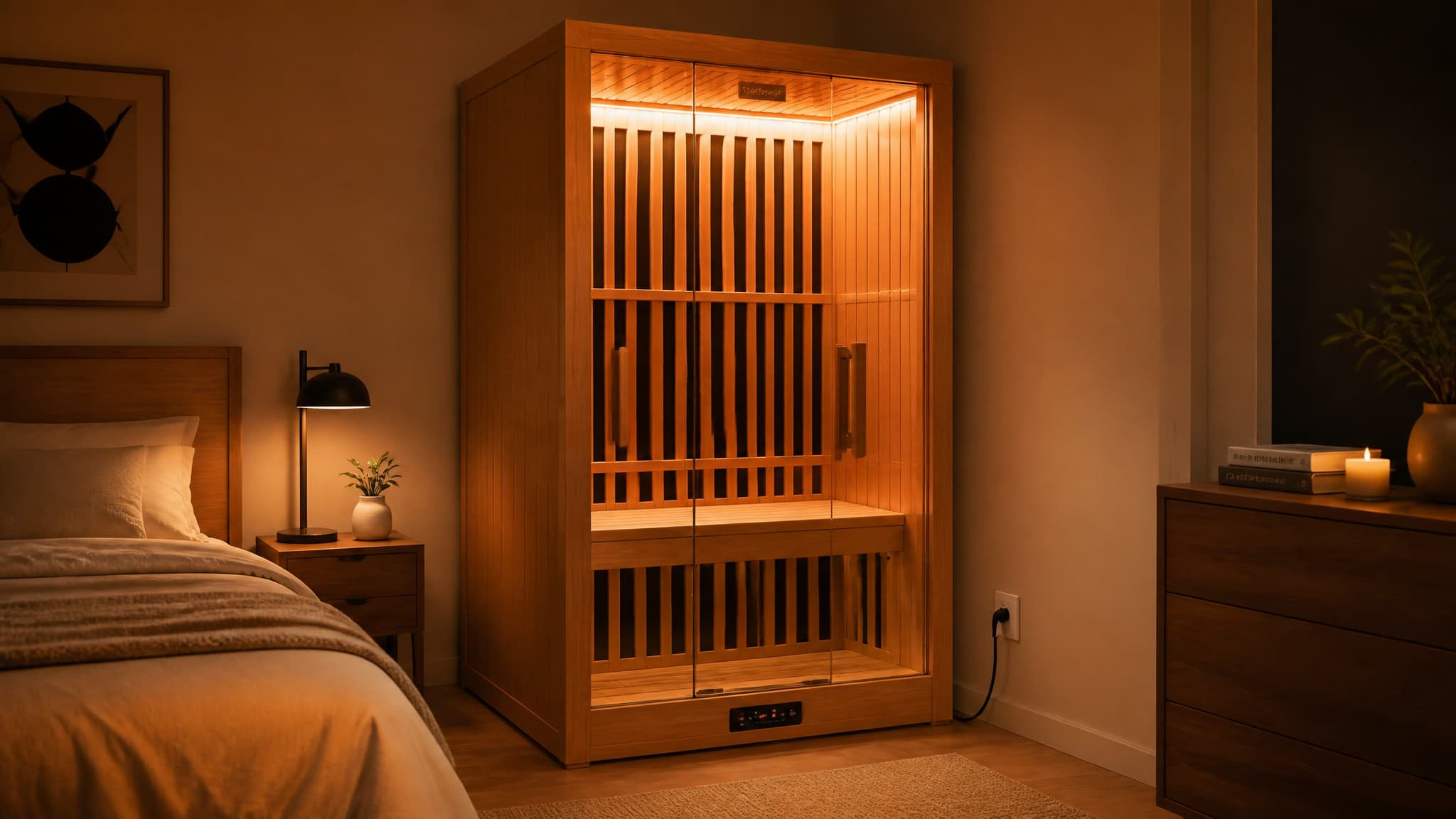
Infrared saunas are easier to set up. Most of them plug into a standard 120V outlet, so you can put one in a bedroom, a spare room, or a corner of the basement without electrical work. They're typically indoor units, from compact 1-person designs to roomy 4-person models. They also heat up fast, most reach temperature in 10-15 minutes, which makes them genuinely easy to use daily.
The tradeoff is that they don't deliver the dramatic, multisensory heat-and-steam experience of a traditional sauna. If you love the intense blast of hot air and the löyly ritual, an infrared unit won't replicate it.
Traditional saunas are the opposite. They need a 240V electrical circuit and often professional installation, plus a ventilated space. They also take longer to heat, typically 40-60 minutes with a standard 6kW heater, which means you're planning sessions an hour in advance. (A more powerful heater, like the 9kW option we build into some of our units, cuts that preheat time roughly in half.) They cost more to operate, roughly $15-30 per month in electricity versus around $5-10 for infrared, and they need more care: managing the stove, monitoring humidity, maintaining the wood.
So the honest "downside of infrared" is this: you trade the intensity and ritual of a traditional sauna for convenience, lower cost, and gentler daily use. For most people, that's a good trade. For purists, it's not.
Dry Sauna Sweating: Yes, You Still Sweat
One common misconception: "It's a dry sauna, so am I even supposed to sweat?" Yes, absolutely.
"Dry" is about the humidity, not the heat. A dry sauna is simply one where the air is low-humidity, as opposed to a steam room which is high-humidity. Infrared and traditional Finnish saunas are typically dry in this sense. You're supposed to sweat in both; your body's cooling system doesn't care whether the air around you is 180°F or 140°F. It cares about your core temperature rising, and both accomplish that.
The reason it might feel like you're not sweating in a dry infrared sauna is that the heat isn't blasting your skin, so the sweat evaporates quickly into the dry air. In a traditional sauna, the intense ambient heat keeps your skin hot and wet. A steady trickle that evaporates on contact can feel like "nothing," when it's actually a solid physiological response.
Which Sauna Is Right for You?
Once you filter out the hype, the decision comes down to five questions:
- What do you actually enjoy? If you love intense heat, the roar of hot stones, and the ritual of pouring water on the rocks, a traditional sauna will never be matched by infrared. If you prefer a calmer, steady warmth you can relax into, infrared fits better.
- How long are your sessions? If you have 45 minutes to commit, infrared's longer, steadier sessions work. If you want maximum intensity in 15 minutes, traditional delivers.
- Who's the sauna for? If it's just you and you'll use it after work or first thing in the morning, infrared's fast heat-up and 120V plug-in convenience is hard to beat. If it's a family or a dedicated space, traditional.
- Is this a daily habit or a weekly ritual? Infrared is easier to use daily because it's convenient. Traditional saunas are more often a deliberate, once-or-twice-a-week event, which is fine, but consistency is what drives health benefits.
- What does your space allow? No 240V circuit? No outdoor or vented space? Then traditional may not even be an option, and that's fine. A well-built infrared sauna is a legitimate choice.
One thing that matters more than type: build quality. A sauna is a significant investment, and the quality of the construction determines whether you're still happy with it three years from now. For infrared, look for thick walls (real insulation, not glorified closet panels), tempered glass, and full-body heating panels, make sure the panels actually cover your whole body, including the floor, not just a couple of sections. At SaunaCloud, we use 8-11 panels including a dedicated floor heater because full-body coverage is what makes infrared sessions effective.
Sweat Less, Worry Less
Here's the summary you came for: you sweat less in an infrared sauna than in a traditional one, at least, at any given moment. But because infrared sessions run two to three times as long, and because the health benefits come from raising your core temperature (not from how dramatic your sweat looks), a quieter sweat doesn't mean a wasted session.
The research is clear that traditional saunas have the strongest evidence. The emerging research suggests infrared produces many of the same responses, at gentler intensity, with far more convenience. And the honest expert consensus, from researchers like Chris Minson at the University of Oregon, is simply this: the best sauna to use is the one that is available to you.
So if you own an infrared sauna, sit back, expose some skin, give it a full 30-45 minutes, and stop comparing your sweat output to someone else's traditional-sauna session. Your body is doing the work. Trust it.
Frequently Asked Questions
Why don't I sweat much in an infrared sauna?
Infrared saunas heat your body directly instead of blasting the air around you, so your skin stays cooler and sweat evaporates quickly into the dry air. This can make it feel like you're sweating less than you actually are. Sweat typically takes 10-15 minutes to really build up in an infrared session, so shorter sessions may not trigger much visible sweating.
How long should you sit in an infrared sauna to sweat?
Sweat generally takes 10-15 minutes to really build in an infrared sauna, and full sessions typically run 30-45 minutes. Because infrared heats your body directly at lower air temperatures, the sweat response comes on more gradually than in a traditional sauna, where intense sweating starts within 10-20 minutes in 150-194°F air.
Is a traditional sauna better than an infrared sauna for health benefits?
Traditional saunas have more and longer-term research behind them, including large studies on cardiovascular outcomes in Finnish men. Infrared research exists and shows benefits for blood pressure, vascular function, and heart failure symptoms, but on a smaller scale. The most important factor is which type you'll use consistently, since regular use is what drives health benefits.
Can you use an infrared sauna indoors without special electrical work?
Yes, most infrared saunas plug into a standard 120V outlet, which is one of their main advantages. You can set one up in a bedroom, spare room, or basement corner without electrical work. Traditional saunas typically require more infrastructure, including higher-voltage electrical service and proper ventilation.

Founder & Lead Designer, SaunaCloud®
SaunaCloud: 3,000+ installations since 2014 · Author of The Definitive Guide to Infrared Saunas · Featured in Forbes, Inc., and MSN
Christopher designs every SaunaCloud sauna. His work brings the room, heaters, controls and installation plans together so you can review the project before committing. His professional expertise is sauna design and construction, not clinical medicine.
Custom 3D renderings and a proposal in 24-48 hours.
Continue Reading
Ready to Design Your Sauna?
Every project starts with a conversation. Tell us about your space and we'll create your custom plan — free, no obligation.
Custom 3D renderings and a proposal in 24-48 hours.