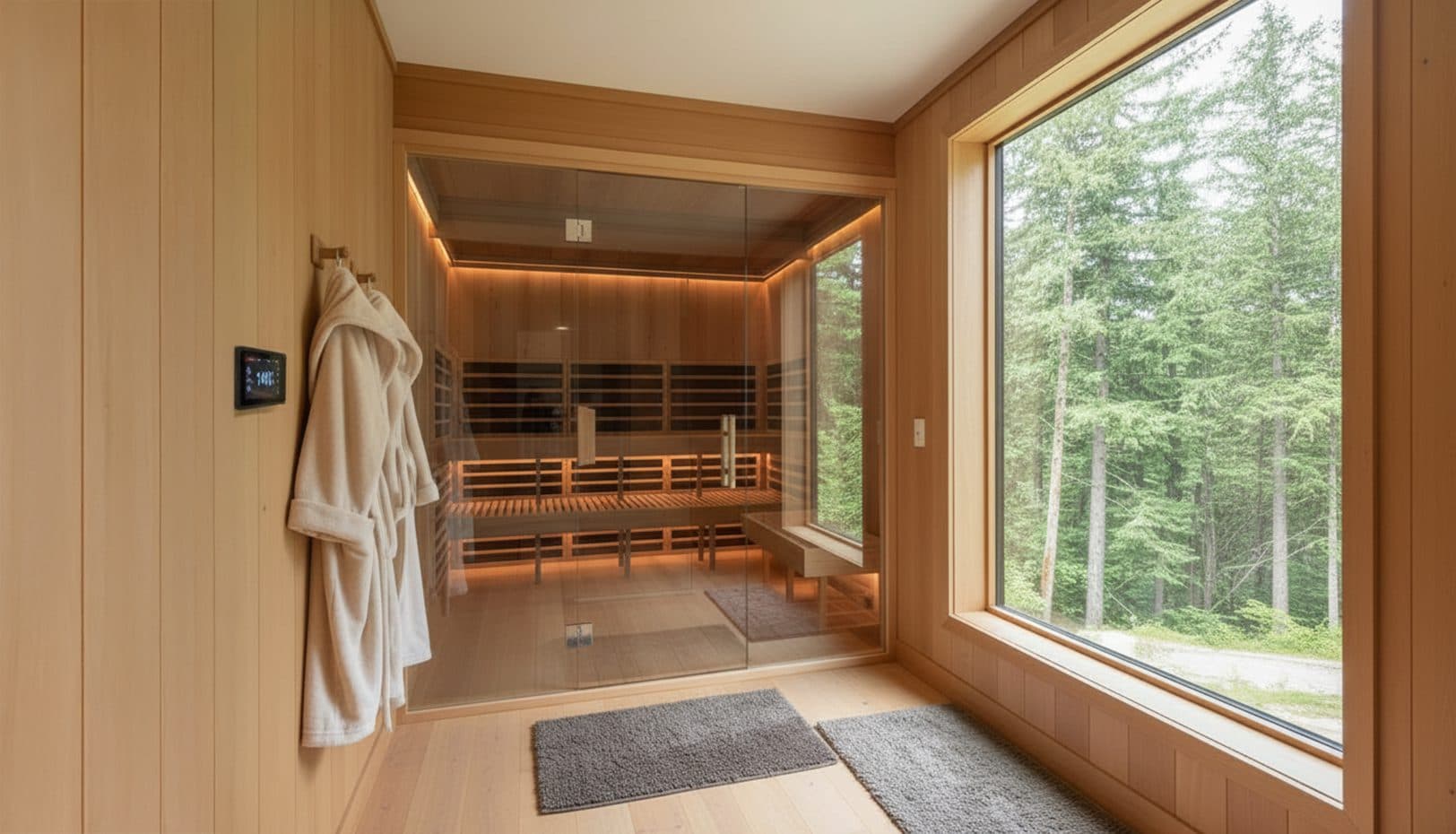
Do Infrared Saunas Make You Sweat? Yes—Here's the Science
Key Takeaways
- Infrared saunas heat your body directly with far-infrared wavelengths instead of warming the air, so you sweat at a cooler room temperature (110 to 140°F) than in a traditional sauna (150 to 195°F), and sweating usually starts around the 10 to 15 minute mark.
- Sweating lightly, or not at all, during a first session is common and doesn't mean the session failed; hydration, heat acclimation, and individual physiology all shape how fast and how heavily you sweat.
- The evidence-backed value of an infrared session is cardiovascular and relaxation response, similar to a moderate walk, while meaningful detoxification and deep muscle penetration claims remain unsupported.
In This Article
You're twenty minutes in, the timer's counting down, and you keep glancing at your forearm like it owes you an explanation. In a traditional sauna you'd be dripping by now. Instead there's a light sheen, maybe nothing at all, and one question taking up all the space: do infrared saunas make you sweat, and if they don't, what exactly is this doing?
It's the worry we hear most often from people trying infrared for the first time. Sweat is the only visible proof a sauna is "working," so when it doesn't show up on schedule, the whole session starts to feel like a dud. The short answer is yes, infrared saunas absolutely make you sweat. The longer answer is that they get you there differently, which means the sweat often shows up later, looks less dramatic, and doesn't come for everyone at the same intensity. None of that means it isn't working.
Yes, infrared saunas make you sweat
Yes. Plainly and reliably, infrared saunas make you sweat, and the reason is the same one that makes any sauna work: your body sweats to cool itself once its core temperature climbs.
The surprise comes from how that heat gets in. When you sit in a traditional sauna, hot air surrounds you first, then your skin, then your core. An infrared sauna skips the air entirely. The Mayo Clinic describes it as heating your body directly without warming the air around you, using far-infrared wavelengths that land on your skin and raise your internal temperature. Since core temperature is what drives sweat production, not the ambient temperature of the room, you end up sweating even when the space itself feels modestly warm.
Infrared units typically run at 110 to 140°F, compared to 150 to 195°F for a traditional sauna, which is why it can feel like a completely different experience. Part of the profuse sweat in a traditional room is a direct response to the hot air itself. Infrared doesn't have that working for it, so the sweat is less dramatic even when everything is functioning exactly as intended.
Infrared sauna heat: direct to the body, not the air
If you want to understand how an infrared sauna makes you sweat compared to a traditional one, a single difference explains everything: infrared saunas heat your body directly, and traditional saunas heat the air. Every other difference follows from there.
How infrared heats you differently
A traditional sauna pushes the air in the room to 150 to 195°F, and that hot air heats your skin from the outside in. An infrared sauna uses far-infrared wavelengths that land on your body while the surrounding air stays at a much cooler 110 to 140°F. The wavelength does the work that hot air does in a traditional setup.
The physical response is closer to mild exertion than to sitting in extreme heat. Mayo Clinic describes infrared exposure as producing effects similar to a moderate-paced walk, with a raised heart rate and increased blood flow. That's a helpful frame: you're not supposed to feel like you're cooking. You're supposed to feel like you've been moving steadily.
Why the lower temperature still works
What matters isn't the thermostat readout but the wavelength reaching your body. Far-infrared light penetrates your skin and raises your core temperature enough to trigger the sweat response, which is why the room can feel cooler than a traditional sauna while the machinery of sweating still kicks in. Core temperature typically climbs 2 to 3°F over a session, and that's the number that matters.
There's a non-obvious catch worth knowing: theoretically, cranking an infrared unit's temperature higher can push the wavelength out of the ideal far-infrared range, reducing the benefit rather than adding to it. More isn't always more, even when your instinct says otherwise.
And one quick clarification, because people mix these up all the time: an infrared sauna is not red light therapy. They're different parts of the light spectrum and entirely different devices, even if the marketing sometimes blurs the line.
Why some people sweat less in an infrared sauna
Because the air around you is cooler, the sweat often takes longer to show up, and for some people it barely shows up at all. That's normal, and it's not a sign the session failed.
A light sheen can still be a working session
Sweating less in an infrared sauna than you would in a traditional one usually comes down to the direct-heat mechanism. Without hot air pressing on your skin, your body has less immediate reason to produce a dramatic, visible sweat, but it's still doing the work. Core temperature still rises the same 2 to 3°F, and once it does, your body starts cooling itself the only way it knows how.
The tell that it's working anyway is a damp, sticky film on your skin, even without visible beads of sweat. That film is the heat response happening. Individual variables matter a lot here: hydration status, how acclimated you are to heat, body size, age, muscle mass, fitness level, and any medications that affect sweating or blood pressure all shift when and how much you sweat. A well-hydrated person often starts sweating within ten minutes; others take fifteen to twenty, and some need a few sessions before their body learns the environment.
At the other end, a few people sweat heavily even in the cooler air, because the direct heat on the body triggers a strong response. Both reactions fall well within normal range, though how much do you sweat in an infrared sauna depends on those same factors.
Session length and timing: when the sweat starts
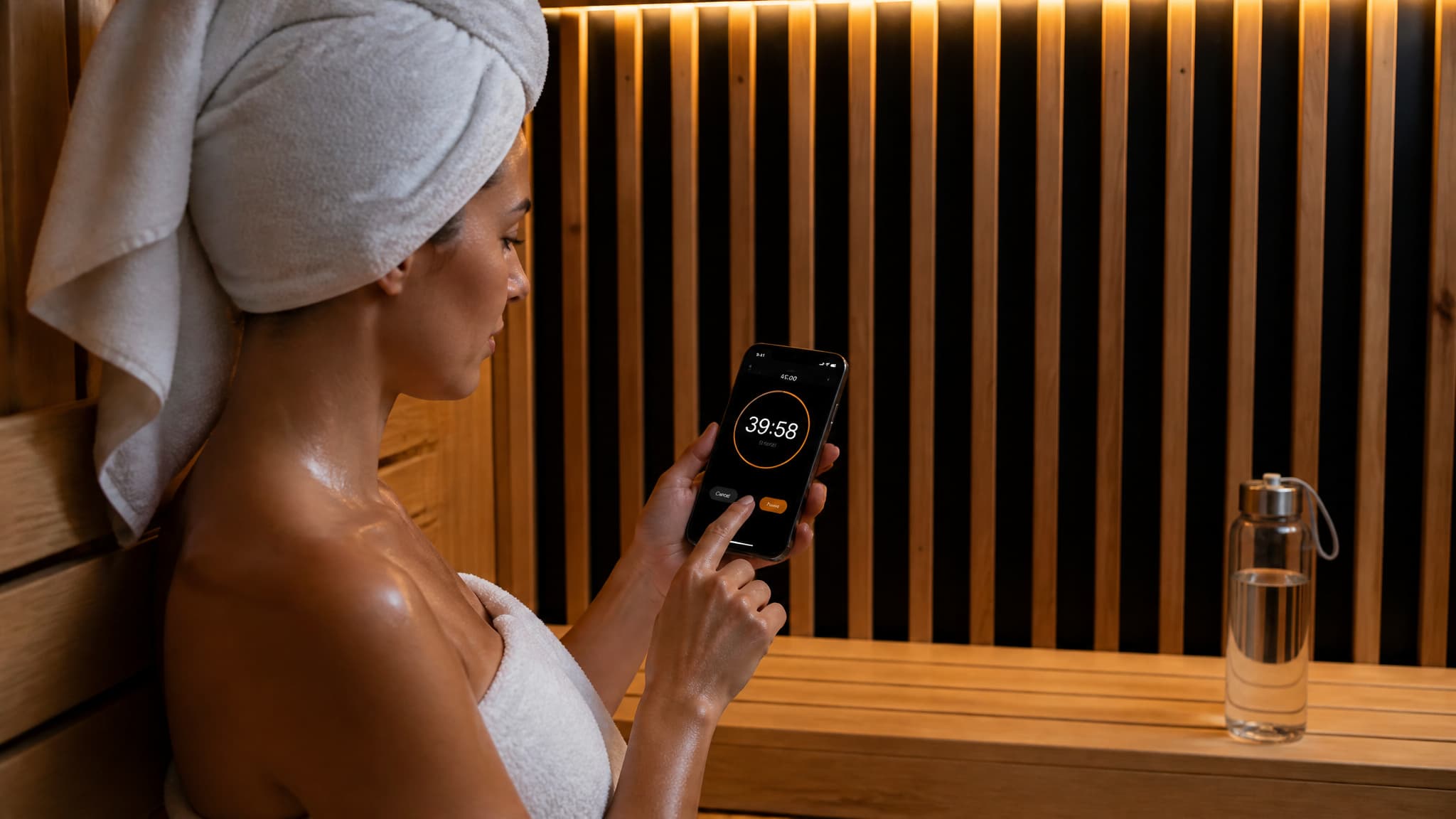
Plan on a well-hydrated person starting to sweat within about 10 to 15 minutes as core temperature comes up, and don't judge the first few minutes of a session. The outcome is largely decided before you step in, because preparation is what lets the heat penetrate in the first place.
Prepare your body before you step in
Light exercise beforehand makes a real difference. A short yoga routine, some qi gong, or a slow jog dilates your blood vessels, so the heat reaches your core more effectively once you're inside. Hydrate before you enter rather than waiting until you're thirsty. Wear as little as makes sense, a towel or swimsuit, to maximize skin exposure. And if your hair matters to you, wrap it in a damp towel to protect it from the dry heat.
How long to stay
Start short and build up. Exercise physiologist Rachelle Reed, PhD, advises beginners to increase your heat tolerance gradually, beginning with five to 10 minutes per session. The cap for a beginner session is 20 minutes, and a realistic total commitment, including cooldown and rehydration, runs 30 to 45 minutes. For people who use a sauna regularly, two to four sessions a week of 10 to 20 minutes is a sensible cadence. We've mapped out the typical timelines for getting to that first sweat if you want the fuller picture.
Home units run from one-person to eight-person capacity, but the timing advice stays the same regardless of size.
What your sweat actually contains, and the detox question
No, sweating in an infrared sauna is not a meaningful way to detoxify your body, at least not based on the evidence we have. Here's the honest breakdown of what you're actually losing and why the detox framing oversells it.
Sweat is mostly water and electrolytes
The overwhelming majority of what you sweat away is water and salt. That's the whole reason rehydration matters more than any talk of flushing or releasing: you're losing fluids and electrolytes, and replacing them is the job, before, during, and after the session.
The detox claim is the weakest link
Trace amounts of heavy metals like arsenic, cadmium, lead, and mercury, along with chemicals like BPA and phthalates, can appear in sweat, sometimes at higher concentrations than in blood or urine. That sounds dramatic, and it's a favorite of sauna marketing. But the evidence that infrared saunas produce clinically meaningful detoxification is preliminary and inconclusive. Mayo Clinic's position is that larger, more exact studies are needed before firm conclusions can be drawn. We've dug into what's actually in your sweat and what the toxin claims get wrong separately.
The honest reframe keeps the value where the evidence is: your cardiovascular system and your relaxation response are getting the workout, not some imagined toxin-extraction pipeline.
Health benefits: what research supports vs what's hype
The supported benefits are cardiovascular and relaxation effects, similar to moderate exercise, while recovery, skin, and chronic-condition claims are still preliminary. Treat them that way and you'll have an accurate picture of what the machine is actually doing.
Established: cardiovascular response and relaxation
Infrared exposure raises your heart rate and boosts blood flow in a way researchers compare to moderate-paced walking. It promotes relaxation, and it may temporarily lower blood pressure. Reed notes that people dealing with muscle soreness, or anyone looking for a cardiovascular benefit, could see a positive impact from regular use. That's the closest thing the research gives us to a rock-solid claim.
Promising but preliminary: recovery, skin, and chronic conditions
A longer list of conditions has been studied but not conclusively proven: high blood pressure, heart failure, dementia and Alzheimer's, headache, type 2 diabetes, and arthritis. Infrared may increase blood flow to the dermis, the second layer of skin, which could potentially affect collagen and elastin. That's a possible skin effect, not a deep-tissue one.
This is the boundary that matters: claims that infrared penetrates deep into muscles lack scientific support. The wavelengths do their work in the skin's layers, not your muscle tissue. And benefits accumulate with consistent use, which is why research focuses on regular sessions rather than single ones. One session isn't the measure; a rhythm is.
As Reed puts it, sauna use is most effective when it's a regular, manageable habit, not an extreme endeavor. We've looked closer at the benefits specifically tied to infrared-induced sweating.
Infrared vs traditional: which you'll sweat more in
You'll sweat more, and faster, in a steam room or traditional sauna, but that doesn't mean infrared is weaker. The two arrive at the same destination through very different weather.
Lower temperature doesn't mean a weaker effect
A steam room's high humidity and heat produce profuse, immediate, visible sweat. Traditional saunas, running at 150 to 195°F in hot and often humid air, do the same. Infrared saunas run dry and cooler, at 110 to 140°F, so the sweat is less obvious and comes on slower. Both types raise your core temperature and induce sweating, with a comparable cardiovascular response.
That dramatic traditional-sauna sweat is partly a reaction to hot, humid air, and it isn't the measure of therapeutic effect. For a true side-by-side of how the two formats differ, here's our direct comparison of infrared and steam sauna sweat.
Who each one suits
The lower, dry heat is what makes infrared the more accessible option for beginners and for anyone who finds traditional sauna temperatures overwhelming. It's often the gentler way to build the habit. (For the record, a "steam room" or "steam sauna" is the high-humidity format, distinct from a "dry sauna.")
Real-world studios like Perspire Sauna Studio and Bull City Soles offer infrared sessions alongside things like massage, Rolfing structural integration, cold plunge, and contrast therapy, which is how many people first encounter the technology. Some people find they like pairing a hot session with a cold one afterward, if that's your sort of thing, but it's an option, not a requirement.
Who should talk to a doctor before using an infrared sauna
If you have a heart condition, you're pregnant, or you take any medication that affects sweating or blood pressure, check with a doctor before using an infrared sauna. The reason is straightforward: sauna exposure creates cardiovascular strain similar to moderate exercise, and that's not a negligible load for certain bodies.
Sports medicine physician Michael Redler is direct about who's at risk. People with unstable cardiac disease, kidney disease, or pregnancy face dehydration risks, he says. He also notes that saunas aren't safe for anyone who's intoxicated, which pairs with the hard rule around alcohol: skip it before and after a session, because it's a diuretic that amplifies dehydration and can raise the risk of cardiac arrhythmia under heat stress.
The reassuring counterbalance is that Mayo Clinic reports no harmful effects for generally healthy users. For most people, common sense and an honest self-check are enough. If you know you have a condition that touches your heart, your blood pressure, or how you sweat, get the green light first. Most healthy adults can use a sauna safely with the same basic precautions you'd apply to any workout: start easy, hydrate, and listen to your body.
Hydration and cooldown: avoiding the post-session crash
Yes, infrared saunas can cause dehydration if you don't hydrate, because any sauna use means fluid loss through sweat. The fix is a protocol, not a scramble afterward.
Hydrate with electrolytes, not just water
Hydrate with water, electrolyte drinks, or coconut water before, during, and after your session, and skip sugary drinks. People who hydrate with plain water alone often feel fine in the sauna, only to crash with a headache or dizziness an hour later. Electrolytes are the part that gets skipped, and they're usually the missing piece. Have a light snack before you go in, something like fruit or yogurt, rather than a heavy meal.
The real sauna risk is standing up too fast
The most common post-session problem isn't overheating, it's orthostatic hypotension, the lightheadedness that comes from blood pooling when you stand too quickly. Your body needs a minute to catch up. Stand up slowly, cool down gradually, and give yourself a transition before you head back to real life. Also wait at least two hours after a heavy meal before a session, and know the signs that mean leave immediately: dizziness, blurred vision, unusual fatigue, fast breathing, headache, fainting, or nausea. If you notice any of those, that's your cue to get out and cool down, not to push through.
The 2,000-year history behind the infrared trend
Infrared saunas aren't a wellness fad that materialized from nowhere. They're the latest delivery system for one of humanity's oldest practices. People have been using heat and sweat for health for roughly 2,000 years, starting with the pit saunas of Stone Age Finland and the sweat houses of ancient Islamic cultures.
The Finnish concept of löyly captures what's really going on: it's the transformative heat and steam ritual at the heart of the whole experience. The core aim has never changed. Raise your core temperature, trigger sweating, get your cardiovascular system moving. The only thing that's new is the delivery mechanism, electromagnetic radiation instead of hot rocks and steam.
So, back to the question that brought you here. Do infrared saunas make you sweat? They do, reliably, even when the mirror doesn't show the dramatic drenching you'd get from a traditional sauna. A session that leaves you with just a light sheen is still doing real work on your heart rate, your blood flow, and your nervous system.
The honest version of the tradeoff is this: infrared gives you genuine cardiovascular and relaxation effects at a temperature your body finds comfortable, while the grander claims about detoxification and deep muscle penetration are marketing running ahead of the science. The fix for the doubt is a solid session protocol, not a stronger sauna. Start short, hydrate with electrolytes, stand up slowly on the way out, and let the benefits build across repeated sessions rather than looking for a single dramatic verdict. Give it a few weeks, check in with how you feel afterward instead of how wet you got, and you'll have your answer.
Frequently Asked Questions
Why do I sweat so much in an infrared sauna?
Your body sweats to cool itself whenever core temperature climbs, and infrared saunas raise core temperature by heating the body directly with far-infrared wavelengths rather than heating the surrounding air. Because the heat lands straight on your skinholistically, some people sweat heavily even at the cooler 110 to 140°F room temperatures. Hydration level, heat acclimation, and individual physiology all influence how quickly and how much you sweat.
What are the negative effects of an infrared sauna?
The main risks are tied to dehydration, cardiovascular strain, and heat intolerance. If you have a heart condition, kidney disease, or pregnancy, you should get medical clearance first. Alcohol is a clear no-go around sessions because it's a diuretic and can raise the risk of arrhythmia under heat stress. For healthy adults, the commonly cited downside is mostly overstated claims, detoxification and deep tissue penetration, not actual physical harm.
How often should you use an infrared sauna for best results?
For general wellness, two to four sessions per week of 10 to 20 minutes each is a reasonable starting point. Beginners should start with shorter sessions, around 5 to 10 minutes each, and increase gradually, with 20 minutes as the early cap. Including cooldown and rehydration, a typical session runs 30 to 45 minutes total.
What temperature does an infrared sauna reach?
Infrared saunas typically run at 110 to 140°F, which is cooler than the 150 to 195°F range of traditional saunas. The lower air temperature doesn't mean less heat for your body, the far-infrared wavelengths raise your internal temperature directly without needing hot air, which is why you sweat at a faster rate than the room temperature would suggest.
Does an infrared sauna burn calories like exercise?
The cardiovascular response in an infrared session is comparable to moderate-paced walking, which means your heart rate and blood flow increase similarly. Researchers compare the effect to moderate exercise, not a replacement for it. It can support a workout routineais but isn't a calorie-torching equivalent to running or strength training by itself.

Founder & Lead Designer, SaunaCloud®
SaunaCloud: 3,000+ installations since 2014 · Author of The Definitive Guide to Infrared Saunas · Featured in Forbes, Inc., and MSN
Christopher designs every SaunaCloud sauna. His work brings the room, heaters, controls and installation plans together so you can review the project before committing. His professional expertise is sauna design and construction, not clinical medicine.
Custom 3D renderings and a proposal in 24-48 hours.
Continue Reading
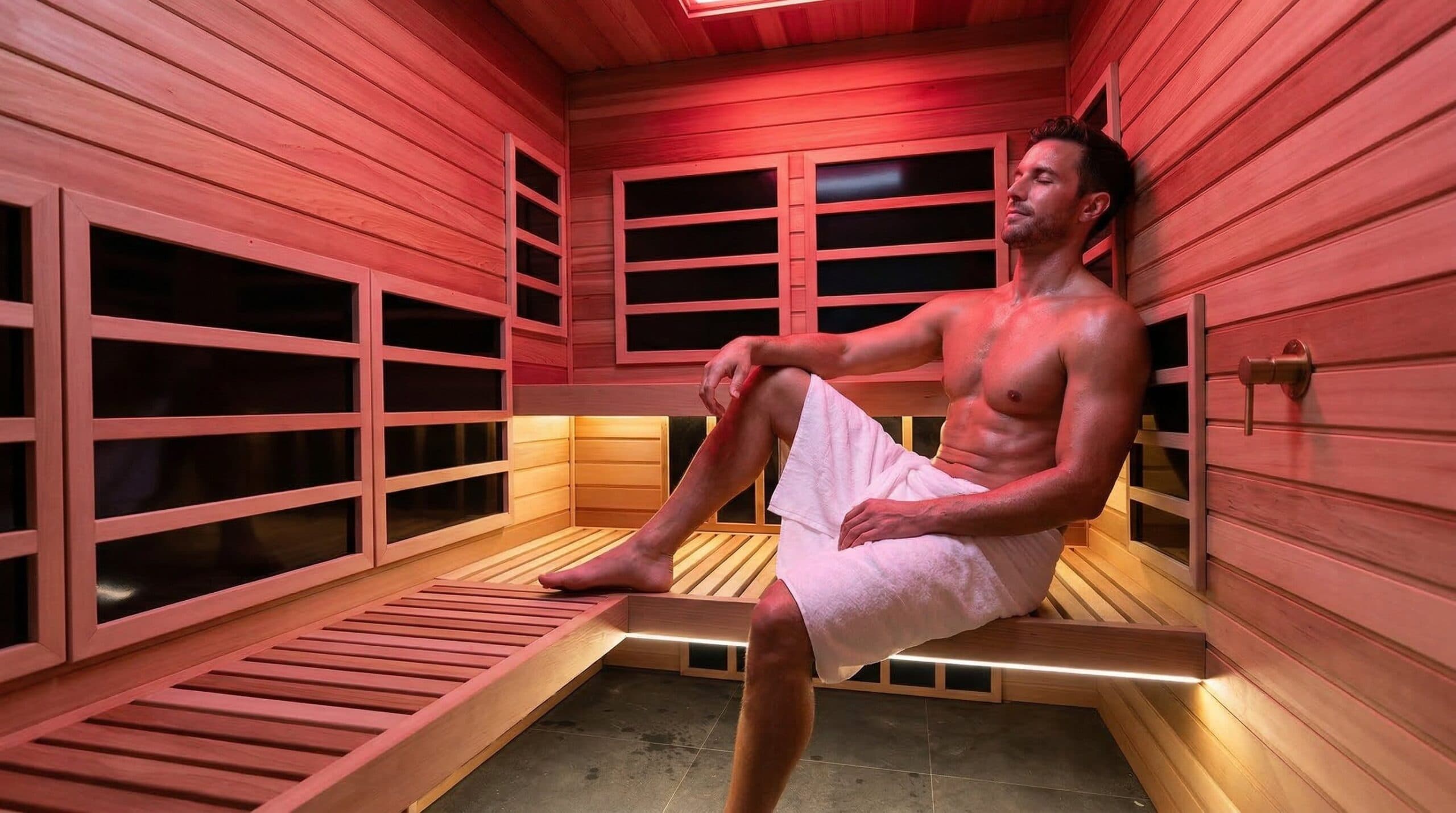
Health
Far Infrared Sauna Therapy for Crohn's Disease: A Review of the Inflammation Science and Clinical Evidence
Read article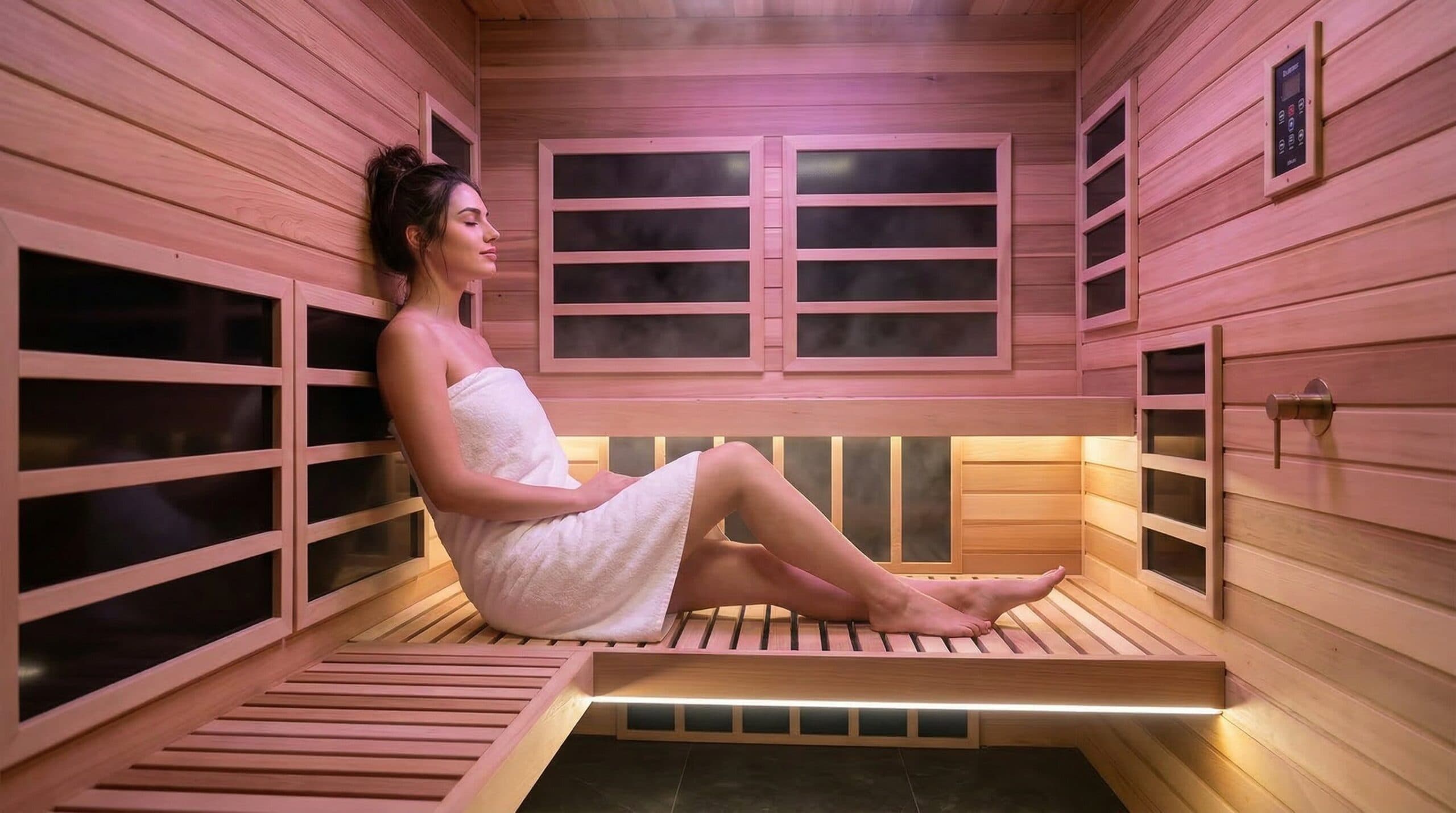
Health
Infrared Sauna Therapy for Fibromyalgia: The Clinical Evidence for 50% Pain Reduction
Read article
Health
Infrared Saunas and Gout: How to Manage Uric Acid, Reduce Flares, and Find Relief Between Attacks
Read articleReady to Design Your Sauna?
Every project starts with a conversation. Tell us about your space and we'll create your custom plan — free, no obligation.
Custom 3D renderings and a proposal in 24-48 hours.