
Who Discovered Infrared Radiation? Herschel's 1800 Prism Experiment
Key Takeaways
- British astronomer William Herschel discovered infrared radiation in February 1800 by splitting sunlight through a glass prism and recording the highest temperature on a blackened-bulb mercury thermometer placed just past the visible red band.
- Glass prisms silently absorb longer infrared wavelengths, which distorted Herschel's map and delayed spectrum unification until Macedonio Melloni's 1830s rock salt prism and thermopile tests, James Clerk Maxwell's 1860s equations, and Heinrich Hertz's 1887 to 1888 wave demonstrations.
- Infrared spans 700 nm to 100,000 nm across near, medium, and far sub-bands, driving thermal imagers, space observatories like the 6.5-meter James Webb Space Telescope, and the direct radiant heat inside an infrared sauna.
In This Article
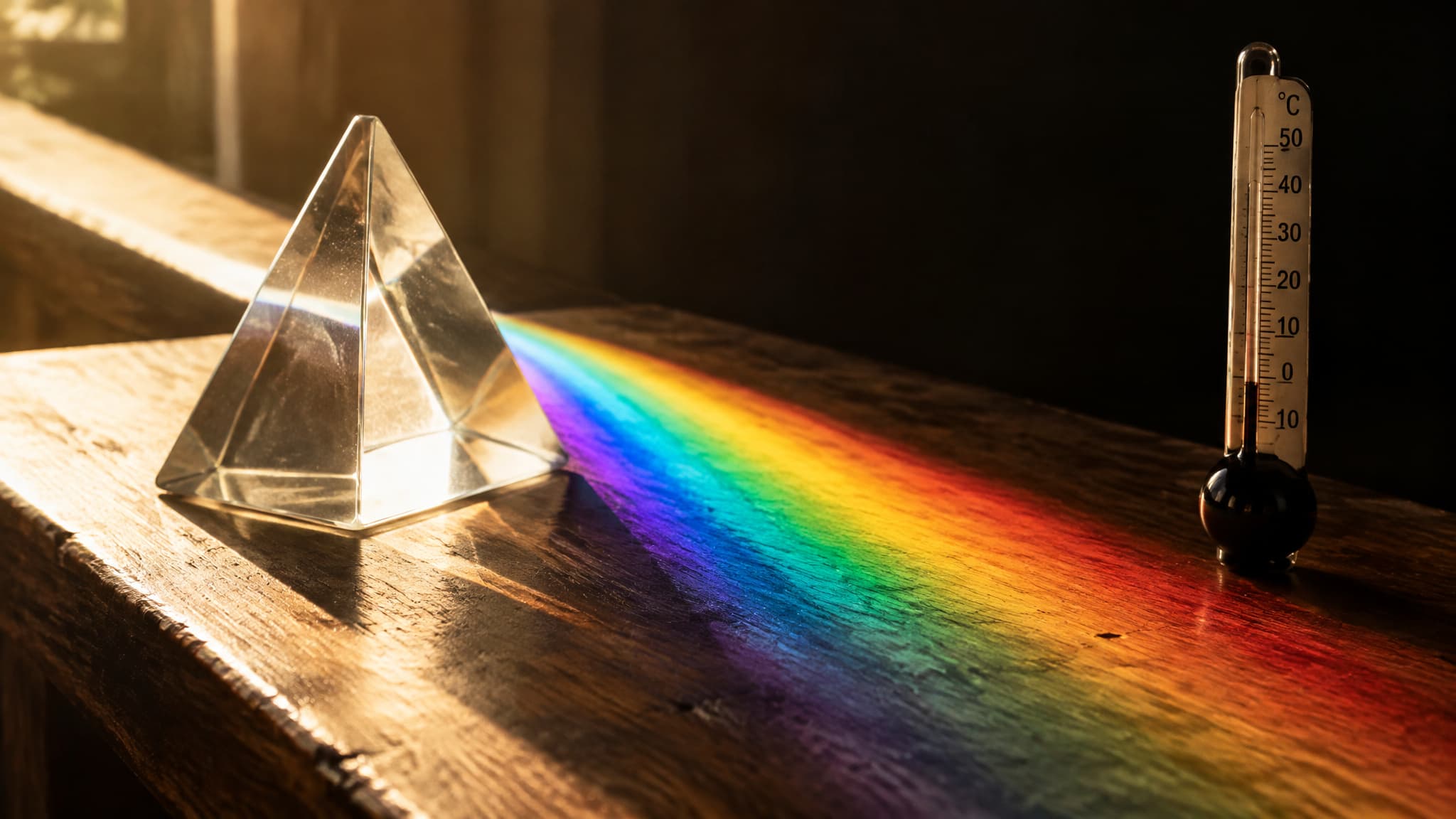
William Herschel is the British astronomer who discovered infrared radiation in February 1800 while studying the Sun, providing the first demonstration of a form of light invisible to the human eye. Before that bench test, sunlight and the visible rainbow appeared to have the exact same boundaries. Passing sunlight through a glass prism, Herschel placed a thermometer in the dark space just beyond the visible red edge and recorded the highest temperature of the entire spectrum.
Herschel sent his paper to the Royal Society in 1800, naming the emissions "calorific rays." He assumed those invisible heating rays were a separate physical phenomenon from light, an initial interpretation that took decades of better optics and electromagnetic theory to correct. Once physicists untangled that hardware bug, Herschel's accidental thermometer reading became the foundation for everything from deep-space thermal telescopes to modern radiant heat cabins.
How Herschel discovered infrared light with a prism and thermometers
William Herschel discovered infrared light by directing sunlight through a glass prism and measuring each color's temperature with blackened-bulb mercury thermometers. To isolate the heating effect of the solar spectrum from room conditions, the setup described by Dave Evans and Science Retold paired three thermometers per color measurement with a control thermometer kept out of the sunlight to track ambient room temperature.
The six-color measurement
The bench workflow was pure maker-grade hygiene for 1800. Herschel blackened the thermometer bulbs so they would absorb radiant heat efficiently, then parked them across the six visible bands in temperature order: violet, blue, green, yellow, orange, and red. As he stepped the sensors across the rainbow, the temperature readings climbed steadily from the violet end toward the red end.
The reading beyond the red edge
Next, Herschel moved a thermometer into the dark strip just past the red edge, where no sunlight was visible at all. That beyond-red sensor registered a higher temperature than any visible color, and he replicated the measurement repeatedly to rule out instrument noise. In modern classroom demonstrations, such as those shown by educator James Lincoln, teachers swap the mercury thermometers for a temperature-sensitive liquid crystal sheet that changes color when warm. Observers watching the sheet usually expect the temperature to drop off smoothly past the red band, which makes the spike in the dark region past the visible edge a surprise.
Why Herschel was measuring sunlight in the first place
Herschel measured heating across the solar spectrum to identify which colors carried the most heat so he could build an effective eye-protection filter for solar observation. As universemagazine.com and Science Retold note, he was studying the Sun and his instruments were getting dangerously hot, while looking at the Sun through a telescope was damaging his eyes. Finding invisible radiation was an accidental byproduct of solving a practical hardware and safety problem on his observing rig.
Who William Herschel was, and why the Royal Society believed him
William Herschel was a German-born British astronomer and musician whose established reputation for building his own telescopes gave the Royal Society the confidence to trust his 1800 invisible-heat readings rather than dismissing them as thermometer error. Born in 1738 in Hanover, Germany, Herschel moved to England in 1757 and worked simultaneously as a professional musician and an obsessive skywatcher.
In 1781, he discovered Uranus, the first new planet found in the modern era, using a telescope he built himself. When a researcher who had already expanded the known Solar System with homemade optics reported anomalous heat sitting in the dark beside the red band of sunlight, the Royal Society took the data seriously.
Calorific rays: the name and interpretation that didn't survive
William Herschel discovered infrared radiation, which he named calorific rays in his 1800 Royal Society paper because he believed they were a separate species of ray distinct from visible light. That early classification helped lock in an 1801 scientific consensus that split solar emissions into three separate zones: heat rays beyond red, visible light in the middle, and chemical rays beyond violet.
Herschel's conclusion wasn't a careless mistake; his own refraction measurements of the calorific rays seemed to confirm they behaved differently from visible light. A year later, in 1801, German researcher Johann Wilhelm Ritter tested the opposite end of the spectrum using paper coated in silver chloride, which darkens when exposed to light. Ritter found that a strip placed past the violet edge darkened faster than the strip sitting inside the violet band. Ritter's "chemical rays" are what we now call ultraviolet light, while the modern name "infrared," meaning "lower than red," replaced Herschel's calorific rays once the separate-species model fell apart.
The glass prism was eating the signal, and Melloni proved it
Early 1800s replications of Herschel's experiment produced inconsistent results for decades because glass absorbs infrared radiation, with absorption increasing at longer wavelengths. Researchers blamed measurement error, prism differences, and room conditions rather than the glass itself, until Italian physicist Macedonio Melloni swapped the optics in the 1830s. Using a rock salt prism that transmits infrared where glass absorbs it, alongside a thermopile co-developed with Leopoldo Nobili that was roughly 40 times more sensitive to radiant heat than a mercury bulb thermometer, Melloni remapped the infrared region as far larger than assumed and proved calorific rays reflect, refract, and polarize like light along a continuous range.
Maxwell, Hertz, and the moment calorific rays became infrared
Scottish physicist James Clerk Maxwell predicted electromagnetic waves traveling at the speed of light in his 1860s equations, and German physicist Heinrich Hertz demonstrated in 1887 to 1888 that long-wavelength electromagnetic waves could be generated and detected in a lab. As the Mr. P. and Science Retold accounts detail, those two milestones converged to prove the spectrum extends past the human eye in both directions.
Once theory caught up with hardware, calorific rays, chemical rays (ultraviolet), visible light, and radio waves slotted into place alongside gamma rays, x-rays, and microwaves as a single phenomenon on the electromagnetic spectrum differing only in wavelength. That continuous-spectrum picture didn't stop at radio: the 1965 discovery of cosmic microwave background radiation, the faint afterglow of the early Universe, required observing wavelengths far longer than infrared but rested on the exact same continuous-spectrum concept Herschel stumbled into.
What infrared is: bands, wavelengths, and why it feels like heat
Infrared radiation is electromagnetic radiation spanning wavelengths from 700 nm, where visible red light ends, out to roughly 100,000 nm, or about 1,000 times longer than red light, with frequency scaling inversely as wavelength increases. By comparison, the visible light our eyes can process occupies a tiny slice from roughly 400 to 700 nm.
The near, medium, and far sub-bands
Hardware engineers split the infrared range into three sub-bands: near-infrared (700 to 1400 nm), medium-infrared (1400 to 30,000 nm), and far-infrared (30,000 to 100,000 nm). Herschel's 1800 prism test only probed the near-infrared, the band his glass prism didn't completely swallow. Near-infrared detectors can use the same photocells as visible light, whereas medium-infrared and far-infrared sensors require active cooling so the detector's own warmth doesn't blind it.
Why every warm object is an infrared source
Every object above absolute zero emits electromagnetic radiation with a peak wavelength set by its temperature, a physical principle unknown in Herschel's time. Because the Sun is superheated, its emission peaks in visible light, whereas a human body at roughly 310 K peaks in the mid-infrared. Heat and infrared radiation aren't the same thing, since heat is thermal energy, but because warm everyday objects radiate in the mid-infrared, our skin registers those invisible light wavelengths as radiant warmth.
Infrared at work: thermal imaging, night vision, and the snakes that got there first
Infrared radiation is used for thermal imaging, remote sensing, and detecting objects that emit heat without visible light. As long as an object sits above absolute zero, its thermal emission lets an infrared sensor spot it in total darkness, whether that target is a warm-blooded animal on a forest floor or a cool star hidden behind interstellar dust.
| System or Organ | Detects Emitted Mid-Infrared Heat | Requires Ambient Light to Image | Works in Complete Darkness | Requires Active Sensor Cooling |
|---|---|---|---|---|
| Thermal Imager | Yes | No | Yes | Yes (for mid- and far-infrared sensors) |
| Conventional Night Vision | No | Yes (amplifies weak visible or near-infrared light) | No | No (uses visible-light-style photocells) |
| Pit Viper Pit Organs | Yes | No | Yes | No |
Thermal imaging versus night vision
Movies love to mash thermal cameras and night-vision goggles into a single glowing green HUD, but the two technologies read different parts of the physics stack. Conventional night vision amplifies weak ambient visible or near-infrared light bouncing off a scene, using the same family of photocells as standard digital cameras. Turn off every photon in a sealed room, and standard night vision goes blind. Thermal imagers ignore reflected light and read the mid-infrared radiation emitted directly by warm bodies.
On a planetary scale, satellites use that same thermal signature for remote sensing of Earth's surface and atmosphere, while astronomers rely on it to locate low-temperature stars and clouds of interstellar dust that remain dark in the visible spectrum. None of these infrared tools required a new invention, only better detectors engineered around the infrared radiation Herschel discovered.
Pit vipers detected infrared first
Human eyes see only a narrow sliver of the electromagnetic spectrum, so we needed mercury thermometers, rock salt prisms, and cooled semiconductor sensor arrays to catch up with biology. Rattlesnakes and other pit vipers evolved specialized pit organs positioned between their eyes and nostrils that act as biological infrared antennas. Those pit organs detect the mid-infrared radiation coming off a ~310 K mammal, giving the snake built-in thermal targeting that lets it strike warm-blooded prey in complete darkness without needing a single photon of visible light.
From one thermometer to orbiting observatories: the infrared astronomy lineage
Infrared telescopes need to operate on high-altitude aircraft or in space because Earth's atmosphere absorbs longer infrared wavelengths, leaving only narrow, separate observing windows from the ground. Near-infrared light is actually delayed less by the atmosphere than visible light, allowing many large ground-based telescopes to observe both visible and near-infrared bands using similar CCD sensors.
Why the atmosphere forces infrared telescopes airborne and spaceborne
Infrared went undetected not because it was absent from sunlight, but because early recording materials could not capture it: the glass quietly absorbed it before it could reach the detector, and early images captured on glass plates or film were sensitive mainly to blue and green colors. Following the radio astronomy boom of the 1950s and 1960s, astronomers pushed into infrared to hunt cold objects like brown dwarfs, orphan planets, and interstellar gas clouds, punch through dense dust, and capture redshifted light from distant galaxies and quasars where intergalactic matter halves visible brightness but infrared sharpens contrast to reveal the early Universe. The human eye cannot detect most of the enormous range of wavelengths, and even with many astronomical instruments already operating in the infrared range, scientists need even more of them.
The airborne era. Galileo, Kuiper, SOFIA
Putting infrared telescopes on planes raised them above the tops of the highest mountains and the worst atmospheric water vapor. NASA's Galileo flying observatory aboard a specially equipped Convair 990 aircraft (1965 to 1973) observed Solar System objects including the Ikeya-Seki comet and Jupiter's moons, the first demonstration that infrared telescopes could work outside the atmosphere.
Galileo's work was continued by the Kuiper Airborne Observatory (1974 to 1995), which discovered Uranus' rings in 1977 and Pluto's atmosphere in 1988. Later, SOFIA, the Stratospheric Observatory for Infrared Astronomy run by NASA and the German Aerospace Center (DLR) from 2010 to 2022, flew a 2.5-meter telescope above 12 km to find water on asteroids and water traces in the Moon's temperate latitudes.
The space era. IRAS to WISE, and the telescopes flying now
Orbit removed the atmospheric filter entirely. In 1983, the Infrared Astronomical Satellite (IRAS) spent 10 months in orbit observing comets and proving the space-telescope concept.
In 1995, the European Space Agency (ESA), with Japanese and American help, launched the Infrared Space Observatory (ISO), an observatory with an operational duration of ~3 years that ran at 1,000 times the sensitivity and 100 times better angular resolution than IRAS to catalog tens of thousands of objects, water in molecular clouds near the Galactic center, intergalactic gas and dust, and protoplanetary disks showing planets can form around old stars. After the U.S. military's Midcourse Space Experiment mapped the galactic plane in 1996, and alongside Japan's AKARI mission (2006 to 2011) finding supernova remnants in the Large and Small Magellanic Clouds, deep-cooled observatories became the standard.
Spitzer (2003 to 2020) used a sunshield and a near-Earth heliocentric trailing orbit to dodge Earth's heat, imaging supernova remnants, protostellar objects, and distant galaxies in false color and becoming the first telescope to see an exoplanet directly before its coolant ran out. ESA's Herschel Space Observatory (2009 to 2013), named for William Herschel, carried a 3.5-meter single-piece main mirror that remains the largest single-piece mirror ever flown in space; the James Webb Space Telescope's 6.5-meter mirror is larger, but segmented. Meanwhile, the Wide-field Infrared Survey Explorer (WISE, launched 2009, mission ended July 2024, de-orbited and burned up November 1, 2024) used a wide field of view to find 365 near-Earth objects, 34 comets, the coldest brown dwarfs (Y dwarfs), and the third and fourth closest star systems to the Sun, while ruling out a Jupiter- or Neptune-sized Planet Nine or wandering brown dwarf near our Solar System.
Three spaceborne infrared observatories operate today: the flagship James Webb Space Telescope, Euclid (operating since 2023 to survey dark matter and dark energy, with 26 million galaxies in its first data release), and SPHEREx (measuring redshifts for 450 million galaxies and studying protoplanetary disks). Next up is the Nancy Grace Roman Space Telescope, a wide-angle survey concept first discussed in early 2010 that entered integration in 2025 with its instrument and platform built and tested ahead of a potential fall 2026 launch window contingent on NASA funding.
The sauna bridge: radiant heat you can feel, and what the history does not claim
No, infrared radiation is not inherently harmful to humans except under intense, unfiltered direct solar exposure like the radiation that cooked Herschel's eyes through his telescope: every object above absolute zero emits electromagnetic radiation with a peak wavelength set by its temperature, and a human body at roughly 310 K naturally emits mostly mid-infrared. Infrared therapy's effectiveness is a medical question the 1800 discovery story cannot answer, making historical physics a solid guide for buyers comparing how sauna heaters transfer warmth, while anyone seeking treatment for specific health conditions or evaluating clinical side effects must look to modern medical trials such as Japan's clinical Waon therapy research, not a 19th-century optical bench.
At SaunaCloud, where we have designed and handcrafted custom cedar infrared saunas in California since 2014 across more than 3,000 installations in private homes, clinics, and wellness centers, we look at Herschel's February 1800 prism-and-thermometer rig as the exact physical foundation every cabin depends on. When you look at how infrared saunas transfer radiant warmth, the cabin is running Herschel's beyond-red thermometer test in reverse:
- Heated emitters generate infrared wavelengths across the invisible spectrum without needing to heat the cabin air to visible-glow temperatures.
- Your body at roughly 310 K absorbs that radiant energy directly, just as Herschel's blackened mercury bulbs absorbed the invisible solar band past the red edge.
- A control thermometer in the room still matters, because efficient radiant transfer warms the person on the bench at lower ambient air temperatures than a traditional steam or rock stove.
We treat infrared emission as a measurable hardware engineering problem, not wellness mysticism. Just as Melloni had to ditch infrared-absorbing glass and upgrade his sensor sensitivity to get a clean signal, we engineer our cabins around proprietary low-EMF VantaWave heaters and integrated red light therapy systems that maximize verifiable radiant heat output while keeping electromagnetic fields low.
Our custom builds hold the #1 spot on Trustpilot at 4.8 stars and an A+ BBB rating. William Herschel didn't foresee home wellness cabins when he parked a thermometer in the dark beside a rainbow in 1800, and his paper doesn't prove clinical health outcomes, but every time you step into an infrared sauna and feel deep heat from an emitter that isn't glowing red, you're experiencing his calorific rays firsthand.
Frequently Asked Questions
What type of radiation did William Herschel discover?
William Herschel discovered infrared radiation in February 1800 while trying to find a safe optical filter for solar observation. In his initial paper for the Royal Society, he called these invisible emissions "calorific rays" because he thought heat-carrying rays and visible light were separate phenomena. Because his glass prism absorbed longer wavelengths, his 1800 bench test actually only detected the near-infrared slice of the spectrum.
How did William Herschel discover infrared light with a prism and thermometer?
Herschel routed sunlight through a glass prism to split it into a rainbow and lined up blackened-bulb mercury thermometers across the six visible color bands, keeping a separate thermometer in the shade as an ambient control. After noticing that temperatures rose steadily from violet to red, he placed a thermometer in the dark space just beyond the red edge. That sensor recorded the highest temperature of all, proving invisible heating rays existed past the visible spectrum.
Where does infrared radiation come from and what are its sources?
Every physical object sitting above absolute zero emits electromagnetic radiation, with its peak wavelength determined by its temperature. Superheated sources like the Sun peak in the visible spectrum while radiating plenty of infrared, whereas cooler everyday sources, like a human body or a mammal at roughly 310 K, peak in the mid-infrared band. In engineered cabins like the custom cedar saunas we have built at SaunaCloud since 2014, heated emitters are tuned to generate those invisible wavelengths directly without needing to glow red-hot.
Is heat infrared radiation, or are they different things?
They are physically distinct: heat is thermal energy, whereas infrared radiation is a band of electromagnetic waves spanning 700 nm to 100,000 nm. People routinely conflate the two because warm everyday objects radiate heavily in the mid-infrared, and human skin absorbs those invisible wavelengths and registers the energy transfer as radiant warmth. That direct radiant absorption is how an infrared sauna warms you on the bench even while the ambient cabin air stays cooler than a traditional steam room.

Founder & Lead Designer, SaunaCloud®
SaunaCloud: 3,000+ installations since 2014 · Author of The Definitive Guide to Infrared Saunas · Featured in Forbes, Inc., and MSN
Christopher designs every SaunaCloud sauna. His work brings the room, heaters, controls and installation plans together so you can review the project before committing. His professional expertise is sauna design and construction, not clinical medicine.
Custom 3D renderings and a proposal in 24-48 hours.
Continue Reading
Technology
Halotherapy and Infrared Saunas: The Honest Truth About Salt Therapy, Salt Panels, and What Actually Works
Read article
Technology
History of the Finnish Sauna: From 7000 B.C. Pits to Modern Culture
Read article
Technology
How Infrared Sauna Works: Why It Heats Your Body, Not the Air
Read articleReady to Design Your Sauna?
Every project starts with a conversation. Tell us about your space and we'll create your custom plan — free, no obligation.
Custom 3D renderings and a proposal in 24-48 hours.