Infrared Sauna Price by Size and Type (1-Person to 4-Person, Far vs Full Spectrum): What Meter Testing Shows at Each Price Tier
Key Takeaways
- Tested home sauna prices span four budget tiers (under $1,000, under $2,000, under $3,500, and $5,000 to $6,000+), with $2,000 to $3,000 acting as the structural floor where verified low EMF, full-body heater layout, solid joinery, and reliable customer service become attainable.
- Most built-in "full spectrum" sauna add-ons use quartz halogen near-infrared emitters peaking around 1600 nm rather than the 660 nm and 850 nm wavelengths used in photobiomodulation studies, making far-infrared-only cabins the core-temperature workhorse and standalone panels the smart route for red light therapy.
- A “low EMF” label tells you less than measurements taken inside an assembled, running cabin. Compare magnetic and electric field readings at the bench, backrest, and lower-body contact points, along with the testing conditions.
In This Article
Two 2-person full-spectrum infrared saunas can sit in the same browser tab and differ by more than $5,000. Across the examples reviewed here, home sauna prices range from roughly $350 for a portable steam kit to $13,000 for a large traditional cabin. Capacity sets the price floor, while heater technology, wood grade, and EMF shielding help explain the spread.
Choosing the right sauna matters because you want something you’ll use regularly. Research has linked regular sauna bathing with cardiovascular benefits and lower mortality, though those associations don’t establish cause and effect or guarantee the same benefits from every sauna type. For a home purchase, comfort, effective heating, and a setup that fits your routine are more useful priorities than a long list of promised health outcomes.
Infrared sauna prices by size and type: the quick-answer matrix
Choosing between a 1-person and 2-person infrared sauna starts with the available floor space and usable bench width. A bench around 43 inches wide can feel tight for two adults, regardless of the capacity on the label. The examples in this guide span roughly $1,500 to $11,600 for two-person infrared cabins, with portable formats below that range and larger or custom builds priced according to their specifications.
Far-infrared-only cabins and full-spectrum models overlap in price, so compare equivalent sizes and construction. Premium far-infrared examples fall around $4,500 to $6,500, while two-person full-spectrum examples range from about $5,000 to more than $10,000.
Price matrix by capacity and heater type
Table note: These rounded planning figures summarize the examples in this guide. They are not live quotes or guarantees of what a particular budget buys. Confirm pricing, dimensions, electrical requirements, and warranty terms before ordering.
| Capacity & Format | Approximate Budget / Format | What to Compare |
|---|---|---|
| 1-Person Portable | Around $350 for a steam tent or $700 for an infrared blanket in the examples reviewed | Steam and infrared are different formats; compare storage, seated or reclining posture, cleaning, and coverage. |
| 1-Person Cabin | Premium far-infrared examples around $4,500; other configurations vary | Usable interior space, heater placement, outlet requirements, and service access. |
| 2-Person Cabin | Roughly $1,500–$6,500 for far-infrared examples; about $5,000–$11,600 for full-spectrum or outdoor infrared examples | Bench width, grounding, heater layout, weather protection, and electrical supply. |
| 3-Person Cabin | Larger full-spectrum examples around $8,500; custom builds priced to specification | Actual seating room, circuit requirements, and whether the extra width suits your routine. |
| 4-Person Cabin / Barrel | Examples around $3,400 for a basic infrared cabin and $8,200 for a traditional barrel | Compare heating formats separately, along with insulation, bench layout, and installation costs. |
| 5–7 Person Cabin | Large traditional examples around $13,000; custom infrared and hybrid builds vary | Room volume, heater sizing, electrical work, access, and maintenance. |
For three or more users, compare the interior layout carefully. A larger capacity label does not tell you whether everyone can sit comfortably or whether the heater placement suits each seat.
The four real cost drivers
Per-seat pricing isn't linear across the four tested budget tiers (Tier 1 under $1,000, Tier 2 under $2,000, Tier 3 under $3,500, and Tier 4 at $5,000 to $6,000). If you're mapping out how much an infrared sauna costs across sizes and build tiers, four structural factors drive the spread:
- Capacity and electrical scale: Stepping beyond 2-person 120V cabins into 3- to 7-person units requires heavier lumber and 220V-240V electrical work.
- Heater technology: Grounded low-EMF panels and concealed under-bench emitters cost far more to manufacture than unshielded carbon sheets.
- Wood grade: Clear cedar and heat-treated thermowood carry a steep material premium over thin, stapled hemlock panels.
- Heater spectrum: Adding near- and mid-infrared emitters pushes 2-person cabins into the $5,000 to $11,600 bracket.
Roughly $2,000 to $3,000 is the structural floor where low EMF, effective heater layout, solid build quality, a real warranty, and responsive customer support become attainable; no sauna under $2,000 clears all five bars.
Far infrared vs full spectrum: what the premium actually buys
Full-spectrum infrared saunas rarely justify their $2,000+ price premium over far-infrared-only cabins because far infrared does the heavy lifting for core temperature and sweat, while most built-in "full spectrum" near-infrared bulbs miss clinical red light wavelengths by nearly 1,000 nanometers. Heater physics and emissivity shift as cabin temperature rises (making static micron marketing claims misleading), and full-spectrum emitters always carry an EMF tradeoff:
- Far infrared (the core-temperature workhorse): Raises core body temperature more effectively than any other home sauna option (and beats steam sauna options), driving the heat-stress response, heat shock proteins, sweat, and detox results in cabins from ~$1,500 to $6,500.
- Mid infrared: Exists as an intermediate wavelength band, though brands routinely treat it as a standalone selling point without clinical evidence backing separate mid-IR sauna outcomes.
- Full-spectrum near-infrared add-ons (roughly $5,000 to $10,000+ cabins): Check whether the added light source is a quartz halogen heat emitter or a dedicated red light array. Distinguish heat emitters peaking around 1600 nm from the 660 nm and 850 nm wavelengths discussed in photobiomodulation research.
Built-in red light add-ons vs standalone panels
Buy a standalone red light therapy panel (or a purpose-built medical-grade system) rather than paying extra for a standard "full spectrum" sauna's halogen emitters if you want clinical photobiomodulation benefits. Most built-in full-spectrum add-ons don't deliver real red light therapy because a quartz halogen bulb peaking near 1600 nm is a heat lamp, not a PBMT array. True PBMT panels require dedicated power supplies, heat sinks, cooling fans, and high irradiance that can't survive inside a generic heater housing.
If you're weighing a home infrared sauna with red light therapy cost against separate gear, use a standalone panel outside the cabin or run your red light session while the sauna preheats with your skin clean, cool, and dry. Here at SaunaCloud, we solved that mismatch across our custom builds by pairing our proprietary low-EMF VantaWave far-infrared heaters with purpose-built integrated red light therapy systems engineered for therapeutic irradiance rather than generic halogen bulbs.
Under $1,000: blankets, tents, and portable infrared
Under $1,000, the main choices are steam tents, infrared blankets, and other compact portable formats. They suit different routines: a tent lets you sit upright, a blanket stores under a bed, and a dome provides a reclining enclosure. Check the heating method before comparing prices.
Portable steam tents
An entry-level steam kit can cost around $350. A steam tent uses a generator and a fabric enclosure, so compare generator durability, cleaning access, seating room, and replacement-part availability. Its humidity and heat delivery differ from an infrared cabin.
Infrared sauna blankets
The blanket example sits around $700. Blankets work like a heated sleeping bag, trading upright seating and cabin space for compact storage. Compare fit, heat coverage, cleaning instructions, and warranty terms rather than assuming a higher price guarantees a better session.
DIY tents and compact enclosures
DIY tent concepts can come in around $350. When assessing a tent setup, look closely at heat-rated materials, emitter guards, clearances, and electrical compatibility. For any portable enclosure, check whether its dimensions and posture will be comfortable enough for regular use.
2-person infrared saunas: comparing features at each price point
Two-person cabins are a popular home format, offering room to spread out alone or share a session. Some run on 120V, while higher-output and outdoor configurations may need a dedicated 240V supply. The examples in this guide range from about $1,500 for basic cabins to more than $11,000 for premium outdoor infrared builds.
Compact indoor cabins
Start with the usable bench width and interior depth. A small footprint can help a cabin fit into a bedroom or home gym, but it may feel cramped with two adults. Confirm the required circuit, installation clearance, and warranty coverage for controls as well as heaters and cabinetry.
Roomier full-spectrum cabins
In the roughly $5,000 to $7,000 examples, compare the extra seating room, emitter arrangement, and included delivery service. Ask what the full-spectrum specification adds to the configuration and whether that feature matters to your intended use.
Cabins with integrated red light
Compare the light system separately from the sauna heaters. Ask for its wavelengths, output at the intended seating distance, placement, and service requirements. A full-spectrum heater description alone does not establish what a dedicated red light system provides.
Higher-output indoor cabins
Higher-output configurations can sit around $8,000. Check ceiling height, delivery access, warm-up requirements, and the specified electrical supply. Include any required circuit installation in the total budget.
Outdoor infrared cabins
Premium outdoor infrared examples approach $11,600. Compare weather protection, insulation, roof design, exterior maintenance, and warranty conditions for outdoor use. Confirm that the cabin is intended for your climate and installation location.
Traditional outdoor alternatives
Traditional thermowood cabins provide a separate comparison point, with two-person options around $5,700. Compare their heating method, warm-up routine, electrical requirements, and maintenance separately from infrared cabins.
3-person infrared options
If two seats feel tight, compare a wider prefabricated infrared cabin with a custom layout. The larger full-spectrum example in this guide sits around $8,500, but the useful comparison is the extra interior room, heater coverage, and installation cost.
4-person and larger: barrel saunas and big cabins
Four- to seven-person examples in this guide range from about $8,200 to $13,000 for traditional cabins and barrels. Larger infrared cabins and custom rooms offer different layouts and heating systems, so compare those categories separately.
Traditional barrel saunas
Barrel designs offer a compact outdoor format, but the curved walls affect seating and headroom. Compare bench height, usable space, weather protection, heater sizing, and the warranty on both the room and its components.
Large indoor and outdoor cabins
For group use, check how the advertised capacity translates into actual bench space. Include electrical work, foundation or floor preparation, delivery access, and assembly in the budget. A custom layout may be worth considering when standard dimensions do not suit the room.
Under $2,000: what cheap saunas actually deliver
Infrared saunas under $2,000 can offer an affordable entry point, but compare heater coverage, joinery, warranty terms, and customer support closely. A lower purchase price leaves less room for premium materials and service, and the details vary between individual cabins.
When something breaks in this tier, some companies simply don't answer the phone or email. Still, judge a budget unit against its own price tier rather than against a $6,500 benchmark clipped out of context on social media (where viewers with an $18,000 home gym and ~$10,000 plunge/sauna budget set unrealistic expectations); if a $1,800 cabin gets you sweating three times a week, it's a win for your wallet.
Big-box retail cabins (roughly $1,700–$2,000)
Budget retail cabins can appeal to shoppers who value straightforward ordering and a clear return policy. Comparing big-box infrared saunas with custom-built cabins comes down to the construction, heater layout, and support included in the price:
- Cabinet construction: Check panel alignment, floor support, heater guards, and the materials used inside the cabin.
- Delivery and assembly: Confirm freight-damage procedures, replacement-part availability, and who handles assembly problems.
- Heater coverage: Look for the actual emitter locations, particularly around the lower body, rather than relying on a total heater count.
- Testing and support: Request complete-cabin EMF measurements and read the warranty and return conditions for the specific unit.
Entry-level wooden cabins (roughly $1,500–$1,700)
At this price, compare the layout before choosing by appearance. Floor and lower-leg heater placement, bench comfort, and performance in the intended room are useful points to investigate. Ask about parts availability and support response times as well as the headline warranty.
Online marketplace cabins
Inspect the specifications for bench weight limits, floor construction, wall thickness, and installation clearances. Look for detailed assembly photos and reviews that show the cabin operating. Quality and heater layout vary, so a good or bad result for one unit should not stand in for the entire category.
The $3,400-$6,500 mid tier: where quality starts
Moving from a roughly $2,000 retail cabin into the $3,400 to $6,500 range gives you more room in the budget for substantial framing, a more complete heater layout, and documented grounding. Compare those features directly; the price alone does not establish build quality.
Compact cabins around $3,400
Compare frame construction, door fit, usable space, and warm-up performance in conditions similar to your home. A compact cabin with fewer decorative extras may suit you better than a larger enclosure with less attention to its core components.
Grounded cabins around $4,500–$6,500
Ask how the heaters and shielding are grounded and whether measurements cover the fully assembled cabin. Inspect the placement of sidewall, lower-body, floor, and under-bench heaters where included. Documentation and a clear layout are more useful than an unexplained “zero EMF” label.
Specialized layouts
Reclining benches, accessible layouts, outdoor construction, and commercial use each introduce different requirements. Confirm the usable dimensions and intended duty cycle instead of assuming that a larger or more expensive residential cabin will suit every application.
Low-EMF claims vs measured reality: what a meter actually shows
Low-EMF claims are most useful when supported by measurements inside an assembled, running cabin at the points where you sit. The cited TF2 meter testing illustrates why testing conditions matter. When comparing reports, look for:
- Magnetic and electric fields: Results for both, with the units clearly identified.
- Measurement locations: Bench, backrest, sidewalls, and lower-body contact points, with the distance from each emitter recorded.
- Operating conditions: Background readings, which heaters and accessories are running, and whether grounding is documented.
Treat each result as evidence about the tested configuration. It does not establish the readings of every sauna in the same price bracket.
Why brochure reports and $30 meters fail
A third-party PDF report on a single heater on a lab bench understates exposure because an assembled cabin runs eight heaters plus a power supply, control panel, lighting, and ceiling/wall wiring (which is why testers joke that you should take a single-heater report and multiply it times six). Your seated body also acts as part of the circuit, compounding ambient electric fields, and ~$30 consumer meters often flatter budget saunas that spike on professional equipment.
How to verify EMF and who needs the upgrade
Across ELF magnetic field thresholds at body contact, under 1 mG is ultra-low, under 3 mG is low, 3 to 10 mG is medium, and over 10 mG is high. True grounded shielding adds $500 to $1,500 to a sauna's build cost (and here at SaunaCloud, we engineered our VantaWave heaters and custom cedar cabins around verified low-EMF grounding rather than PDF claims). While the WHO notes low-level EMFs aren't conclusively harmful, some studies link chronic high exposure to oxidative stress, sleep disruption, and calcium signaling changes, making verified low-EMF worth the money if you use your sauna 30 to 45 minutes 4+ times a week, have EMF sensitivity, or manage a chronic illness, whereas casual 15-minute users (1 to 2 times weekly) are likely fine with standard levels.
Hidden costs by size: electrical, delivery, and renting first
Larger cabins, high-output two-person units, and hybrid systems may require a dedicated 220V–240V circuit, while many smaller indoor infrared cabins use 120V. Confirm the exact voltage, amperage, outlet, and installation requirements for the configuration you choose, and include any necessary electrical work in your budget. If you're a first-time buyer, consider trying a local infrared sauna session before spending $5,000+ on a home unit:
- Test your heat tolerance first: Book two or three ~$40/hour sessions at a local spa, float tank center, chiropractic office, or functional medicine/naturopath clinic to confirm how your body responds to infrared vs traditional heat.
- Audit your delivery path: Full cabins arrive on heavy freight pallets via semi-truck liftgate. Rock or gravel driveways stop pallet jacks cold, so check your driveway surface and measure how much space you need for an infrared sauna, including doorway widths, hallway turns, and stairwell clearance, before ordering.
Heater layout: the spec that decides whether a session works
Poor heater placement, not infrared technology itself, is the primary reason a budget infrared sauna fails to make you sweat, and a cheap cabin becomes a waste of money when it skips floor and lower-leg heaters. Every clinical sauna benefit depends on the hyperthermic response: raising your core body temperature to elevate heart rate, trigger cardiovascular conditioning, release endorphins, and drive a heavy sweat. When an influencer-hyped budget cabin only mounts weak carbon panels behind your upper back, your torso warms up while your legs and feet stay cold, stalling core temperature rise:
- Layouts to question: Sparse panels concentrated behind the upper back, with limited coverage around the sides and lower body. Ask how the design heats each seated position.
- Layouts to compare: Emitters distributed around the back, sides, and lower body, with floor or under-bench coverage where included. Check their placement relative to the bench and your seated posture.
Wood grade and build quality at each price point
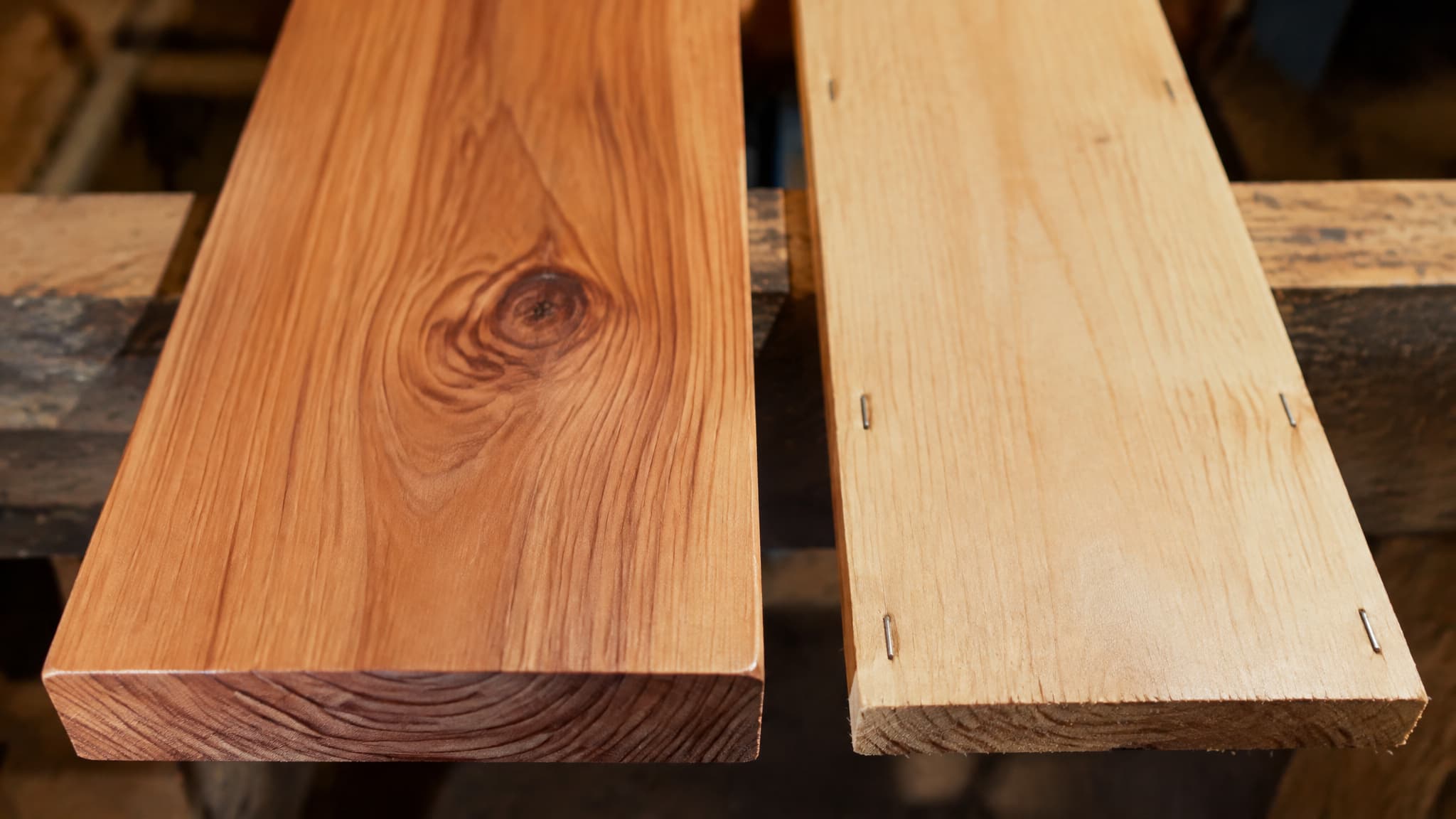
No single sauna wood is best for every buyer: cedar is the classic choice for durability, moisture resistance, affordability, and aroma (though it's not hypoallergenic), hemlock is the scent-free, allergy-friendly indoor alternative, aspen is a scent-free European staple that should be thermo-treated before sauna use, and thermowood is heat-treated Scandinavian softwood engineered to resist cracking, warping, mildew, and insects outdoors.
Cedar, hemlock, aspen, and thermowood tradeoffs
Here at SaunaCloud, we handcraft our custom cabins in California from natural Western Red Cedar across more than 3,000 North American installations because cedar handles decades of heat cycling without warping, though we always advise severe allergy or scent-sensitivity sufferers to choose hemlock or thermo-treated aspen instead. For outdoor kits, compare thermowood construction alongside the roof, weather sealing, drainage, and maintenance requirements.
Fit-and-finish tells by price tier
To earn even a passing 3 out of 5 construction score in GGR's rubric, a cabin needs quality lumber, a sturdy frame, minimal creaking, and zero air leaks (alongside heating within 35 minutes for 3/5 performance and an accurate temperature display/adjustment for 3/5 extras). In sub-$2,000 teardowns (scoring 4 to 4.5 out of 10 on fit and finish), look out for misaligned roof pieces, missing brad nails, crooked heater guard slats, floating floors, and interior glues that off-gas VOCs.
Fit and performance issues to check before buying
Use these practical checks to narrow the options before ordering:
- Bench width: A two-person label does not guarantee comfortable seating for two adults. Measure the usable space.
- Heating performance: Look for repeated sessions in a room similar to yours, including warm-up time and heater placement.
- Blanket coverage: Check the dimensions and which areas of the body the design encloses.
- Tent posture: Make sure a sit-only enclosure has enough room for a comfortable chair and position.
- Dome clearance: Check the internal dimensions and whether you can enter, exit, and recline comfortably.
Who to trust on a $1,000-$10,000 purchase: auditing the reviewers
Before trusting any reviewer on a $1,000 to $10,000 sauna, verify that they've physically sat inside competing brands and shown live EMF meter readings inside an assembled cabin on camera, rather than repeating brand-loyal myths like needing 170°F to detox. Garage Gym Reviews tested 30+ saunas for our performance benchmarks, scoring each 1-5 across multiple sessions with certified trainers and coaches, including Matt Dustin, CSCS, PN1-NC, Amanda Dvorak, ISSA-CPT, ISSA-CNC, and Carolina Panthers strength coach Thomas Barbeau, CSCS, SCCC, with Dr. Raj Dasgupta, a physician holding four board certifications, providing medical review (some top brands remain under evaluation due to long lead times).
Matt Justice's independent testing of 40+ models across 1,000+ videos provides the teardown and EMF data, backed by a 35,000 to 40,000-member Certified Sauna Facebook group that helped ~500+ buyers last year. Justice started that project after a 2016-2017 post-leukemia detox protocol using a DIY shower heat-lamp rig relieved his brain fog and anxiety.
Matching your budget to a unit: the decision in one pass
Match your budget to a sauna that works in three steps:
- Lock in capacity and power: Measure the room and usable seating space, then confirm the specified circuit. Budget for electrical work where required.
- Compare the heater and light systems separately: Check what the infrared configuration includes and whether any red light feature is a dedicated system suited to your intended use.
- Pick your budget priorities: Around $1,500–$2,000, examine the basic cabin and heater layout closely. Around $3,400–$6,500, look for stronger construction and documented testing. For a custom cedar build here at SaunaCloud, request a quote based on your dimensions, heater layout, and integrated features.
Frequently Asked Questions
Is a full spectrum infrared sauna worth the extra cost over far infrared only?
Rarely, because the $2,000+ upcharge mostly buys quartz halogen bulbs peaking around 1600 nm rather than the 660 nm and 850 nm wavelengths proven in clinical photobiomodulation studies. Far infrared already does the heavy lifting for raising core body temperature, triggering heat shock proteins, and driving a deep sweat. Unless you buy a cabin with a purpose-built integrated red light system like the ones we engineer here at SaunaCloud, you are better off pairing a far-infrared cabin with a standalone red light panel.
Which is better, full spectrum or far infrared sauna?
Far-infrared-only cabins are the smarter core-temperature workhorse for most buyers, delivering the heat-stress response and sweat in builds from ~$1,500 to $6,500 without the EMF and price penalties of full-spectrum heaters. Standard full-spectrum cabins ($5,000 to $10,000+) tout mid-infrared without separate clinical backing and use near-infrared halogen heat lamps that miss therapeutic red light targets by nearly 1,000 nanometers. If you want true red light therapy alongside your heat sessions, run a dedicated standalone panel outside the cabin or while your far-infrared unit preheats.
What is the cheapest way to try infrared sauna therapy at home under $500?
Portable formats are the first place to look under $500, but check whether the product uses infrared or steam. Steam tents and DIY tent concepts can fall around $350. Compare heat-rated materials, guarding, electrical requirements, cleaning, and warranty support before choosing. A local paid session is another way to try the experience before buying equipment.
Do I need an electrician or dedicated circuit for a 3-person or 4-person home sauna?
It depends on the specified electrical load. Larger cabins and higher-output two-person systems may require a dedicated 220V–240V circuit, while other configurations use 120V. Confirm the manufacturer's voltage, amperage, and connection requirements and have any required electrical work handled by a qualified electrician.
Is a budget 1–2 person infrared cabin from a big-box retailer a good deal?
It can be, if the bench space, heater layout, construction, and support meet your needs. Examples in this guide sit around $1,700–$2,000, but compare the complete purchase terms rather than a temporary discount. Confirm whether the cabin is far-infrared or full-spectrum, check lower-body heater coverage, request relevant test documentation, and read the return and freight-damage policies.

Founder & Lead Designer, SaunaCloud®
SaunaCloud: 3,000+ installations since 2014 · Author of The Definitive Guide to Infrared Saunas · Featured in Forbes, Inc., and MSN
Christopher designs every SaunaCloud sauna. His work brings the room, heaters, controls and installation plans together so you can review the project before committing. His professional expertise is sauna design and construction, not clinical medicine.
Custom 3D renderings and a proposal in 24-48 hours.
Continue Reading
Buying & Comparison Guides
Should You Build Your Own Custom Infrared Sauna? 10 Years of Lessons and the Three Paths Forward (2026)
Read article
Buying & Comparison Guides
Can I Put an Infrared Sauna in My Garage? Yes — If You Clear These 5 Checks
Read article
Buying & Comparison Guides
Can You Put an Infrared Sauna in an Uninsulated Garage? The 60°F and 45°F Thresholds That Decide Everything
Read articleReady to Design Your Sauna?
Every project starts with a conversation. Tell us about your space and we'll create your custom plan — free, no obligation.
Custom 3D renderings and a proposal in 24-48 hours.