Can You Put an Infrared Sauna in an Uninsulated Garage? The 60°F and 45°F Thresholds That Decide Everything
Key Takeaways
- Infrared saunas struggle below about 60°F ambient and essentially fail in stock form near 45°F, per Matt Justice of Certified Saunas, so your winter garage temperature is the single best predictor of performance.
- Real-world readings run below advertised maxes: GGR's hands-on tests read 160°F on the Luminar 5 (rated 170°F) and 149°F on the Pod (rated 165°F), and no independent instrumented test has verified a cabin reaching 170°F for any brand.
- Before blaming the walls, check the outlet: a dedicated 20-amp circuit matters because voltage sag from 120V to 105V cuts heater output measurably, and garages often run on shared circuits with freezers and tools.
In This Article
So you've been eyeing an infrared sauna, and the only real estate you have is the garage. Not a cozy finished basement with a thermostat set to 70, but the actual garage, with its concrete slab, drafty door, and January air that feels like it belongs outdoors. Which leads to the question you typed: whether an infrared sauna can run in a garage that has no insulation and still do its job?
Yes, it'll run. But cold ambient air costs you twice: it stretches your warm-up time and it lowers the peak temperature you can reach. The most useful numbers I've found come from one sauna reviewer, who reports that infrared saunas struggle below about 60°F ambient no matter the brand, and effectively won't perform in stock form near 45°F. On the manufacturer side, one manufacturer disclosed in August 2026 that an indoor model, rated at 165°F, typically runs somewhere between 150 and 165°F based on the surrounding room.
Near 165 in a climate-controlled space. Plateauing near 150 in a cold garage. That's the company saying it out loud, which I appreciate.
So here's your pre-purchase move: figure out roughly how cold your garage gets in winter, match it against those lines, and you can predict your experience before spending a dollar. Below, I'll walk through what the cold actually does, what real-world readings show versus the numbers on the box, and the cheap fixes in priority order.
Key takeaways
- Infrared saunas struggle below about 60°F ambient and essentially fail in stock form near 45°F, per one sauna reviewer, so your winter garage temperature is the single best predictor of performance.
- Real-world readings run below advertised maxes: GGR's hands-on tests read 160°F on a 5-person outdoor model (rated 170°F) and 149°F on a far-infrared model (rated 165°F), and no independent instrumented test has verified a cabin reaching 170°F for any brand.
- Before blaming the walls, check the outlet: a dedicated 20-amp circuit matters because voltage sag from 120V to 105V cuts heater output measurably, and garages often run on shared circuits with freezers and tools.
What cold actually does to an infrared sauna
An infrared heater has a fixed wattage. It can't "crank up" when the room gets cold; it just runs the same output into a colder target. That means every degree of ambient cold gets paid out of two places: how hot the cabin ultimately gets and how long it takes to get there. That's the whole mechanism, and it's the honest one-sentence version.
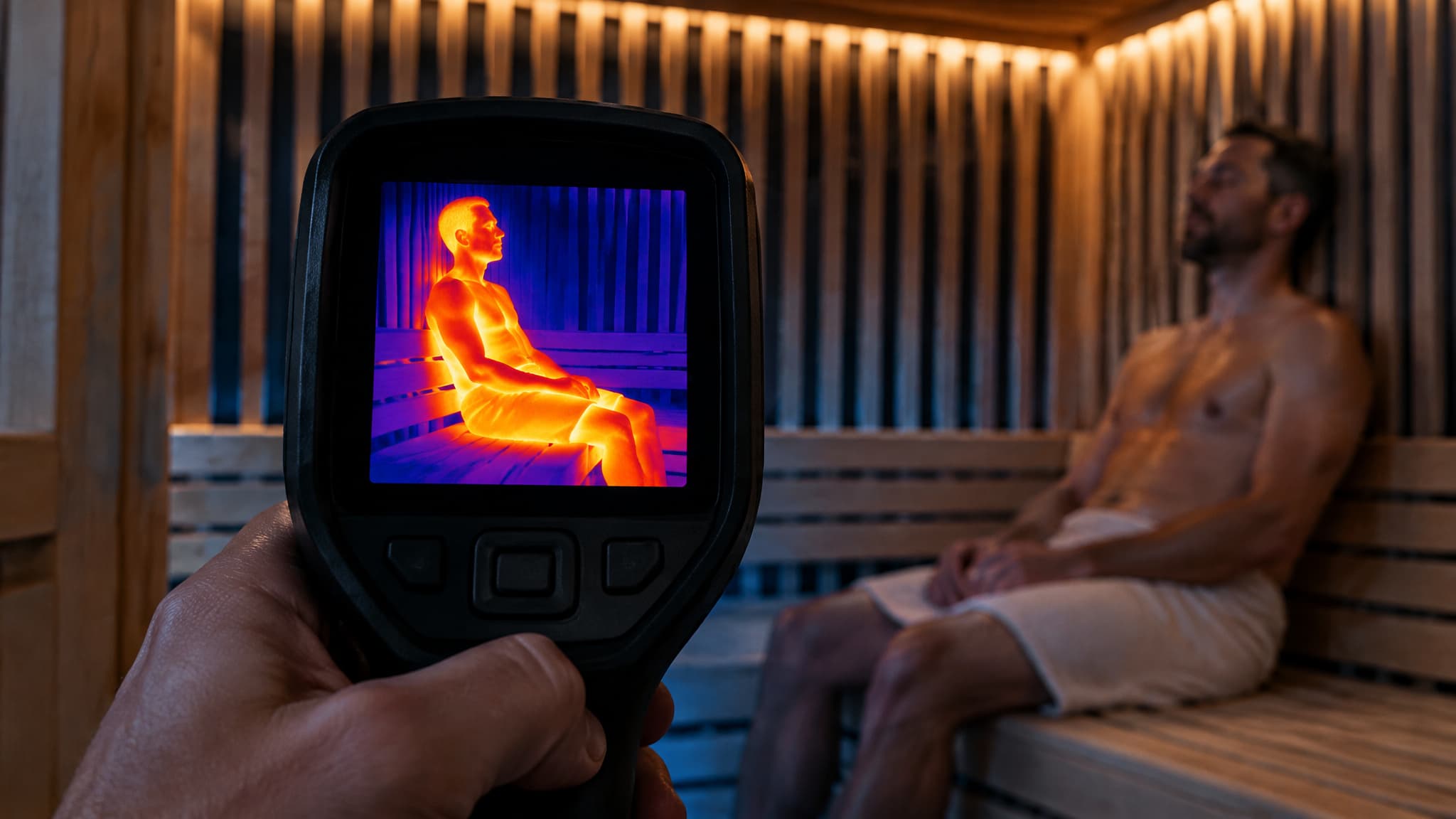
The contrast people remember comes from the reviewer's comparisons: a sauna in a 76-78°F Florida home hit 150°F far more efficiently than the same class of heater in a 48°F environment. Same machine, radically different room, radically different result. He also does a Flir camera demo showing far-infrared saturation wrapping the body from the bench and front heaters, which is as close as you'll get to seeing the thing work.
Why the same sauna works in October and seems broken in January
A common pattern installers report looks like this: the unit seemed fine when the garage was still holding some warmth in October, then January arrives and the cabin plateaus maybe 10-20°F lower while warm-up takes roughly twice as long. Nothing about the sauna changed. The room did. That's the ambient-temperature effect in its purest form, and it's why I keep saying to check your winter garage temp before buying rather than your October one.
Garage-specific heat losses a spare bedroom doesn't have
A garage has stressors an interior room doesn't. Every door opening swaps warm cabin air for cold garage air. Open wall vents bleed heat continuously. Uninsulated slab floors pull heat down.
And cabin size multiplies the penalty: a 4-person or 5-person model has more air and surface area to warm, so the same conditions hit it harder. I can't give you a per-door-opening temperature drop because no source quantifies that, but the direction is consistent everywhere.
Rated vs. real: what temperatures garages actually produce
Real-world infrared readings consistently run below manufacturer ratings, so the honest way to plan your garage is around observed floors, not advertised maximums. To weigh any temperature claim, it helps to know the four kinds of numbers you'll run into: the manufacturer's number, a reviewer's number, an independently instrument-measured number, and a random customer's number. They're not equally trustworthy, and in this space the independent-instrument category is basically empty.
- GGR's hands-on testing: Garage Gym Reviews read 160°F on a 5-person outdoor model, against the 170°F listed in GGR's own roundup. On a far-infrared model, GGR measured 149°F against the current 165°F product-page rating. Worth knowing: GGR doesn't publish the thermometer model, sensor position, ambient conditions, or repeat count, so these are context, not a gotcha.
- One editorial garage timing: a review of an outdoor-rated model in a garage installation reported the display hitting 170°F after about 40 minutes. That's a single, unverified display reading, not an instrument measurement, and I'm labeling it as exactly that.
- The teaching moment: GGR's own pages disagree, 160°F in the hands-on and 170°F in the roundup, for the same 5-person outdoor model. That's what uncontrolled ambient conditions produce. The exact cause isn't established, and I'm not going to pretend it is.
Here's the part I want to be straight about: no independent instrumented test has verified a cabin from any brand reaching 170°F. The research is limited here. And on disclosure, for the record: the evidence review cited here is manufacturer content from a company that sells these saunas (another source is a retailer that has sold and installed saunas since 2004), so I weigh temperature claims accordingly. Notably, though, the manufacturer content reports readings below its own maxima and publishes ambient-dependent operating ranges instead of one best-case number, which is more useful than the industry norm. All sources were checked August 13, 2026.
How long a cold-garage sauna takes to heat up
Standard preheat is 15 to 25 minutes; in a cold or outdoor space, budget 20 to 30. The one garage-specific timing on record is that outdoor-rated model’s display hitting 170°F after about 40 minutes, and it's a single unverified editorial report, so treat it as a "could take this long" data point rather than a promise. For contrast, at a trade show SaunaCloud had an infrared room pass 100°F within 15 minutes starting from a 70°F room. That's what a warm room buys you.
Model details matter here. Among the models reviewed, app-based remote preheat is available on a full-spectrum line in both sizes, a far-infrared model, and an outdoor-rated line in 2-person and 5-person sizes. Other full-spectrum and far-infrared models use onboard panels only. Remote preheat matters most when your sauna lives in a cold garage, because the whole point is you're not standing in a 45°F room waiting for the thing to warm up.
One manufacturer’s control app pairs by Bluetooth within about 30 feet, supports scheduled preheats, and can auto-start the sauna when it drops below 20°F outside. Know your model's preheat story before setup day, not after.
Fix the outlet before the walls: a garage triage list
In practice, the first culprit in an underperforming garage sauna is the outlet, not the walls. That's the pattern installers (including one retailer installing since 2004, and SaunaCloud, with over 3,000 custom builds since 2014) keep reporting, and it inverts what most people assume about uninsulated spaces.
- Check the dedicated 20-amp circuit and voltage. Voltage sag to 105V versus 120V cuts heating performance measurably. Garages often run shared circuits with freezers, power tools, and garage-door openers, which is exactly how you end up undervolted.
- Cheap retention fixes. Door gaskets run $20 to 50 to replace, and an extended 20 to 30 minute cold-space preheat costs nothing.
- Then, and only then: insulation, a vapor barrier, and floor matting.
Quick test: Before blaming the room, plug the sauna into its own dedicated circuit and verify you're getting close to 120V under load.
One honest flag: the vapor barrier and floor-matting guidance isn't really covered by the sources I reviewed, so verify against your manufacturer's manual before spending on those. And one installer warning worth internalizing: better heat retention can't rescue an underpowered heater package. The classic example is a 6'x6' room heated by two small back-wall panels; no amount of gasket-and-insulation work fixes that. The manufacturer countermeasures are instructive as design cues: one outdoor-rated model uses an aluminum-insulation-cedar sandwich construction, and app preheat exists specifically for cold spaces. Also note that no source quantifies how many degrees any retrofit gains you, so be wary of anyone selling you a number.
Does an infrared sauna in a garage need a dedicated 20-amp circuit?
The two indoor models reviewed both specify standard 120V power on a dedicated 20-amp circuit. One runs on exactly that supply while powering its 11 far-infrared heaters, spread across four zones. Check your own model’s electrical requirements. The reason it's not fine print: installers found that voltage sag to 105V (versus a full 120V) measurably degrades panel output, and garages are the most likely room in your house to have shared circuits with freezers, power tools, and garage-door openers pulling down the line.
The takeaway is actually good news: undervoltage, not a broken sauna, may explain weak heating, and it's checkable before you spend anything. If your garage sauna is underperforming, this is the cheapest and most common explanation to rule out first. Our guide on infrared sauna ventilation requirements covers the other garage-infrastructure topic people forget until afterward.
Why won't my infrared sauna in the garage heat past 140 degrees?
First, figure out whether it's the room or the sauna before deciding anything's actually broken. Installers who field this question constantly, including an independent retailer and SaunaCloud, point to the same short list of culprits, and in a garage the environment usually wins. Worth knowing up front: bench level reads 15 to 20°F below the ceiling sensor, so even a correctly working cabin shows a display number your body never actually feels.
Run through these in order:
- Preheat adequacy. 15 to 25 minutes is standard; 20 to 30 in cold spaces. A short preheat in a cold garage guarantees a disappointing first impression.
- Door gaskets. Worn seals leak constantly. Replacement runs $20 to 50.
- Sensor placement. Sensors near doors, vents, or glass give distorted readings, and distorted readings distort heater behavior.
- Circuit and voltage. The 105V-versus-120V sag again. Check it.
- Panel age. Carbon panels can develop cold spots after 5 to 7 years. If your unit is older and suddenly uneven, this might be it.
Construction matters too: thin-wall builds (think 1/4-inch plywood versus 3/4-inch cedar) lose heat faster no matter what you do. And there's an operating-discipline piece that's easy to miss. Habits that are harmless in a spare bedroom, like cracking the door, leaving vents open, or doing a short preheat, each carry a real cost in a cold space. A garage is simply a different usage playbook. If it turns out your unit checks out but the category itself is the issue, our piece on the downsides of infrared saunas lays out the honest cons.
Is an infrared sauna still effective if it never reaches its maximum temperature?
A garage plateau in the 130s to 145°F can still deliver a fully effective session, the practical question is where to put an infrared sauna in the first place, since placement shapes the ambient reading. The common failure here isn't the sauna; it's judging a working infrared cabin by the wall thermometer. Traditional saunas work like a fan heater, heating the air around you. Infrared works like a campfire, heating your body directly. Air temperature is a proxy for the therapy, not the therapy itself.
The most concrete way to say this comes from SaunaCloud, and I'm labeling it clearly as a vendor claim, not verified physiology: they say a 135°F infrared session can raise your core temperature to 100.5 to 101.5°F, which is what 190°F traditional air does. SaunaCloud also argues that 110 to 130°F is the infrared sweet spot, because panels stay on continuously below 130°F while hotter-running panels cycle on and off, and hotter heaters push the wavelength out of the 7 to 10 micron band per Wien's Law. That's the vendor's physics argument, not settled consensus, but notice it cuts against the instinct that hotter is automatically better.
For function, use the sweat test from one sauna supplier: profuse sweating by 15 to 20 minutes signals the unit is working right. No sweat after 25 minutes above 125°F signals a real problem. General sweat timeline: onset at 10 to 20 minutes, full sweating by 20 to 30. Your body's signals tell you more than the display does.
Field note: Profuse sweat by 15 to 20 minutes means the cabin is doing its job, even if the display reads lower than you expected.
Which infrared saunas handle cold garages, and when the garage is the wrong answer
In a cold space, the buying question flips. It's not "which cabin is hottest on paper," it's which one loses the least to the room. That puts construction ahead of marketing.
What separates cold-tolerant cabin construction
One outdoor-rated model uses a sandwich build (aluminum exterior, insulation core, cedar interior) plus weatherproofing and received a 5/5 heat-performance score from GGR. That outdoor rating is directly relevant if your garage swings cold. A separate indoor model received 4.4 stars and is listed at 165°F. Two of the indoor lines reviewed run 500W panels, roughly double typical competing panel wattage, which is genuine muscle for fighting a cold room. Heater placement helps too: heaters on the walls, back, under the bench, and at calf level mean fewer cold spots on you, and more heaters (15 on a 5-person outdoor model, eight on one 2-person indoor model, six on another 2-person indoor model) generally means fewer cold spots. The outdoor line and those two indoor lines mix full-spectrum and far-infrared heaters; two other lines reviewed are far-infrared only.
For market context: far-infrared-only systems cluster near 140°F across the category, with one line running about 135 to 150°F, one 2-person model listed at 140°F, and another 2-person model at 165°F in one listing. Full-spectrum systems rate above that cluster. One honest note: the deep evidence here is concentrated on one manufacturer’s models, so treat these as labeled examples, not a market-wide ranking.
If you're shopping as a decision ladder: a far-infrared-only model, then an indoor full-spectrum model (165°F, 120V), then a full-spectrum model with red light therapy (165°F), then an outdoor-rated model (170°F). One targeted tip for cold-basement readers, framed by the vendor: a second ceiling heater can cut preheat time, but the same vendor notes that bolting on conventional heating elements just delivers hot air, not better infrared. That's a vendor claim, weigh it accordingly. And a marketing translation while we're here: "99% emissivity" describes how well a panel radiates versus an ideal blackbody. It's not electrical efficiency, and no separate efficiency testing has been published.
When to switch to a traditional or outdoor sauna instead
If your garage sits near or below 45°F in winter, stock-form infrared is in failure territory, and the honest recommendation changes product categories. Wood-burning barrel saunas handle cold well but need about a two-hour heat-up, so know that trade. Traditional sauna kits are another category to consider. And if what you actually want is 200°F-class air heat, the kind you know from a gym sauna running 185 to 200°F, infrared isn't your machine, and that's okay.
Some people love punishing heat. One traditional sauna line is rated 230°F with an electric stone heater, but flag: that rating conflicts with the roughly 194°F cap on US electric sauna controls (one electric sauna controller spans 104 to 194°F), so treat the 230°F figure as a low-confidence number.
Cost, winter durability, and flooring: what the evidence doesn't cover
Most articles confidently answer these three. The sources genuinely don't, so here's what's real and what's a gap.
Electricity. A two-person infrared unit draws about 1.5 to 1.7kW on 120V, which works out to roughly $0.18 per hour, or about $0.10 to $0.18 per realistic session, per one manufacturer’s baselines. A traditional sauna's 4.5kW heater runs about $0.37 for the first hour at $0.11/kWh. What a cold garage adds, through longer preheat and ongoing heat loss, is directionally obvious but unmeasured. Nobody's published that penalty, and I won't invent one.
Winter durability. Serious cold-climate installations call for insulated walls, double-pane windows, and weatherproof roofing. But freeze-damage specifics aren't covered in the sources, so I can't tell you what a hard freeze does to a specific cabin.
Flooring and warranty. Whether a cabin can sit directly on a concrete slab, what moisture protection it needs, and whether placing an indoor-rated cabin in an unconditioned space voids the warranty: none of this is answered by what I reviewed. Check your specific manual before you buy. Same goes for the related question of placement generally; our walkthrough of whether you can put an infrared sauna in your garage covers the feasibility checklist.
Garage safety: don't let a low thermometer reading push you into risky fixes
The unique cold-garage risk isn't thermal, it's behavioral. A cooler cabin tempts people to override controls, stretch sessions, or add unsanctioned heaters because the number looks low. Don't. Hold the same limits you would anywhere: Cleveland Clinic puts a typical session at 15 to 20 minutes, with beginners starting around 5 minutes at roughly 110°F, and infrared under 30 minutes even for experienced users. Hydrate: 16 to 20 ounces before, sips during, 20 to 30 ounces after.
OSHA's heat-exhaustion signs are your exit cue: headache, nausea, dizziness, weakness, thirst, heavy sweating. Step out and cool down. Confusion, passing out, or seizures mean heat stroke, and that's an emergency, full stop. A few population notes, attributed and brief: ACOG advises avoiding sauna exposure early in pregnancy; the Finnish Sauna Society notes children's heat regulation handles high heat differently; and alcohol raises hypotension and arrhythmia risk.
And one correction while we're here: the Rule of 200 (temperature plus humidity ≈ 200) is a comfort rule of thumb, not a safety standard, which the source itself says. People love passing it off as law. It isn't.
The tie-back to this whole article: judge function by sweat onset, never by tampering with controls chasing a number.
If you want the longer arc of building a habit around this, our infrared sauna session guide walks the first month: most people adapt in 5 to 7 sessions, starting around 110°F for 5 to 10 minutes and ramping from there.
So here's the compressed decision. Garage above about 60°F in winter: workable, with preheat discipline. Between 45 and 60°F: do the cheap fixes first, the circuit check and the gaskets, and consider insulated construction. Below about 45°F: insulate the space or switch product categories, honestly.
And the reframe I'd leave you with: judge your cabin by sweat onset, not the wall thermometer. The sauna you'll actually use is the best one, and the first step is unglamorous and free: go check what your garage actually drops to in January.
Frequently Asked Questions
How long does an infrared sauna take to heat up in an unheated garage?
Standard preheat is 15 to 25 minutes, but in a cold or outdoor space, budget 20 to 30. One garage installation reportedly took about 40 minutes to reach 170°F on the display, though that's a single unverified reading. If your model supports app-based remote preheat, you can start the warm-up before you ever walk into the cold garage.
What is the lowest temperature an infrared sauna can operate in?
The useful thresholds come from one sauna reviewer: infrared saunas struggle below about 60°F ambient no matter the brand, and effectively won't perform in stock form near 45°F. If your garage sits near or below 45°F in winter, the honest move is to insulate the space or switch to a traditional or outdoor-rated sauna.
What cheap fixes make an uninsulated garage usable for an infrared sauna?
Start with the outlet, not the walls: plug the sauna into a dedicated 20-amp circuit and verify you're getting close to 120V under load, since voltage sag to 105V measurably cuts heater output. Then replace worn door gaskets, which runs $20 to 50, and use an extended 20 to 30 minute preheat, which is free. Insulation, a vapor barrier, and floor matting come last, and no source quantifies how many degrees any retrofit actually gains you.

Founder & Lead Designer, SaunaCloud®
SaunaCloud: 3,000+ installations since 2014 · Author of The Definitive Guide to Infrared Saunas · Featured in Forbes, Inc., and MSN
Christopher designs every SaunaCloud sauna. His work brings the room, heaters, controls and installation plans together so you can review the project before committing. His professional expertise is sauna design and construction, not clinical medicine.
Custom 3D renderings and a proposal in 24-48 hours.
Continue Reading

Guides
Infrared Sauna Hydration: How Much Water You Really Need (And Why Plain Water Isn't Enough)
Read article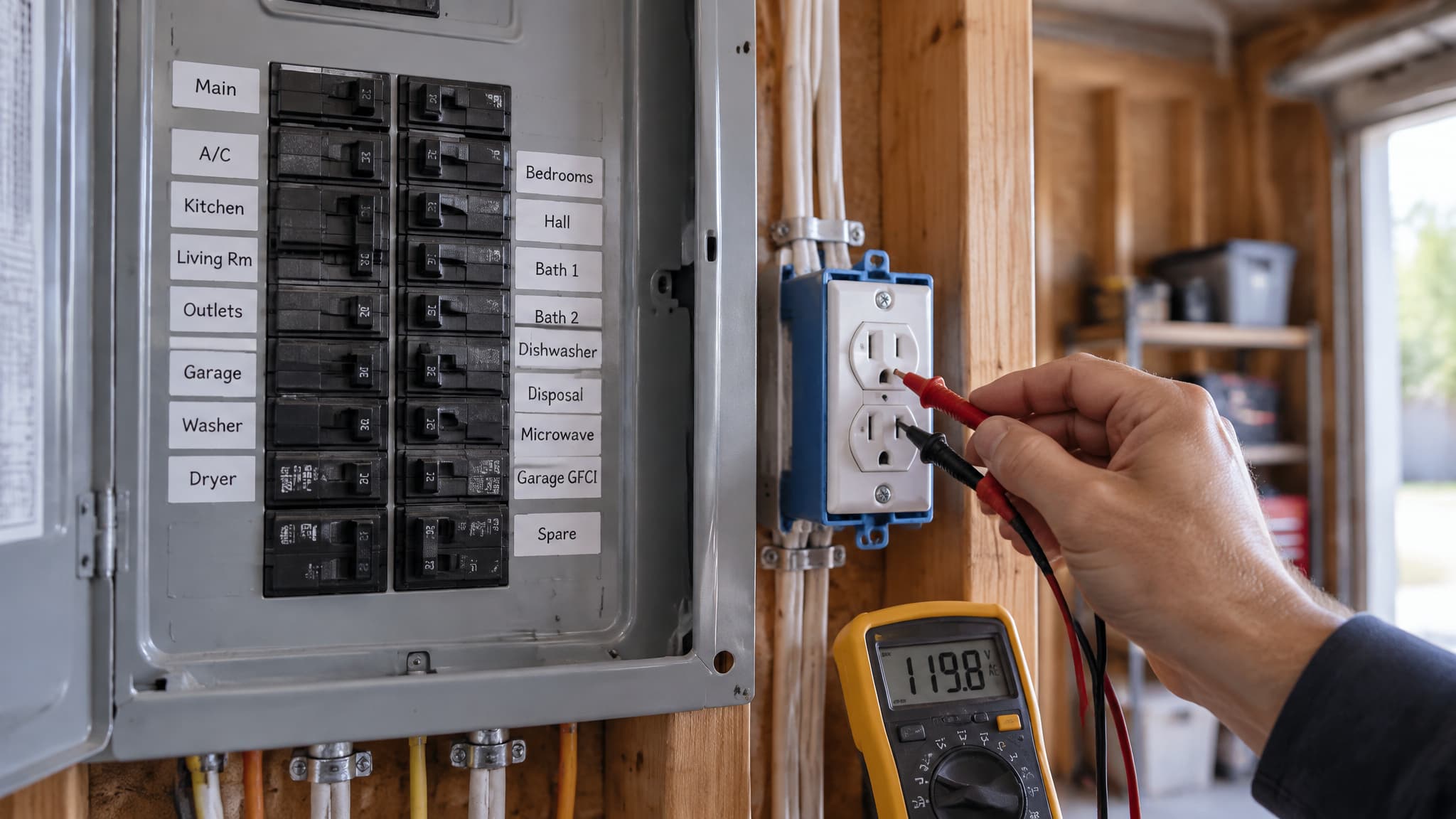
Guides
Outdoor Infrared Sauna vs Indoor Garage Sauna: Voltage, Cost, and Weather Math That Actually Decides It
Read article
Guides
13 Proven Benefits of Infrared Sauna Therapy — With the Research Behind Each One
Read articleReady to Design Your Sauna?
Every project starts with a conversation. Tell us about your space and we'll create your custom plan — free, no obligation.
Custom 3D renderings and a proposal in 24-48 hours.