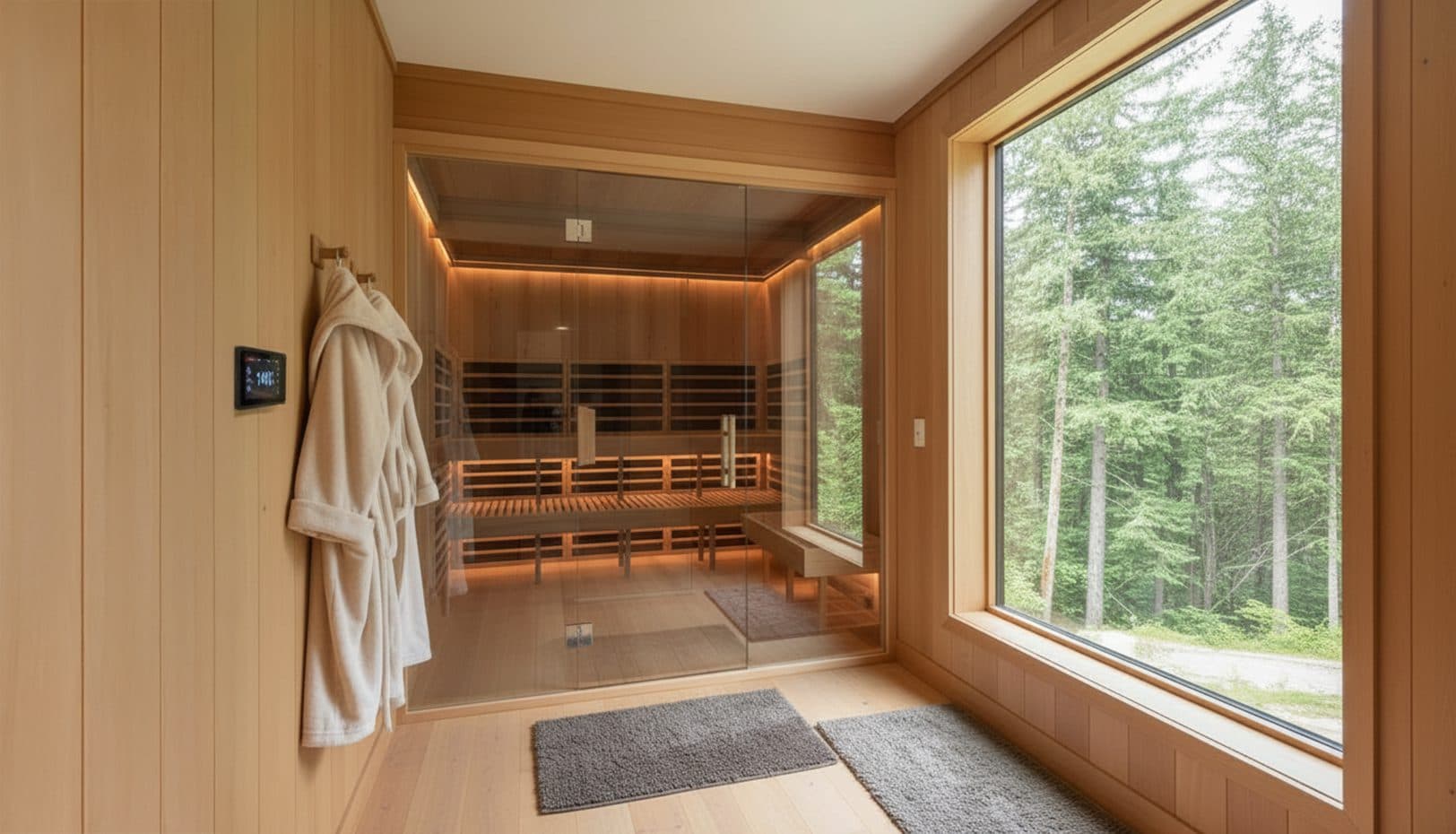
Can I Put an Infrared Sauna in My Garage? Yes — If You Clear These 5 Checks
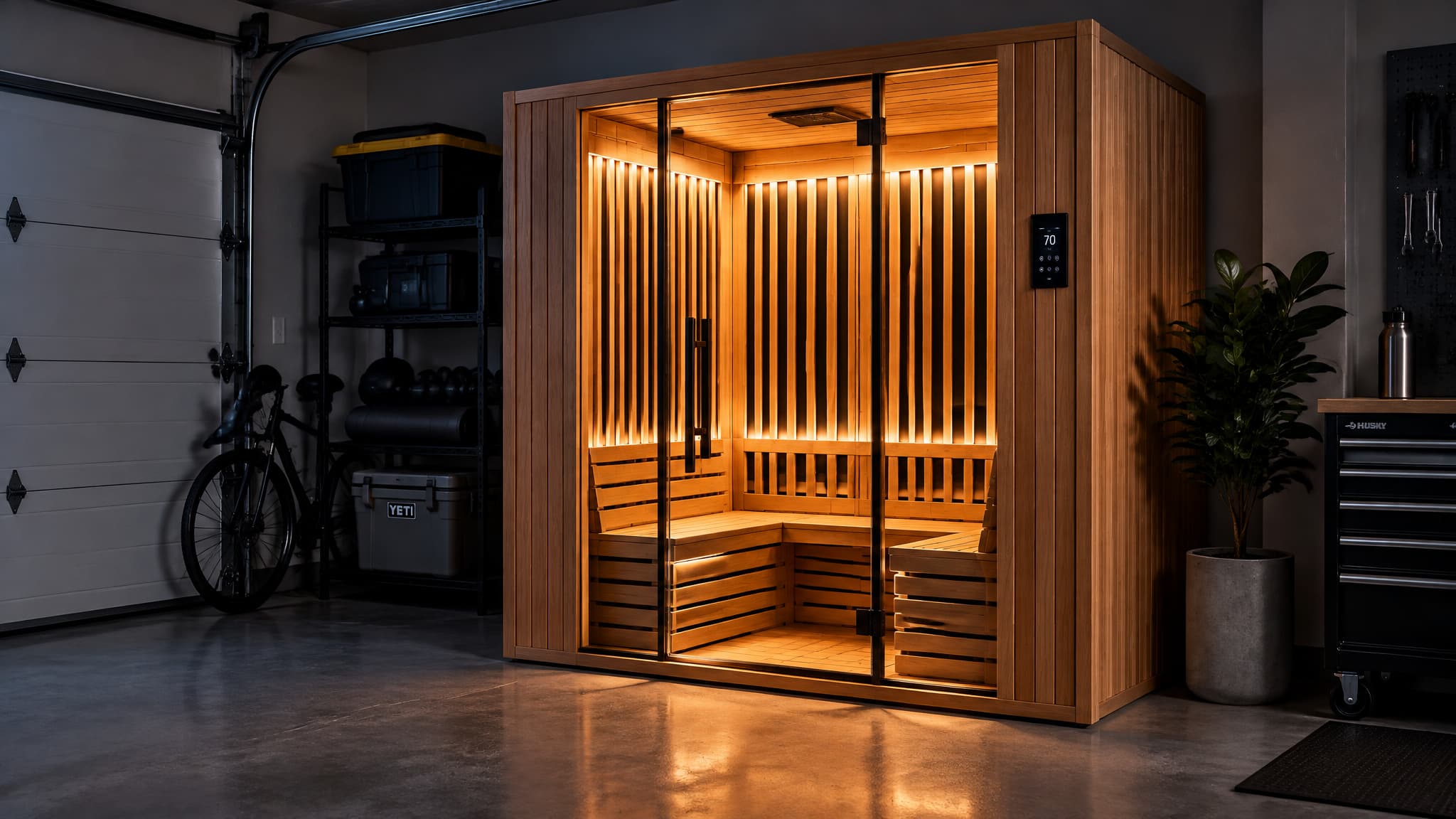
Key Takeaways
- Manufacturer warranty terms decide the garage question first: Spa World says infrared saunas belong indoors in a temperature-controlled space (ideally 20-28°C, roughly 68-82°F) and warns garage placement risks voided warranties, while JNH Lifestyles explicitly permits dry, uninsulated garages.
- A two-person infrared sauna needs about a 4' x 4' footprint and a 7-foot minimum ceiling, and most run off an ordinary 120V outlet; traditional heaters, by contrast, require a 240V circuit wired directly into your panel, which costs $300 to $900 to install.
- Cold slows warm-up and caps your top temperature but doesn't damage the unit, so the fix buyers forget is insulating the garage itself: walls, door, and weatherstripping.
In This Article
An infrared sauna can go in your garage, as long as you've sorted the practical stuff: power, ventilation, moisture, flooring, ceiling height, and above all the warranty language on your specific unit. You're not asking a weird question, and you're not about to break something. People put saunas in garages all the time. The catch, and it's a real one, is that manufacturers don't agree on whether a garage counts as an acceptable home.
Some say yes without blinking. Others warn that a garage can weaken performance and void your coverage.
That split matters more than any construction detail, because you're standing there holding a $2,000 to $10,000 decision in a room that probably doubles as a storage unit with a car parked in it. The checklist covers floor space, airflow, dampness, what the floor is made of, wiring, and how tall the ceiling is. All of it is manageable. But step one isn't a construction plan. Step one is your manufacturer's placement policy, because that's the item that can quietly cost you the most.
At SaunaCloud, we've handled more than 3,000 installations across North America, and we evaluate every placement individually on power, insulation, ventilation, and moisture rather than issuing one blanket rule. That's genuinely how the good manufacturers operate, and it's why the answer to your question is "yes, probably, with planning" instead of a slogan.
Whether a garage voids your warranty
Warranty placement terms are manufacturer-specific, and the differences are not subtle. Two reputable companies will give you opposite answers to the same question, and both are being reasonable from where they sit.
Some manufacturers draw a hard line: indoors only, in a temperature-controlled space, ideally between 20 and 28°C (roughly 68 to 82°F). Their warning is that a garage risks weak performance and voided warranties. Translated into your life: if your garage freezes in January, expect slower, weaker sessions, and if coverage lapses because of placement, you're eating the full repair bill on a multi-thousand-dollar purchase. That's real money, not paperwork anxiety.
Other manufacturers take the opposite position. Their guidance allows dry, uninsulated garages and basements, and they say cold temperatures slow warm-up but don't damage the wood or electronics. Where they do draw a line is outside: outdoor placement voids their wood warranty. Their reasoning is worth understanding.
Some of these units use untreated Hemlock and Red Cedar, which means no chemical treatments and no off-gassing, but untreated wood is exactly the kind of wood that warps and molds when weather hits it. One trade-off, stated plainly.
So which is right? Neither, in a universal sense. This isn't building science, it's contract language, and it varies by brand. The single action that protects your purchase: read the warranty, then call or email the manufacturer before you install.
Tell them where the sauna is going. One conversation. That's it.
Quick test: Before you buy anything, email the manufacturer your garage details and ask, in writing, whether placement affects your warranty.
One more skeptical eye worth keeping: treat "outdoor-rated" claims with some scrutiny. Some units marketed that way underperform outside anyway. Ask how the unit performs in your climate, not just whether it's permitted.
Why a garage works, and its honest downsides
For most homes, the garage is the most practical spot for a sauna because it combines unused square footage with exterior access, and it beats a finished interior room on wiring and ventilation. The basement is its only real rival. Here's how they actually compare.
What garages do better
Most of us have a garage holding square footage we don't use. A sauna reclaims it for something you'll actually use, and you don't have to fight for floor space the way you would in a spare bedroom. The garage is flexible and roomy, which matters more than it sounds when you're assembling flat panels.
The underrated advantages are the building ones. Garages have exterior walls and windows, which makes ventilation easy in a way an interior room can't match. Electrical panels and open framing are right there, so wiring is simpler and often cheaper. And the sauna experience stays contained: heat, humidity, and the sounds of your post-session playlist all stay in the garage instead of drifting into the living room.
There's also a feel to it. A garage sauna gives you something like the outdoor-sauna experience, that sense of stepping away to a separate space, without the weather beating on the unit year-round.
The basement alternative, and the garage's one honest cost
Basements deserve their own nod. They're naturally cool and temperature-stable, which actually helps a sauna heat efficiently. They're private. If there's a bathroom nearby, the post-sauna shower is easy, and anyone who has ever stumbled out of a hot sauna will tell you that matters. A finished, insulated basement is basically move-in ready: level floor, controlled air, done.
The garage trade-off is temperature swings. Cold slows warm-up, which changes your session experience, though it doesn't damage the unit. That's the one real cost, and it's fixable, which we'll get to.
And if neither appeals: a spare room, a home gym, even a dedicated wellness corner all work. Look around your own house. The right spot is the one you'll actually walk to in January.
Space, ceiling height, and the delivery path
A two-person garage sauna needs about a 4' x 4' footprint and a 7-foot minimum ceiling, and the check most people skip is measuring the route the boxes will take to get there.
The footprint
Tape out a 4' x 4' patch on the garage floor. That's roughly what a two-person infrared unit needs. Family-size saunas run 6' x 8' or more, so measure your space before you fall in love with a big one. Most garage setups end up in the 2 to 4 person range, which is convenient because that's also the sweet spot for plug-in models. Leave a few inches of clearance on every side; ventilation and electrical access need breathing room.
Ceiling height
Seven feet is the minimum, with 7 to 8 feet ideal for heat circulation and safe heater clearance. It's the sneaky constraint people discover after ordering. The good news: infrared saunas need less headroom than traditional builds, so a low garage ceiling is less of a problem than you'd expect. For reference, typical units run 6.5 to 7 feet tall and at least 4.5 to 5 feet wide.
Measure the route, not just the room
This is the non-obvious check, and real people have gotten it wrong. The Spruce ran a six-month testing project covering 10 saunas researched from dozens, and one of their testers planned a basement install, misjudged the panel turning radius in a hallway, and relocated to the garage instead. One tested model’s panels had to come in through a window. Another model arrives in three large packages.
Compact models exist if you need them. One compact two-person unit fits in a 4' x 4' x 6'3" space and runs on a standard outlet, which means it fits basically anywhere in a garage. Some compact units are small enough for big closets or wall recesses; check the assembled dimensions on the product page before you assume something won't fit. Measure the doorway, the turns, the path. Twice.
Electrical requirements and real costs
Most two-person infrared saunas plug into a standard 120V outlet. Traditional heaters are a different animal: they need a hardwired 240V circuit. That single split is your first filter when choosing a model, before price, before looks.
Voltage class is your first filter
Several compact infrared models are plug-in 120V units. If your garage has a normal outlet and you don't want to touch the electrical panel, these are your lane. On the other side of the line, some 240V hardwired heater configurations need a dedicated circuit, 30 amps, or 50 for a larger version. That's electrician territory, full stop.
The most common mistake follows a predictable pattern: a buyer assumes the existing garage outlet will run the unit, discovers mid-purchase that it won't, and has to scramble. Ask the voltage question before you fall for a model, not after.
Electricians, permits, and the one rule you don't fudge
Professional electrical installation runs roughly $300 to $900, plus a dedicated circuit, according to electrician Dan Mock of Mister Sparky. Think of it like calling a good mechanic: not optional, but not scary either, and definitely not a reason to attempt your own hardwiring unless that's genuinely your trade. Permits are a quick check, not an obstacle. Many small pre-fab kits skip the building permit, but electrical work may need one, so a short call to your local building department saves headaches. In a semi-humid garage, GFCI protection makes sense.
One rule that has no flexibility: follow the manufacturer's heater clearances exactly, the distance the heater needs from walls and ceiling. That's the one thing you don't fudge.
Moisture, flooring, and why untreated wood is vulnerable
Concrete, tile, and vinyl all work fine on a garage slab. Whether carpet is okay depends entirely on what kind of unit you're buying, and the flooring confusion in this niche comes from people quoting rules written for different equipment.
Vapor barriers and sealing
This is the boring-but-important part, worth doing right once. Steam saunas definitely need a vapor barrier and quality insulation; it's still smart for infrared. Caulk or silicone the gaps so condensation never meets your drywall or wiring, and use moisture-resistant insulation to protect the walls and ceiling around the sauna. And here's the worry worth answering head-on: installed right, a sauna won't make your house damp. The barrier, the insulation, and the ventilation are what make that true.
The flooring rule, resolved
Some installation guidance specifies concrete, tile, or vinyl only, and to avoid carpet and wood because of warping and mold risk. That guidance is written for built-in and traditional installs. Other manufacturers allow more flooring options for their equipment: self-contained pre-fab infrared cabins can sit on any dry, level floor, carpet included. Nobody's wrong.
The distinction is unit type. So, best sauna to put in a garage? That comes down to which types and models tolerate cold floors and temperature swings, so which one are you buying?
If you're on a bare garage slab, the practical version is simple: flat, level, non-slip, and not in the spot where water pools. Interlocking mats, waterproof vinyl, or a raised platform all fix a slab that isn't quite any of those things.
Why the wood rules exist
Here's the mechanism underneath the warranty language. Untreated hemlock and cedar eliminate off-gassing, which is a genuine health plus, but untreated wood warps and molds when it stays damp. That vulnerability is exactly why one manufacturer voids the warranty outdoors. It's also why the post-session drying habit matters: testers found a portable steam unit still wet inside after 24 hours zipped up.
Leave the door open after sessions. It's a habit, not a project.
Do infrared saunas need garage ventilation?
Yes, but far less than a traditional sauna, and your garage is already set up for it. Windows and exterior walls do most of the work.
Infrared makes dry heat with little humidity, but trapped heat still needs somewhere to go. A vent, a small exhaust fan, or a cracked window handles it. Traditional saunas are the demanding case: they need an intake vent near the floor and an exhaust near the ceiling. Either way, ventilation keeps fresh air moving, prevents stuffiness, and reduces the risk of mold and structural damage creeping in over years of trapped humidity.
Here's the reframe that surprises people: garages ventilate nearly free. You already have windows and exterior walls. A basement retrofit, by contrast, means cutting into somewhere that didn't have airflow. This is the garage's hidden advantage, and it's a real one.
Cold garages: the temperature tradeoff
Cold won't damage your sauna. It will stretch warm-up time and cap your top temperature.
That's the position some manufacturers take for their units: cold air means a longer wait and a lower ceiling on how hot the cabin gets, but no harm to wood or electronics. Other manufacturers specify an ideal ambient range of 20 to 28°C for their units to reach the temperatures they were designed for. And honestly: infrared tops out around 140 to 150°F, and people who chase serious heat can find that modest even under ideal conditions. Better you hear that from a friend now than from the sauna in December.
The fix buyers forget to budget for is insulating the room, not the sauna. Walls, the garage door, weatherstripping, sealing drafts. Infrared is the energy-miser of the sauna world, using less electricity and heating faster, and weatherstripping is the cheap fix that keeps heat where you paid for it. In bill terms: insulating an unfinished garage means the sauna works less to give you the same session.
That's it. No kilowatt math required.
If cold-climate performance is your main worry, we've gone deeper on the uninsulated garage question in its own piece.
Choosing the right sauna type and model
For most garages, a plug-in infrared sauna is the best fit: it runs on a standard outlet, needs less headroom, and heats in 10 to 20 minutes. Hardwired traditional units suit garages with upgraded electrical and people who want the classic high-heat experience, though it's worth weighing outdoor-rated versus indoor placement before committing. Portables suit anyone testing the habit before buying in.
Infrared vs traditional vs hybrid
Infrared runs 120 to 150°F, reaches temperature in 10 to 20 minutes, and usually plugs into 120V. It's dry heat, and the radiant kind: it warms you, not the room, which is why it works in smaller spaces with low ceilings. Traditional electric saunas run 160 to 190°F, and they throw off bursts of steam when you ladle water onto the sauna stones. The catch: your room and electrical service have to keep up. It's the classic, and if you've got the space and the panel capacity, it's a different (hotter) experience. Hybrids do both, worth a line for families who can't agree.
Match the model to your electrical state
Unupgraded garage? Plug-in examples start at $2,099 and $3,199. Upgraded electrical and 240V service? One hardwired model starts at $3,596, while another warms in 10 to 20 minutes even on a day when the garage is already hot.
Zero installation appetite? A portable steam unit, which we'll cover below.
Wood, briefly
Premium softwoods hold up best in semi-controlled spaces: Canadian Hemlock, Thermo-Aspen, Nordic Spruce. Thermally treated woods also do well in garages specifically. Avoid untreated pine and plywood, which soak up moisture and fall apart fast. And insulated walls with tight panel joints mean faster warm-up and less heat lost. You'll wait less and sweat more.
Costs and the timeline, broken down like a friend would
The real range: about $2,000 for a compact infrared unit to $10,000 or more for a large traditional build. What drives the price is size, wood, heater type, and extras like lighting, glass fronts, and Wi-Fi controls. Installation adds a few hundred to a few thousand, and the electrician's $300 to $900 is the hidden third that surprises people. No plumbing needed, which is a relief: even steam saunas just need a jug or a nearby sink for water on the stones.
Timeline? Better than you fear. Pre-fab infrared assembles in a few hours, most people finish in a weekend. One compact infrared model goes together in under an hour with two people.
Larger traditional saunas take 1 to 2 days. Modular units can disassemble and come with you when you move, which is an underrated point if you're hesitant. On home value, honestly: a private sauna is a standout wellness amenity, and how much it adds depends entirely on your market. No numbers promised, because honest people don't promise them.
When 140°F isn't enough: the patio heater experiment
People have pushed infrared saunas past their temperature ceiling. Exactly one attempt is well-documented, and it shows what's possible and what careful looks like.
Some context first, because it's fair: many infrared saunas top out around 140 to 150°F, and people who love serious heat find that mild. That's an honest observation about the category, not a knock on it.
David Maus Jr ran the experiment everyone talks about. He mounted a 1500-watt patio heater from a patio store inside the infrared sauna in his garage gym, a compact two-person unit, and ran it alongside the infrared panels. The measured results: roughly 150 to 160°F at 500 watts, about 180°F at 1000, and 200°F-plus at the full 1500.
The safety caveats are the story, not a footnote. He used a GFCI extension cord, had an electrician check the amperage, and dealt with a ceiling heat sensor that trips above roughly 65°C, which he relocated with an explicit disclaimer attached to that decision. He also recommended a roughly one-hour auto-off. Six months of frequent high-heat use later, the only damage was a crinkled warning label. Speakers, lights, and panels all intact.
Yes, you can, one DIYer bolted a 1500-watt patio heater into his garage-gym infrared sauna, ran it alongside the panels, and hit 200+°F, and six months of frequent high-heat sessions later the only damage was a crinkled warning label. But it only worked because he layered in the safety measures first: a GFCI extension cord, an electrician's amperage check, a relocated ceiling sensor with an explicit disclaimer attached, and a roughly one-hour auto-off. We're telling you this because it's documented, measured, and interesting. We're not recommending it. If your heart is set on higher temperatures, the safer paths are a traditional or hybrid unit with proper 240V service, and a conversation with your manufacturer before anything else.
Red flag: Modifying a sauna's heat sensor or wiring yourself can void your warranty and create a fire risk. Talk to the manufacturer first.
Safety, permits, and session limits
None of this is complicated, but it's the section people skim and shouldn't. The safety items are cheap and mostly passive: alarms, GFCI protection, clearances, and keeping combustibles away from the heater. Permits are usually a single phone call, and session limits are a matter of knowing your own body. Here's the short version of each.
Attached-garage safety
Wood-burning saunas generally don't belong in an attached garage. Chimney, sparks, carbon monoxide: that's settled, no both-sidesing. If you love the wood-fire romance, that's a detached-garage or outdoor conversation.
The rest of the safety list is cheap and calm. Smoke detector and CO alarm nearby. A GFCI breaker, which is protection that trips before you get hurt, worth having in a semi-humid garage. Keep cords and outlets off the floor and away from heat.
And move the paint, cardboard, and wood scraps a few feet from the heater, a request we make knowing full well your garage is also a storage unit. Ours too.
Permits and session limits
Many small pre-fab kits don't need a building permit, but electrical work might, so one quick call to your local building department covers it.
On sessions: Dr. Michele Green's guidance is 5 to 10 minutes for beginners and 20 minutes max for anyone. If you have cardiovascular or kidney disease, check with your doctor before you start. And the human version of the fine print: this is information, not medical advice. Talk to your own provider.
Garage vs basement vs outdoors
Through the warranty lens, the three placements rank themselves. Basements are the low-risk pick: temperature-stable, private, often bathroom-adjacent, and they barely see weather. Garages sit in the middle. You get more space, easier ventilation, and heat and humidity kept out of the house.
The cost is bigger temperature swings. Outdoors is the riskiest by a clear margin: some outdoor sauna owners dealt with rain moisture even in a properly built unit, and outdoor placement voids most infrared warranties outright. The untreated-wood problem is exactly why.
Middle grounds exist. Some infrared sauna owners have successfully placed their saunas in 3-4 season rooms, enclosed porches, and sunrooms, which gives you a sense of what "mostly indoors" looks like in practice.
The garage, in the end, is outdoor-feel living with indoor-grade protection. That's the pragmatic compromise most houses are asking for.
Owning it: maintenance, drying, and the habit
The good news is that sauna upkeep is a habit, not a project: a quick wipe-down, an open door to dry, and the occasional comfort upgrade. The work is small, but it's what keeps the wood healthy and the sessions coming. Here's the whole routine, kept deliberately light.
Upkeep, kept breezy
A damp cloth and mild soap handles most interiors. Testers of one compact infrared model went with weekly baking-soda-and-water cleanups, and somewhere along the way a Magic Eraser joined the routine. Portable steam units are the one real rule: dry them with the door open. That's the whole chore list. Sauna ownership should be sustainable, not a second job.
Comfort and habit design
Here's where it gets fun. Ergonomic backrests, LED chromotherapy lighting, Bluetooth speakers (testers called their setup a personal nightclub, and who are we to argue), essential oil diffusers, Himalayan salt blocks. Dessert, not homework. Add a bench, a towel rack, soft lighting, robes hanging nearby, and the corner of your garage becomes a little spa.
The cold-garage convenience worth paying for is Wi-Fi controls: pre-heat from the couch so the warm-up wait never becomes the reason you skip a session. And after a long session, a Saps electrolyte drink helps you rehydrate before you head back inside. And think about placement like a person, not a floor plan. Near a bathroom makes cool-downs easy.
Storage space nearby helps. The spots that feel effortless are the ones that turn a purchase into a habit, which is the entire point.
Recap, in order: manufacturer policy, voltage class, footprint and ceiling and route, moisture and flooring, insulation, safety gear. If the brief's contrarian point got lost anywhere, here it is again plainly: a garage with existing windows, exterior walls, and panel access can be easier to outfit than a finished room. Insulation against temperature swings is the one variable worth budgeting for. Everything else is a phone call and a tape measure.
Your garage is the verdict, not this article. Go look at it.
Frequently Asked Questions
Where is the best place to put an infrared sauna?
For most homes, the garage or a finished basement are the strongest options. The basement is the low-risk pick because it's temperature-stable and private, while the garage wins on space, exterior access, and easy ventilation. The real deciding factor is your manufacturer's placement policy, check it in writing before you commit.
What are the downsides of infrared saunas?
The main honest downside is heat ceiling: most infrared units top out around 140 to 150°F, which people who chase serious heat can find modest. Cold surroundings stretch warm-up time and cap top temperature further. They also use dry radiant heat, so you won't get the steam bursts of a traditional sauna.
Why should you not shower after an infrared sauna?
Actually, a post-sauna shower is generally fine and even convenient, that's part of why placement near a bathroom is recommended. The more relevant hygiene habit is inside the cabin: wipe the interior down with a damp cloth and mild soap, and leave the door open after sessions so trapped moisture dries out and doesn't warp or mold the wood.
What electrical requirements does a garage infrared sauna need?
Most two-person infrared saunas plug into a standard 120V outlet, so a normal garage outlet is usually enough. Traditional heaters are the exception: they need a hardwired 240V dedicated circuit (30 or 50 amps), which means an electrician at roughly $300 to $900. Ask the voltage question before falling for a model, and use GFCI protection in a semi-humid garage.
Do infrared saunas need ventilation in a garage?
Yes, but far less than a traditional sauna. Infrared produces dry heat with little humidity, so a vent, small exhaust fan, or cracked window handles trapped heat. Garages ventilate nearly free thanks to existing windows and exterior walls, which is a hidden advantage over a basement retrofit.
Will an infrared sauna get hot enough in a cold garage in winter?
It will heat, but expect longer warm-up times and a capped top temperature in cold ambient air. Spa World recommends a temperature-controlled space of roughly 68 to 82°F for rated performance, while JNH Lifestyles says cold simply slows warm-up without damaging the unit. Insulating the garage, walls, door, weatherstripping, is the practical fix.
Does putting an infrared sauna in a garage void the warranty?
It depends entirely on the manufacturer, and reputable brands give opposite answers. Spa World warns that garage placement risks voided warranties and recommends indoor, temperature-controlled spaces, while JNH Lifestyles explicitly allows dry, uninsulated garages. Email the manufacturer your garage details and get the placement policy in writing before you buy.
How much does it cost to install a sauna in a garage?
Plan on roughly $2,000 for a compact infrared unit up to $10,000 or more for a large traditional build, plus installation of a few hundred to a few thousand. The hidden third is the electrician: a hardwired 240V circuit runs about $300 to $900. No plumbing is needed, and pre-fab infrared cabins typically assemble in a few hours.
Is an infrared sauna better than a traditional sauna for a garage?
For most garages, yes, infrared is the pragmatic pick because it plugs into 120V, needs less headroom, heats in 10 to 20 minutes, and handles smaller spaces with low ceilings. Traditional saunas run hotter (160 to 190°F) with steam bursts but demand upgraded electrical service and more room. If your garage panel can't support 240V, the choice makes itself.

Founder & Lead Designer, SaunaCloud®
SaunaCloud: 3,000+ installations since 2014 · Author of The Definitive Guide to Infrared Saunas · Featured in Forbes, Inc., and MSN
Christopher designs every SaunaCloud sauna. His work brings the room, heaters, controls and installation plans together so you can review the project before committing. His professional expertise is sauna design and construction, not clinical medicine.
Custom 3D renderings and a proposal in 24-48 hours.
Continue Reading



Ready to Design Your Sauna?
Every project starts with a conversation. Tell us about your space and we'll create your custom plan — free, no obligation.
Custom 3D renderings and a proposal in 24-48 hours.