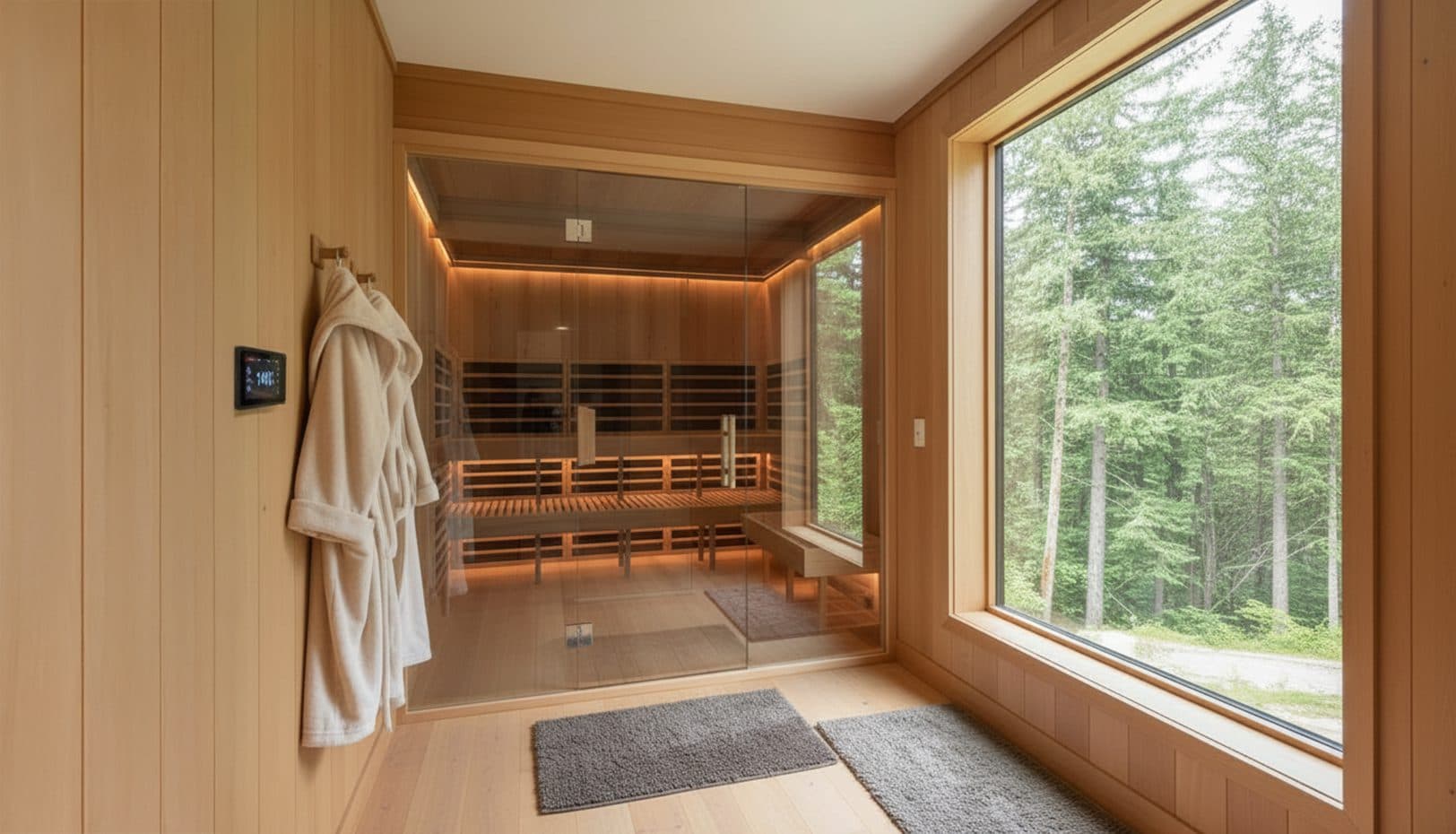
Infrared Sauna Room Ideas: 12 Formats, Layouts, and Materials From a Custom Sauna Builder
Key Takeaways
- A one-person infrared sauna fits in as little as 3'x3', roughly a reach-in closet, as long as the space has airflow, a power feed, and room for insulation and a vapor barrier.
- Infrared runs at 120-150°F versus a traditional stove's 160-195°F, so sessions run longer (30-45 minutes) but cost roughly half as much to operate, around $5, $10 per week for typical use.
- Sequence the build space, then power, then format, then materials: buying the model first is how people end up with a sauna their ceiling, delivery path, or circuit can't support.
In This Article
There's a specific moment every sauna buyer knows: you're standing in front of a spare closet, or a dead corner of the basement, phone in hand, scrolling through gorgeous cedar rooms and salt walls and thinking, could that actually happen here? We've been asked some version of that question across more than 3,000 custom installations since 2014, and the honest answer is usually yes, but not the way the idea galleries tell it. The best infrared sauna room ideas don't start with wood species or LED strips. They start with what you actually have: the space, the circuit, and the format that fits both.
The format spectrum behind every infrared sauna room
An infrared sauna room is a format decision before it's a decor mood board. Across our installs, the choice between a fabric dome, a one-person closet unit, a corner cabin, a custom room, or an outdoor build gets made before anyone picks a finish, because the format determines everything the room will ask of your house. The physics behind the small formats is simple: infrared emitters heat your body directly at 120-150°F, while a traditional stove has to heat the air itself at 160-195°F. Less air to heat means less space and less electrical overhead.
The market has noticed. The global sauna market was valued at USD 904.9 million in 2024 and is projected to reach USD 1,556.8 million by 2033, driven largely by infrared adoption, and the U.S. market is expected to grow by USD 151.3 million by 2029 on smart technology. Over half of people in Nordic countries reportedly have home saunas, and Finland reportedly has more saunas than people, which is the most encouraging statistic in this entire category.
So the spectrum is wide. One end is a fabric dome that tucks into a storage closet between sessions. The other is a handcrafted cedar room built into your walls. Same therapy category, opposite commitments. Here's the builder's order we follow, which idea galleries tend to publish in reverse: space, then power, then format, then materials.
Traditional Finnish sauna vs infrared sauna: the decision that shapes the room
Choosing between a traditional Finnish sauna and an infrared sauna is a choice between two heat delivery systems, and that choice shapes the room before anything else gets decided. A traditional Finnish sauna heats the air with a stove and hot rocks at 160-195°F. An infrared sauna's emitters heat your body directly at 120-150°F. That gap drives everything downstream: how long your sessions run, what the room costs to operate, and how much space and power the build demands.
The traditional experience is shorter and hotter. Sessions run 15-20 minutes, and if you want steam, you throw water over the hot rocks to create löyly, that rolling humid heat Finnish saunas are famous for. It suits social ritual and intense sweat. It also costs more to run, because heating a whole room of air to 195°F takes serious energy.
Infrared flips the trade. Sessions run 30-45 minutes at a gentler temperature, closer to warm sunshine than a blast furnace, because the waves heat your tissue directly instead of the air around you. It's more energy-efficient and can cost roughly half as much to run, and it suits targeted pain relief and longer, slower relaxation. Sore muscles and stiff joints are what people actually notice getting better.
Neither type is objectively better. If you want the social, steamy version, traditional wins for you. If you want quiet 40-minute sessions that don't torch your electric bill, infrared does. Which sounds like your life is the whole question.
The six sauna types, briefly
The North American Sauna Society recognizes six types: wood-burning, electrically-heated, manufactured sauna rooms, smoke saunas, steam rooms, and infrared. The practical unlock in that list is that dry saunas need no plumbing, which is why one can go almost anywhere in your home. Outdoors, the barrel sauna is the traditional-chic option, all curved cedar and backyard character.
On heaters: wood-burning means tending a fire, and it may raise your homeowner's insurance. Electric heaters are cheaper and lower-maintenance, and insurers generally expect professional installation that meets code either way.
The infrared sauna dome: a sauna room that stows in a closet
A fabric-enclosed infrared dome makes sense where no fixed room can be dedicated, because it packs away into a storage closet between uses. The Curve model is small enough for tiny apartments, and it delivers real sauna benefits, especially for muscle aches and joint pain. You'll see "detox" claims attached to domes in a lot of marketing; the evidence there is thinner than the marketing suggests, so we'd lead with what people actually report, which is that sore muscles feel better afterward.
Pair the dome with an amethyst mat and you've got a genuinely compact setup, proof that a tiny apartment doesn't mean skipping the ritual entirely. The honest tradeoff, friend to friend: it tucks away when you're done, but you're trading the full enveloping sauna experience for that convenience. You're sitting in a warm cocoon, not a cedar room. Both sides are real.
One boundary worth stating plainly: the evidence here supports domes, not sauna blankets. If you came looking for blanket options, the research we can stand behind doesn't cover them yet.
The closet conversion: what a 3'x3' infrared sauna actually needs
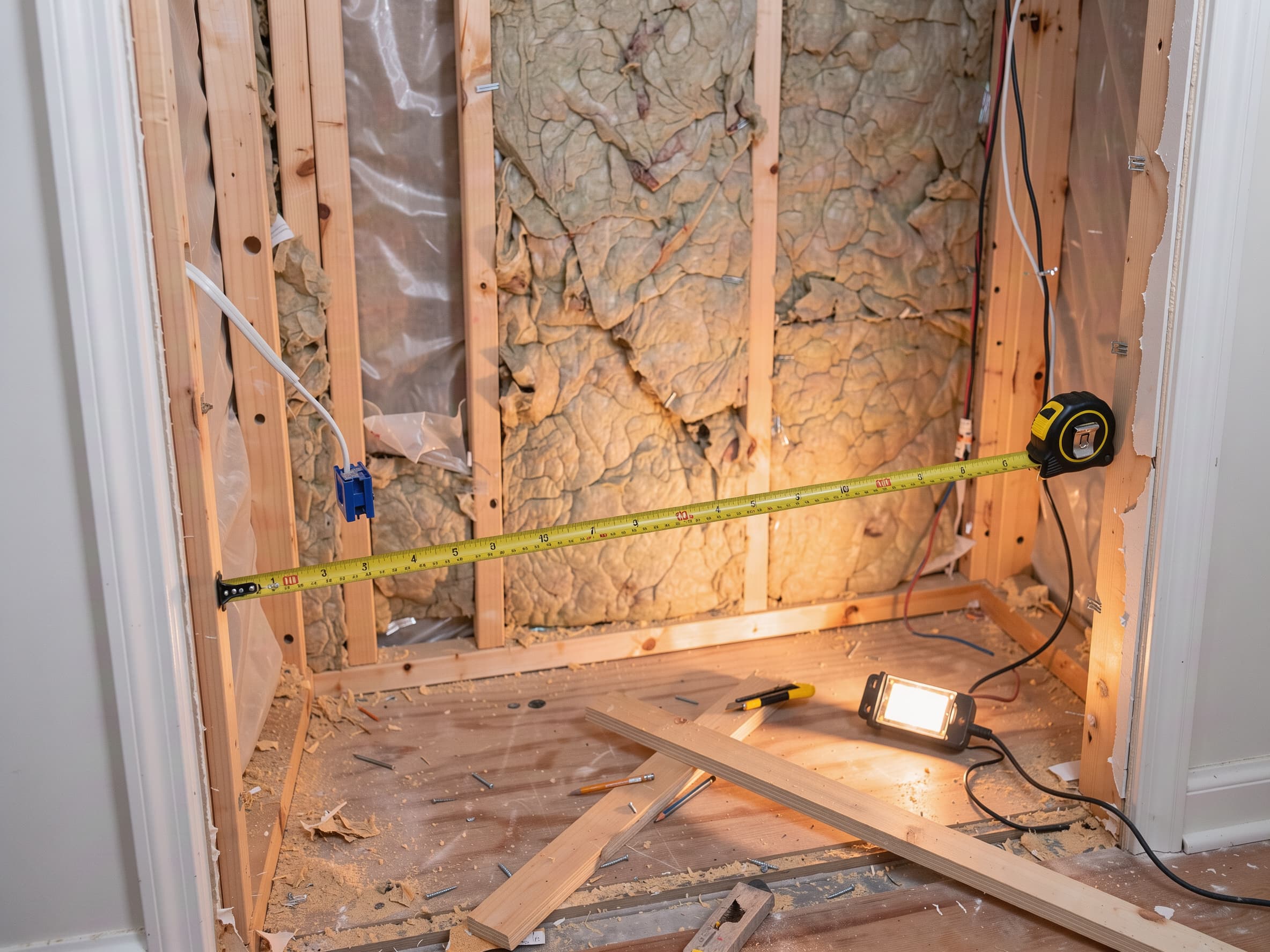
A one-person infrared sauna fits in as little as 3'x3', roughly a small reach-in closet, and most people overestimate how much room they need. That's the permission slip for apartment dwellers and anyone with one unused closet: the footprint is smaller than you think. What the space actually needs is infrastructure, not square footage.
The sizing minimums, kept straight:
- Most infrared units need a 6.5-foot ceiling and at least 4'x4' of floor space. The ceiling height is the number people forget to check.
- 5'x6' is the realistic starting point for a traditional Finnish sauna or a two-person build.
- General traditional minimums run 4'x4' of floor with ceilings above seven feet, which is a different standard from the infrared numbers above.
Architect Mark Holmquist frames the feasibility question conditionally, and it's the right frame: the critical requirements come down to sufficient airflow and a power source, and a closet becomes a functioning sauna once you add insulation, a vapor barrier, and an electrical feed. In other words, feasibility gates on three infrastructure items, not on whether you own a spare room.
The pattern we see across installations is consistent: buyers assume they need a dedicated room, then discover that a 3'x3' unit or a stowable dome delivers most of the ritual they were after. The closet they were going to throw out turns out to be the sauna.
So measure your candidate closet against three gates instead of asking whether it's big enough: can it breathe (airflow), can it be fed (a power run), and can it be sealed (insulation and vapor-barrier feasibility)? If all three are yes, the closet conversion is real. If you're weighing indoor placements more broadly, our guide to indoor infrared sauna room ideas walks the room-by-room versions of this same logic.
The corner cabin: a reviewed 2-person unit and the sightline argument
A specific reviewed unit beats a generic "pick a 2-person cabin" recommendation, so here's a lived-with-it example. The Dynamic Barcelona 2-person infrared sauna seats one or two, heats to temperature in about 5-10 minutes, and has a small corner-friendly footprint. The reviewer, known as The Mexican Dad, notes the quality glass door and hinges, the heating panels, a sensor, and speakers. He uses it to unwind after work, sometimes with music, and recommends it. That quick heat-up is the detail that matters when you're fitting sessions into a real schedule: decide at 6pm, you're sweating by 6:10.
The contrarian placement point, and it's one argument among several rather than the whole thesis: a sauna in a daily sightline tends to get used more than one sequestered in a picture-perfect basement sanctuary. This reviewer's unit sits in a corner of his living space, visible on the ordinary route through his evening. The "dedicated wellness sanctuary" ideal can quietly work against habit formation, because the sanctuary is downstairs and the couch is right here. Placement for habit is a legitimate design criterion.
Indoor locations: basement wellness zone, bathroom spa, or converted spare room
You pick the location by what you want it to do, not just its vibe. A basement is the forgiving blank canvas, private, temperature-steady, with room for a shower or lounge nearby. A master bathroom wins if sauna-to-shower flow is the point, and a walk-in closet can convert too. A spare room works when you'd rather transform a guest room or home office and keep the privacy. Once you know which of those you're solving for, the choice mostly makes itself.
The basement wellness zone
The basement is private, often underused, and temperature-steady, with room to spare for a shower or a lounge nearby. You're already ignoring this space; it's the most forgiving canvas in the house.
A master bathroom spa with sauna-to-shower flow
The selling point here is the flow: sweat, rinse, done, without crossing the house in a towel. A walk-in closet adjacent to the bath can be converted as part of the same layout.
The converted spare room
That guest room or home office nobody uses becomes a private wellness spot. Position the sauna away from direct foot traffic, which keeps the temperature steadier and your relaxation uninterrupted. Don't put your calm corner in the hallway.
The detached outdoor escape: backyard infrared sauna reality check
An outdoor sauna room works as a mental-separation destination, a place you walk to, but it gates on power: outdoor units need proximity to the main structure for 220V service. That single constraint eliminates more backyard dreams than budget does.
The placement requirements for an outdoor build:
- The barrel sauna is the traditional-chic outdoor format, and it's the look most backyard builds borrow.
- Outdoor builds still need the full envelope, R-20 to R-30 insulation with the correct vapor barrier class, because they face weather, not just interior air.
- Position the structure within power-run distance of the house. A beautiful pod at the far property line is a beautiful pod with no heat.
One honest limitation: most available guidance on outdoor setups comes through traditional and barrel framing, so outdoor infrared-specific placement advice beyond the 220V constraint is thinner than the indoor guidance, where we cover converting spare rooms, closets, bathroom corners, and basement nooks in detail. We'd rather tell you that than paper over it. For the weatherproofing and cold-weather side of outdoor builds, our outdoor infrared sauna room ideas guide goes deeper.
Wood choices: cedar, hemlock, and aspen, and where to spend on each
Pick your wood by your priorities: smell, allergies, or style. Western Red Cedar is durable, resists moisture and decay, and smells great when heated, with that classic reddish-brown look. Canadian Hemlock is light-colored, non-aromatic, with a clean uniform grain that suits modern designs, the pick if you don't want the cedar smell. Aspen is hypoallergenic, scent-free, non-toxic, and stays cooler to the touch, which makes it the lead recommendation for anyone with sensitivities. Poplar and basswood round out the Nordic whitewoods, in the same light-colored, scent-free family for buyers who want that look without the cedar aroma.
Whatever the wood, the non-negotiables don't change: it has to survive temperature and humidity swings without warping, stay cool to the touch, and be splinter- and resin-free. Builder Seymen Usta's point holds: quality dry saunas need heat-resistant woods like cedar, hemlock, or spruce.
The cost-tiered tactic is procurement logic, not a budget hack: put premium wood like cedar on the benches and heat-facing walls where your skin and eyes meet it, and cheaper wood like hemlock or eucalyptus everywhere else. That's how we allocate spend on custom builds.
Two safety floors. Cedar and hemlock resist rot naturally with antimicrobial properties. And pressure-treated lumber is a hard no in an enclosed sauna, because the chemical treatments off-gas in high heat; the cheapest option on the lumber aisle is actively the wrong one. On the custom end of the material spectrum, this is where building your own custom infrared sauna comes in, our own cedar builds, handcrafted with low-EMF VantaWave heaters, sit here, with the wood and the heater spec chosen together, not separately.
Sauna flooring options: waterproof, slip-resistant, cleanable
Wet feet and slick surfaces are the actual risk in a sauna room, and carpet is disqualified on sight. Flooring has to be waterproof, slip-resistant, and easy to clean. Four options earn their place:
- Sealed concrete: durable, waterproof, takes a finish well.
- Textured porcelain or ceramic tile: non-slip underfoot and can be sloped for drainage.
- Luxury vinyl tile or plank: rated for wet areas, warmer underfoot than tile.
- Removable cedar duckboard over a waterproof subfloor: lifts out so the surface underneath can dry and be cleaned.
Bench layouts: tiered, L-shaped, or single-level, heat physics as furniture
Bench layout is a heat-physics decision, because where you sit determines how hot your session feels. Heat rises, so your seating height is your temperature setting. The layouts and their numbers:
- Tiered benches offer two heat intensities in one room. The upper bench is hotter because heat rises; that's stratification, not preference.
- L-shaped seating suits square rooms and conversation.
- Single-level benches keep small saunas feeling open.
- Bench depths run 18-24 inches, with two feet of bench space per person.
- Leave 18-24 inches of clearance on each side of the entrance for getting in and out and for air circulation.
Two safety specs belong in the same breath. The door must always open outward and needs a high-quality seal, because you don't want to be pushing against heat to get out. And temperature controls and timers should be reachable from inside without opening the door. The bench numbers back this up: depths of 18-24 inches at multiple heights, with two feet of bench space per person. If you're weighing sitting versus lying down in an infrared sauna, bench height and heater proximity are what make either position work, which we cover in more detail in our piece on sitting up versus lying down.
Electrical and ventilation requirements: the gates before any model gets bought
Before any model gets chosen, the power feed has to be verified and the convection ventilation loop worked out, because electrical capacity is the gate that determines which formats are even possible. This is where vagueness costs money, so the numbers stay exact.
Electrical
Infrared saunas draw 20-40 amps depending on the model, and electric sauna heaters generally need 240-volt service (outdoor units use 220V). Undersized connections create safety hazards and void warranties, so leave the final hookup to a licensed electrician, one licensed visit protects the house and the investment. Ventilation matters just as much: an intake vent low near the heater or floor and an exhaust vent high on the opposite wall create convection, and a moisture-detecting exhaust fan should run during use and for 30 minutes after, ducted outside rather than into an attic or crawlspace. Done right, that setup prevents stuffiness, mold, and moisture damage.
Ventilation
The loop is simple physics: an intake vent low near the heater or floor, an exhaust vent high on the opposite wall. That arrangement creates convection, so air actually moves instead of going stale. A moisture-detecting exhaust fan should run during use and for 30 minutes after, and it must duct outside, never into an attic or crawlspace. The attic shortcut is the mistake people actually make. Done right, this prevents stuffiness, mold, and moisture damage; done wrong, the failure shows up a year later in your walls.
Insulation and vapor barriers: where DIY sauna rooms silently fail
Insulation is what separates a sauna from a hot box that leaks heat, and the failure shows up months later, not at inspection, it's one of the common mistakes covered in honest DIY infrared sauna guidance. Budget with the dollar range first: insulation runs $15, $30 per square meter, roughly $300, $600 for an 8'x5' sauna.
R-20 to R-30 insulation is standard. Fiberglass is cheapest but can degrade over time; mineral wool is the middle ground; spray foam seals tightly at a price. The North American Sauna Society recommends fiberglass with an aluminum vapor barrier, especially at the ceiling. On barrier classes: Class A barriers go on interior-facing surfaces, Class B on exterior-facing walls, meaning the side that faces the room gets Class A and the side that faces the outdoors gets Class B. Drywall must never touch the sauna interior, and the ceiling and upper walls get moisture-resistant paint.
Builder Ruben Gutierrez's caution is the one to keep: skimp here and the outdoor sanctuary you imagined ends up a drafty wooden shed, a risk covered well in these planned outdoor infrared sauna room ideas. The pattern behind most builds that never reach temperature or dump moisture into surrounding walls is the same: under-spec'd insulation or a vapor barrier class in the wrong place.
Sauna lighting and chromotherapy: programming the mood of the session
Lighting gets specced to a therapeutic goal, not decorated arbitrarily, because harsh light ruins a good sauna and warm light makes it. Go soft, indirect, heat-rated, and dimmable, at around 2700K. Cool white feels clinical in a hot dark room; 2700K is the number to keep.
One design trick worth stealing: under-bench LED strips, which make the benches look like they're floating and show off the wood grain. A backlit Himalayan salt wall casts a warm pink-orange glow; treat it as a design feature first, with the therapeutic claims kept attributed and light.
Chromotherapy is the fun layer. The color settings are marketed with calm assigned to blue, balance to green, energy to red, and positivity to yellow. That's what they're pitched for, not proven medicine, but it's a genuinely useful way to think about the room: you're programming the mood of each 30-45 minute session. The copyable spa recipe is short: warm-toned wood, hidden LED strip lighting, a frosted glass door, wooden headrests, small backlit panels.
The health-conscious atmosphere
The vibe goal translates into three concrete choices: calm-promoting colors or chromotherapy, good lighting, and a clutter-free space. Clutter is a stress source, and a hot room full of it undermines the whole point.
Smart sauna technology: panels, speakers, and app pre-heating
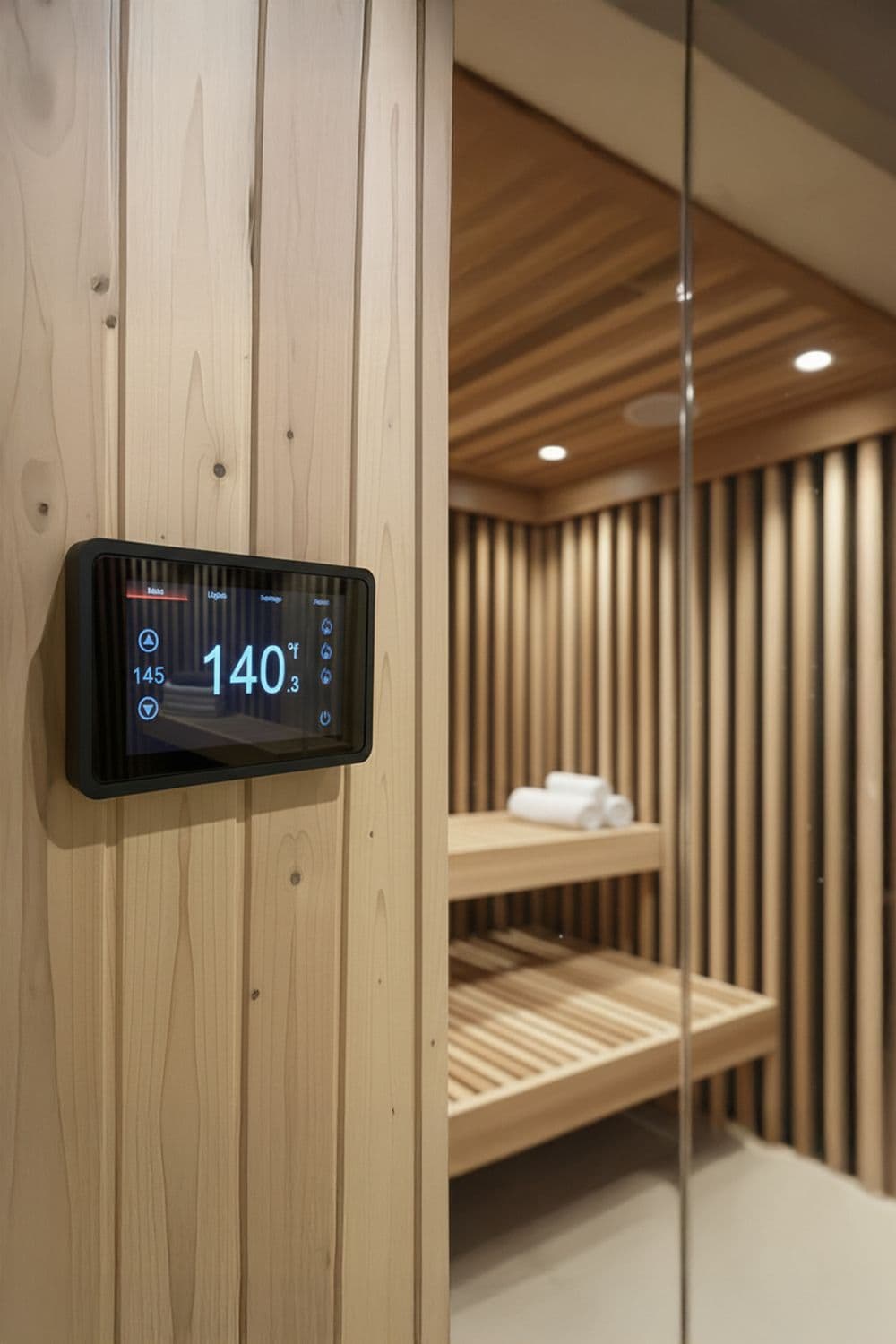
The test for smart features is whether you'll actually use them. Digital panels handle temperature, session time, lighting, and sound, and the practical payoff is that you set it once and stop fiddling. Heat-resistant Bluetooth speakers earn their spot for podcasts, playlists, or meditation tracks, depending on what you'll actually listen to in there. App integration means pre-heating from the couch and starting, stopping, or monitoring from anywhere; the honest appeal is simply that it's warm when you get there.
The low-tech counterpoint still stands: a plain thermometer and hygrometer matter for fine-tuning the climate. Cheap, useful, unglamorous, and no app replaces them.
The complementary wellness stack: matching add-ons to health goals
Every add-on earns its footprint by answering a specific health objective, not by filling space. Six that actually clear that bar:
The amethyst mat with far-infrared and PEMF therapy
In plain terms, it's a mat packed with amethyst stones, delivering far-infrared heat plus PEMF, which is pulsed electromagnetic field therapy, essentially pulsed magnetic fields applied to the body. The vendor claims it supports restful sleep, cell regeneration, reduced inflammation, stress management, and calm; the evidence isn't strong, so hold those lightly. As a meditation corner or pre-bed wind-down element, it works.
A portable aromatherapy diffuser
Compact units don't eat counter or shelf space, which matters more in a small wellness corner than any spec. Aromatherapy gets pitched for stress and insomnia, but the evidence is mixed, so think "some people find it helps." The AROMA ONE is a named example. Finding your oil takes trial and error; you'll probably buy two or three before one clicks.
A portable halotherapy device
Halotherapy is breathing salt-infused air, traditionally pitched for respiratory issues and skin health. It's a wellness practice with mixed evidence, not a prescription. The HALO ONE recreates the salt-cave effect in a small space, and vendor claims about allergy and respiratory help stay attributed to the vendor.
A red light therapy tower
Claimed benefits split honestly: skin health and complexion have decent evidence behind them, non-invasive pain relief has some research support, and immune support is thinner. Towers come in various sizes and can sit next to a desk or reading nook, so you can use one while doing something you were already doing.
Compact exercise equipment
Foldable treadmills, workout mirrors, compact stationary bikes, collapsible weight sets. The payoff is time: no dedicated gym room needed, and no gym commute means the workout actually happens.
Indoor plants and greenery
Plants modestly help air quality, calm, and focus. They won't transform your life, but a greener room tends to feel better, and plant walls and modular gardens make it feasible even in small rooms.
DIY sauna kits and costs: the conditional 30-40% savings
DIY saves real money, 30-40% over prefab, but only if the insulation, vapor barrier, and electrical are done correctly first. The savings are conditional, and the failure mode is catastrophic rather than cosmetic. A DIY build runs $3,000 to upwards of $20,000, and that full range matters: the low end isn't a promise.
A kit includes the interior materials, but you still frame the walls and ceiling yourself. Assembly itself is genuinely approachable: Mande Spa Outdoor kits use tongue-and-groove panels that click into place, a two-adult, couple-of-hours job, with professional electrical hookup recommended. Next to a full custom build, a prefab kit is the easier road, because the interior materials arrive ready to assemble. The custom room is the bigger commitment; the kit splits the difference. The hybrid model is the sensible version of middle: you assemble the kit, and the final hookup goes to a licensed electrician.
Builder Kiril Ratia of Ratia Construction offers a warning, stated once and calmly: a leak or electrical fault in a cheap DIY build can snowball into serious damage or even fire. Real risk, worth respecting.
Infrared sauna downsides: lower temperatures, longer sessions, real amperage
The three practical tradeoffs, named plainly: infrared tops out at 120-150°F versus traditional's 160-195°F, sessions run longer at 30-45 minutes versus 15-20, and models can draw 20-40 amps, more electrical demand than most buyers expect. Idea-gallery content tends to skip this section; a builder shouldn't.
On session evidence, the ranges reconcile cleanly once you see they're different scopes. Research-backed benefits generally show up with 15-45 minute sessions at 140-160°F. Separately, studies on traditional wood-burning saunas point to 10-15 minute sessions for blood flow and endorphins. These figures are compatible; different studies measured different things in different sauna types. No false precision required.
The verdict stays individual: these limits are only disqualifying if you want intense enveloping heat or short sessions. For targeted pain relief and extended relaxation, the lower temperature and longer duration are the design, not a defect. We lay out the full tradeoff in our piece on the downsides of an infrared sauna.
Usage ritual: how a session actually runs
Shower before entering, keep a towel between your skin and the wood, sit for 10-15 minutes of heat, then cool down. (There's a real post-session window worth knowing about; we cover why not to shower immediately after an infrared sauna in its own piece.) For cultural color: löyly is the steam Finns create by throwing water over hot coals with a bucket and ladle, vasta and vihta are birch twigs used for circulation, and the traditional cool-down ends with a jump into a freezing lake, though most readers will use a shower. Traditional saunas center on shared social ritual; infrared warmth is closer to gentle sunshine than enveloping heat.
Maintenance routine: minutes per session, sanding per quarter
Two habits after every session: wipe down the benches and walls, and leave the sauna completely dry with the door open. That open-door dry-out is the same moisture-control logic from the insulation section, applied in miniature. Every few months, add light sanding, regular heater checks, and a deeper clean with gentle, wood-appropriate cleaners. Small habits, not a chore mountain.
Planning sequence and cost of ownership: space, power, format, materials
A two- to three-person sauna used 3-4 times a week at about 15 minutes a session runs roughly $5, $10 per week to operate, and infrared can cost about half as much to run. That's less-than-your-coffee-habit territory, a general figure rather than a guarantee.
The planning rule that protects the rest of your budget: design the room before purchasing, so the model fits the room's constraints. The builder's ladder runs space, then power, then format, then materials, and buying the model first is how buyers discover that the ceiling, the delivery path, or the circuit can't support it. It's the most common pre-purchase mistake we see, and it's entirely avoidable. This sequencing is also why our designer-to-customer process settles power and placement before any material conversation happens.
Budget for professional electrical, HVAC, and moisture work upfront; the hidden costs are what wreck budgets later. Keep water nearby, and consider a cool-down alcove with seating. That comfort detail is what separates a usable sauna corner from a nice-looking one.
Tie the three ownership horizons together and the picture is manageable: $3,000, $20,000 to build, $5, $10 a week to run, minutes of maintenance per session. The concrete next step is the one the galleries bury: measure the space and confirm the circuit before falling for a specific model.
| Model | Standout spec | Limitation |
|---|---|---|
| Infrared sauna dome | Infrared sauna dome: Compact fabric-enclosed unit that fits in a storage closet when not in use; Provides sauna benefits including detox and relief for muscle aches and joint | Infrared sauna dome: Compact fabric-enclosed unit that fits in a storage closet when not in use; Provides sauna benefits including detox and relief for muscle aches and joint |
| Location ideas | Location ideas include basement wellness zones, master bathroom spa corners with sauna-to-shower flow, converted spare rooms, and detached outdoor escapes; basements are private, | Detached outdoor escapes need proximity to the main structure for 220V power. |
| Wood choices | Canadian Hemlock is light-colored and non-aromatic for modern designs; Aspen is hypoallergenic, scent-free, and stays cooler to the touch. | Sauna interior wood must withstand extreme temperature and humidity swings without warping, remain cool to the touch, and be free of splinters and resins; a cost-saving strategy |
| Sauna flooring options | Options include sealed concrete, luxury vinyl tile/plank for wet areas, and removable cedar duckboard over a waterproof subfloor. | Standard carpet should be avoided because it fails the waterproof, slip-resistant, easy-to-clean requirements. |
| Bench layouts | Benches at multiple heights with 18-24 inch depths and two feet of bench space per person. | L-shaped seating suits square rooms and social use, while single-level benches are the option that keeps small saunas open. |
| Sauna lighting and chromotherapy | Sauna lighting should be soft, indirect, heat-rated, and dimmable at 2700K; under-bench LED strips create a floating look, a backlit Himalayan salt wall is both design and | Sauna lighting should be soft, indirect, heat-rated, and dimmable at 2700K; under-bench LED strips create a floating look, a backlit Himalayan salt wall is both design and |
| Smart sauna technology | Smart sauna technology: Digital panels control temperature, session time, lighting, sound; Bluetooth heat-resistant speakers for podcasts/playlists/meditation tracks; App | A thermometer and hygrometer remain essential classic tools for fine-tuning the climate alongside smart controls. |
| DIY sauna kits and costs | Kits include interior materials, but the builder must frame the walls and ceiling. | Not published |
Spec comparison
Frequently Asked Questions
What is the 200 rule sauna?
The "200 rule" is a general convention that circulates in sauna communities, not a sourced building standard. It gets referenced as a rule of thumb for sauna design dimensions, but it doesn't carry the authority of code. Treat it as community wisdom to sanity-check, not a requirement your build must satisfy.
Is it better to lay down or sit up in an infrared sauna?
Both positions can work, bench height and heater proximity are what make either one effective. Heat rises, so a higher bench or upper tier runs hotter than a lower one, which is stratification, not preference. Tiered benches give you two heat intensities in one room, so you can choose your intensity session by session.
Infrared sauna vs traditional Finnish sauna: which is better for a home sauna room?
Neither is objectively better, they're two different heat delivery systems. Traditional Finnish saunas heat the air with a stove at 160-195°F for shorter, hotter, steamy social sessions, and cost more to run. Infrared emitters heat your body directly at 120-150°F for quieter 30-45 minute sessions at roughly half the operating cost. If you want the social, steamy ritual, traditional wins; if you want long sessions that don't torch your electric bill, infrared does.

Founder & Lead Designer, SaunaCloud®
SaunaCloud: 3,000+ installations since 2014 · Author of The Definitive Guide to Infrared Saunas · Featured in Forbes, Inc., and MSN
Christopher designs every SaunaCloud sauna. His work brings the room, heaters, controls and installation plans together so you can review the project before committing. His professional expertise is sauna design and construction, not clinical medicine.
Custom 3D renderings and a proposal in 24-48 hours.

Ready to Design Your Sauna?
Every project starts with a conversation. Tell us about your space and we'll create your custom plan — free, no obligation.
Custom 3D renderings and a proposal in 24-48 hours.