
Can You Take a Book Into an Infrared Sauna? Paper, Kindle, and Audiobook Risks
Key Takeaways
- A paperback's glue softens above 120°F, and your infrared sauna operates at 120–140°F — repeated sessions will eventually loosen pages, especially in hardcovers. Designate a cheap "sauna copy" and accept the wear.
- Most e-readers and phones have a maximum operating temperature of 95°F. Your sauna exceeds that by 25–45°F. One session probably won't kill your device, but daily exposure over months measurably degrades the battery and voids the warranty.
- Audiobooks carry zero risk because the device stays outside the sauna. They also let you close your eyes and recline fully, which aligns with the relaxation the sauna is designed to produce.
In This Article
Yes, you can take a book into an infrared sauna — but the smart answer depends entirely on what you're bringing. A paperback will survive differently than a Kindle, and an audiobook removes the problem completely.
The reason the answer isn't simpler comes down to how infrared saunas work. Traditional saunas heat the air to 150–195°F, often with steam that saturates everything in the room. Infrared saunas use light waves to heat your body directly at 120–140°F, so the ambient air stays cooler and drier. That changes the risk profile for both paper and electronics compared to what you've probably heard about saunas in general.
But it doesn't eliminate the risk. Here's what happens to each option, and how to decide what belongs in your session.
Paper Books in an Infrared Sauna: The Real Risk Isn't What You Think
If you've heard that saunas ruin paper books, you've probably heard it in the context of a traditional steam sauna. That's a different problem: pages soak up moisture fast, edges curl, paper goes wavy. In a traditional sauna, humidity is the enemy.
Infrared saunas are dry heat. Your pages will probably be fine from a moisture standpoint.
The risk is the glue. Modern paperbacks use adhesive that softens at temperatures above 120°F. Your infrared sauna runs at 120–140°F. Do the math: one session won't turn your book into a pile of loose pages, but do it regularly — say, three times a week for a few months, and you'll start noticing pages pulling away from the spine. Hardcovers are worse because rigid covers warp more easily in heat, and they cost more to replace.
The Sauna Copy rule. The practical solution is simple: pick a specific paperback that you don't mind getting battered. A used copy of something you've already read. Accept that it'll get heat-worn, enjoy it without stress, and don't bring first editions or library books.
Keep a towel handy for dry hands. Always choose paperback over hardcover.
There is one genuine upside to paper in the sauna: digital detox. No notifications, no screens, no temptation to switch tabs. But you're accepting damage as part of the ritual, and that's a tradeoff worth naming honestly.
If you want something more durable, books printed on synthetic pages or laminated pages are designed for exactly this kind of environment. Magazines printed on synthetic stock hold up the same way. They won't warp or curl. You can also DIY-laminate pages of a favorite book if it's not sold in a waterproof edition.
E-Readers and Electronics: The Temperature Problem
Here's the math: most consumer electronics — iPhones, Samsung and Google phones, Amazon Kindles, are rated for a rated for a maximum operating temperature of 95°F (35°C). Storage limit is 113°F (45°C). Your infrared sauna runs at 120–140°F. That's 25–45°F above what the manufacturer designed the device to handle.
A traditional sauna at 180°F is worse — safety sensors trigger thermal shutdown. Infrared is borderline. But infrared's radiant heat can heat a device casing faster than the air temperature alone would suggest.
What that means for a single session: It probably won't destroy your device. Many people report years of using a Kindle in the sauna with no immediate failures.
What that means for 300 sessions: Heat accelerates lithium-ion battery degradation — electrolyte decomposition speeds up, internal resistance increases, capacity fades. Daily exposure over months is measurable. Your battery will hold less charge, and eventually it'll swell or fail. You're also voiding the manufacturer warranty by operating the device outside its rated conditions.
If you're going to bring an e-reader, here's how to reduce the risk:
- Go waterproof. The Kindle Paperwhite and Kindle Oasis have an IPX8 rating, which means they can handle sweat and humidity. But understand that water rating says nothing about heat tolerance. It helps with moisture, not temperature.
- Use the floor strategy. Heat stratifies in an enclosed space. Hold the device low, near your lap. The air at floor level is meaningfully cooler than at bench level.
- Remove thick protective cases. Counterintuitive, but a case insulates heat and traps it against the device. Your instinct is to protect the device — in a sauna, the case works against you.
- Limit sessions to 10–15 minutes. Short bursts. Then set the device outside to cool.
- Use the warm light setting if your Kindle has one. Bright white light disrupts melatonin production and works against the relaxation the sauna is meant to foster.
E-ink displays are more heat-tolerant than LCD or OLED screens, and the smaller battery means less thermal mass. A Kindle is the lowest-risk screen device you can bring in — but you're still accepting that you're shortening its lifespan.
Audiobooks: The Zero-Risk Option That's Also Better for Your Body
Audiobooks eliminate the entire problem. The device stays outside the sauna. There's no heat risk, no humidity risk, no battery concern, no content risk.
The setup is simple: your phone stays outside, streaming to a Bluetooth speaker positioned inside away from the heaters. For permanent setups, integrated ceiling-mounted speakers — the kind we build into custom SaunaCloud installations, are the cleanest solution.
What makes audiobooks better for the experience, not just safer: Reading a physical book or screen requires eye focus and a forward-head posture that creates neck and shoulder tension. That tension counteracts the relaxation the sauna exists to produce. Audiobooks let you close your eyes, recline fully, and enter a genuinely meditative posture — no holding, no straining, no device to worry about.
The one caveat: Choose your content carefully. The sauna is an emotional amplifier. A high-stress political podcast or a thriller might feel more intense in the heat than it would on a walk. Save the heavy stuff for the cooldown.
The Cognitive Angle: Why Reading in the Heat Is Actually Harder
If you've tried reading a dense chapter in the sauna and found yourself rereading the same paragraph three times, it's not a concentration problem. It's physics.
When your body's core temperature rises — the clinical term is hyperthermia, it acts as a cognitive load. Your brain is busy managing heat stress: maintaining blood pressure, diverting blood flow to your skin, keeping your internal temperature stable. That competes for the same working-memory resources you need to follow a complex plot or dense non-fiction. Research from the NIH National Library of Medicine confirms that heat stress directly impairs cognitive performance, making it harder to sustain focus on demanding material.
The timing insight that changes how you approach sauna reading: A A 2023 study by Chang and colleagues reported significant increases in theta and alpha brain wave power during the rest phase immediately after a sauna session. Those brain waves are associated with deep relaxation, creativity, and a calm-alert state. The Japanese concept of "totonou" describes this exact post-sauna euphoria — high physical relaxation with improved cognitive efficiency.
The practical takeaway: save the challenging reading for the cooldown phase, 10–15 minutes after you exit, while wrapped in a robe in a cool room. That's when your brain is primed for deep reading or creative thinking. Use the hot phase for lighter material or audiobooks.
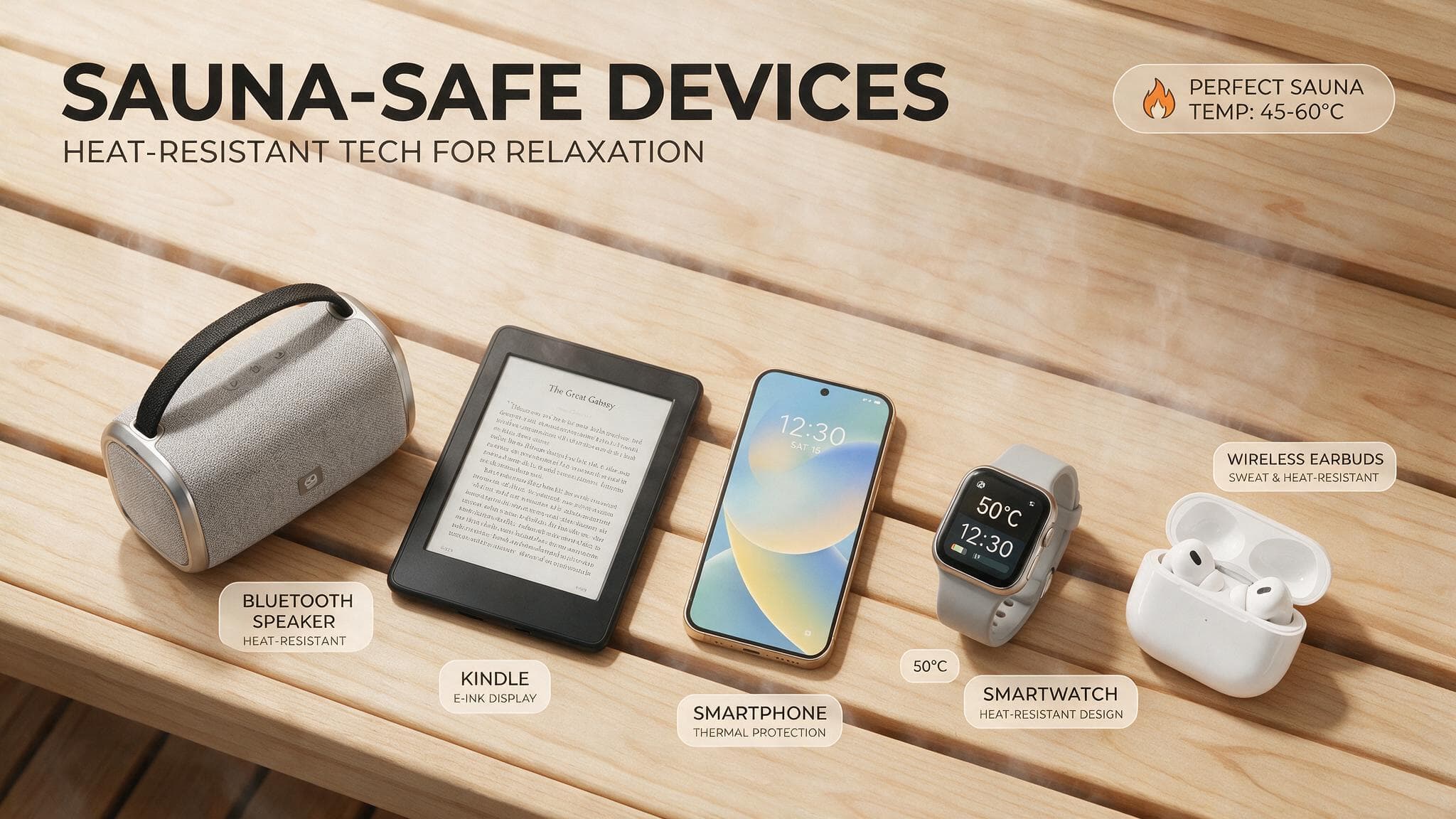
Device Risk Ranking: What's Actually Safe to Bring In
Not all devices face the same risk. Here's the hierarchy, from lowest risk to highest, based on how heat behaves and what each device is built to handle.
Bluetooth speaker — lowest risk. No body contact. Can be positioned away from heaters. It's not subjected to your body heat, sweat, or the higher temps near the ceiling. You control exactly where it lives.
Kindle or e-reader — moderate risk. E-ink displays handle heat better than phone screens. The battery is smaller, meaning less thermal mass to heat up. Still exceeding rated temps by 25–35°F, but the risk profile is manageable for short sessions.
Smartphone — high risk. Large lithium battery running 35–55°F over its max rated temperature. Risks include battery degradation, screen dimming, thermal shutdown, and moisture damage from sweaty hands. A single session probably won't kill it, but this is the device where cumulative damage adds up fastest.
Smartwatch or fitness tracker — high risk. Designed for exercise sweat, but not sustained 130–150°F. Direct skin contact at elevated temperature adds risk, and the small battery is still vulnerable. Short sessions are probably fine, but you're exceeding specs every time. For reference, the Apple Watch is rated to a maximum operating temperature of 95°F, far below sauna conditions, making it a poor choice for regular sauna use.
Wireless earbuds or AirPods — highest risk. Small lithium batteries positioned close to your head. Exposed to ear sweat. The adhesives holding components together soften in heat.
This is the worst device to bring into a sauna — can you bring your phone in? Your Kindle? Your AirPods? The short answer: you can, but you're operating every device well outside its rated can you bring your phone in? The combination of heat, moisture, and battery proximity is concerning.
Protecting Your Gear: Practical Steps That Work
Most sauna-reading advice focuses on heat damage, but the hidden risk is condensation.
When you move a hot device into a cool room — say, from your 130°F sauna into a 70°F hallway, internal condensation can form. That moisture inside the electronics is a greater long-term risk than the heat itself. The fix is simple: wrap the device in a dry towel and let it cool gradually before you turn it on or bring it inside.
Other protection measures that help:
- Distance is your best protection. Keep books and devices well away from heaters and hot stones.
- Dry hands, dry surfaces. Sweat is moisture, and moisture is the enemy of both paper and electronics.
- A Ziplock bag or dry bag provides a moisture barrier. Toss in a silica gel pack to manage humidity inside.
- For paper books, use a towel as a barrier between sweaty hands and the pages.
- Heat-resistant covers and screen protectors exist, but they're mitigation, not guarantees. Don't assume they make the device safe.
It's generally recommended to remove contact lenses before a sauna. High heat and low humidity cause rapid tear evaporation, leading to acute dry eye. Lenses can dehydrate, change shape, adhere to the cornea, trap bacteria, or cause abrasions. Prescription glasses are safer, though metal frames can get hot.
Your eyes need to function to read, so this is worth taking seriously. (For what it's worth, the infrared light itself doesn't damage your eyes — unlike UV, infrared is on the opposite end of the spectrum and doesn't harm the cornea or retina. The heat is the issue, not the light, and whether you can use an infrared sauna while on medication is a separate but important question.)
Lighting matters too. If you're reading paper books, install a warm-toned, dimmable reading light. If using a Kindle, switch to the warm light mode. Bright white light disrupts melatonin production and works against the relaxation the sauna is supposed to give you.
Staying Safe: When Sauna Reading Isn't the Best Idea
A sauna session elevates your heart rate through heat stress — blood vessels dilate, blood flow diverts to the skin, and your heart rate increases to maintain blood pressure. It mimics the cardiovascular response of moderate exercise like a brisk walk. For healthy people, this "passive cardio" effect is actually beneficial. But for people with certain conditions, it's not.
The medical boundaries worth knowing:
- The American Heart Association advises people with uncontrolled high blood pressure, heart failure, or heart valve disease to consult a physician before sauna use.
- Rapid heart rate and blood pressure changes can be dangerous for compromised cardiovascular systems.
- Some studies under medical supervision show benefits for stable heart failure patients (it's called Waon therapy), but that's supervised medical treatment, not casual home use.
- Health authorities recommend limiting sessions to Health authorities recommend limiting sessions to 15–20 minutes for healthy adults, with beginners starting at 5–10 minutes.
The hydration connection specific to reading: Cognitive function dips as you dehydrate. Reading demands mental focus, which can make you ignore thirst cues. If you're engaging in a cognitive task like reading, actively drink water throughout the session. A study in Frontiers in Physiology confirms that heat stress impacts fluid balance rapidly.
The distraction warning: Media can mask early signs of overheating — dizziness or nausea. Stay tuned into how your body feels. If you're absorbed in a chapter and miss the signal to cool down, that's a problem.
Disclaimer: This content is for general informational purposes only and does not constitute medical advice. Consult a licensed healthcare provider before using a sauna, especially if you have underlying health conditions.
Alternatives to Reading: Other Ways to Fill the Time
If you decide against bringing media, or you want variety, there are genuinely sauna-appropriate alternatives that don't involve a device or a book.
Breathing exercises. Deep, slow breaths reduce stress and promote relaxation. Inhale deeply through your nose, hold, then exhale slowly through your mouth. If you feel lightheaded, exit and cool down.
Meditation. The sauna's heat creates a peaceful environment with no distractions. Sit or lie comfortably, close your eyes, focus on your breath. Some people use guided sauna meditations.
Sauna-friendly board games. These exist — made from strong materials with waterproof cards or pieces. Choose games that are easy to play in a small space and won't disturb others.
Music. Many saunas have built-in speakers. Choose relaxing music rather than loud or disruptive tracks. Music strongly affects mood and can enhance the experience.
Socializing. Talking with others can pass the time, but not everyone wants to chat, so be considerate.
Simply relaxing. The sauna's benefits — stress reduction, improved circulation, work whether or not you're doing anything. You don't need to fill the time.
The Case for Bringing Nothing
Scrolling your phone in the sauna is like texting during a massage. You're physically present, but you've removed yourself from the experience.
A 2023 NIH study found significant increases in theta and alpha brain waves after a sauna session — brain states associated with deep relaxation and meditation. Those effects are strongest when you're not competing with them.
Many long-term daily sauna users report that digital disconnection became their most valued benefit — above the sweating, the heat, and the endorphin rush. Research by Chang in 2023 supports this, showing that the post-sauna brain wave changes linked to relaxation are strongest when you are not competing with digital input.
This isn't a prescription. If you're enjoying your Kindle in the sauna, that's fine. But consider that the disconnection itself is a therapeutic intervention, not just a side effect. Thirty minutes without your phone might become the most valuable part of your day.
Final Verdict: Choosing What Works for You
Here's a framework for deciding based on your priorities:
If your priority is the experience of a physical book — the tactile feel, the smell of paper, the digital detox, use a designated "sauna copy" paperback, keep it away from direct heat, and accept the wear as part of the ritual.
If your priority is convenience and you want your Kindle — use a waterproof model, hold it low near your lap, remove the case, and limit sessions to 10–15 minutes. Be aware that you're exceeding temperature specs and the cumulative risk is real.
If your priority is safety and maximum relaxation — choose audiobooks. The device stays outside, your eyes stay closed, and your posture aligns with the sauna's purpose. It's the cleanest solution.
If your priority is the deepest possible sauna experience — try bringing nothing. Just the heat, the quiet, and the cooldown. It might not feel like "enough" at first, but many long-term users report it becomes the most valuable part of the practice.
The worst thing you can bring into the sauna is something that keeps you from noticing how your body feels. Choose accordingly.
Frequently Asked Questions
Can you read a book in an infrared sauna?
Yes, but the type of book matters. A paperback will survive moisture-wise since infrared saunas use dry heat, but the glue softens above 120°F, so repeated sessions can loosen pages. Designate a cheap 'sauna copy' and accept the wear.
What can you bring into an infrared sauna?
You can bring paperbacks, e-readers, or audiobooks, but each has trade-offs. Paperbacks risk glue damage over time, electronics like Kindles exceed their rated temperature limits, and audiobooks are the safest option since the device stays outside. A towel for dry hands and a Ziplock bag for moisture protection are smart additions.
What's the difference between reading a paperback and an e-reader in an infrared sauna?
Paperbacks face glue softening above 120°F, which can loosen pages over time, but they offer a digital detox with no screens. E-readers like Kindles exceed their 95°F operating limit, risking battery degradation and voided warranties, though they're more convenient. Audiobooks eliminate both risks entirely.
How does heat affect your ability to read in a sauna?
Heat stress from the sauna acts as a cognitive load, making it harder to focus on complex material. Your brain diverts resources to manage body temperature, so you might find yourself rereading paragraphs. Save challenging reading for the cooldown phase, when brain waves associated with deep relaxation peak.

Founder & Lead Designer, SaunaCloud®
SaunaCloud: 3,000+ installations since 2014 · Author of The Definitive Guide to Infrared Saunas · Featured in Forbes, Inc., and MSN
Christopher designs every SaunaCloud sauna. His work brings the room, heaters, controls and installation plans together so you can review the project before committing. His professional expertise is sauna design and construction, not clinical medicine.
Custom 3D renderings and a proposal in 24-48 hours.
Continue Reading
Safety & Best Practices
Sauna Safety for Kids: Age-Specific Guidelines, Temperature Limits, and Why Infrared Is Safer (2026)
Read article
Safety & Best Practices
Senior-Safe Sauna Design: Features That Prevent Falls
Read article
Safety & Best Practices
What Is the 200 Rule for Saunas? A Safety Guideline Explained with Real-World Heat Stress Examples
Read articleReady to Design Your Sauna?
Every project starts with a conversation. Tell us about your space and we'll create your custom plan — free, no obligation.
Custom 3D renderings and a proposal in 24-48 hours.