What Is the 200 Rule for Saunas? A Safety Guideline Explained with Real-World Heat Stress Examples
Key Takeaways
- The 200 rule says temperature in Fahrenheit plus humidity as a percentage should stay under 200; it's a sauna-community safety heuristic, not a scientifically validated threshold.
- At the 2024 Shanghai Masters, 86°F with humidity over 80% produced a combined sum near 166–170 — far below 200, yet Novak Djokovic vomited, Arthur Rinderknech collapsed, and Jannik Sinner retired, because exertion changes the equation.
- For your own sessions, aim for a combined sum of 150–170 as a beginner, cap sessions at 5–10 minutes, and remember that a dry sauna at 210°F can be safer than a steam room at 110°F.
In This Article
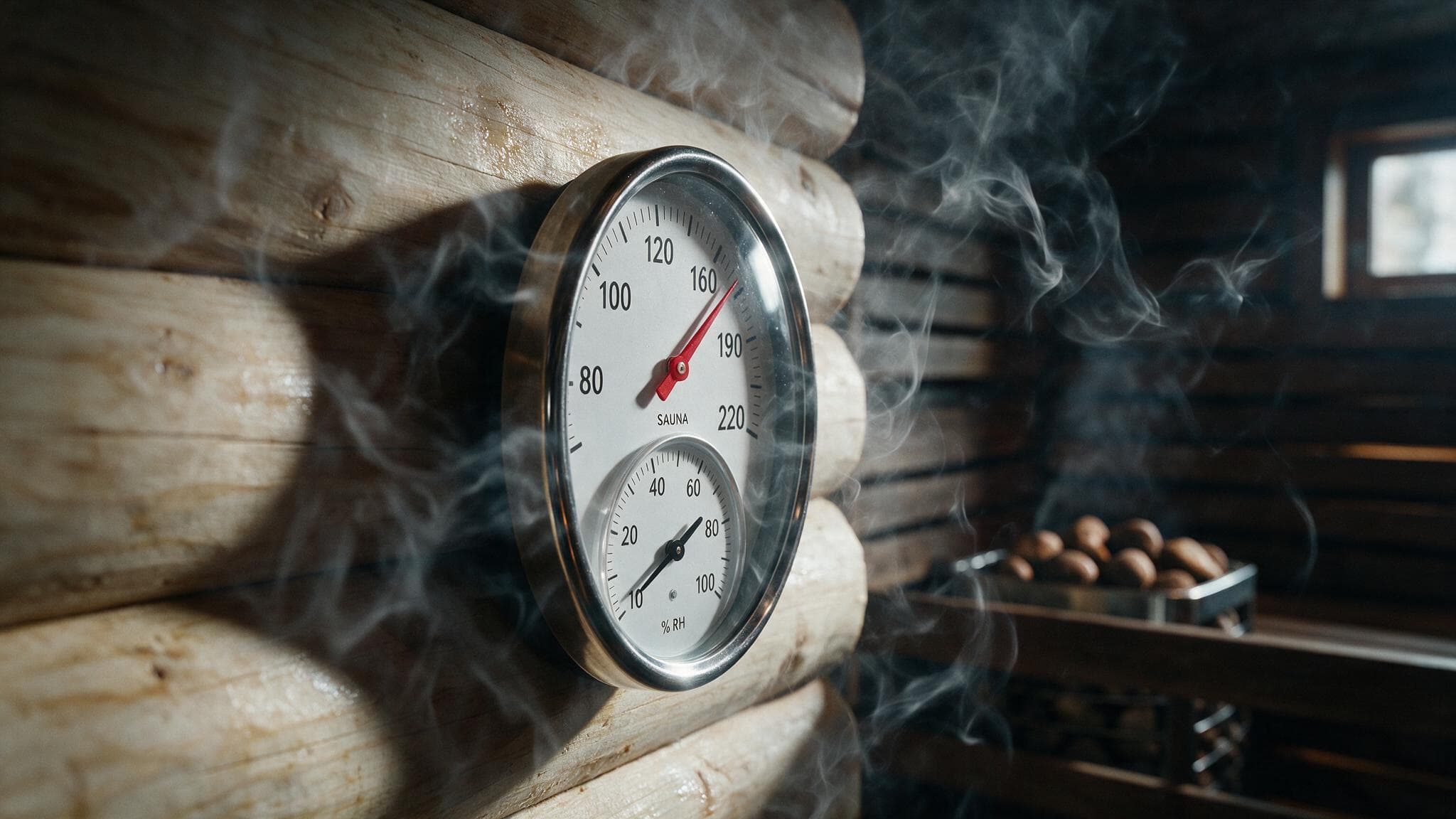
The 200 rule is arithmetic you can do before you open the sauna door: take the temperature in Fahrenheit, add the humidity as a percentage, and keep the total under 200. A sauna at 190°F with 10% humidity lands right at the line. Add moisture to the air, and a room that felt fine starts pushing past it.
The rule circulates among sauna regulars as a heuristic — a rule of thumb, not an official medical standard. It's worth a closer look because of what happened at the 2024 Shanghai Masters, where elite tennis players were physically undone in conditions that scored roughly 166–170: a temperature around 86°F (30°C), humidity over 80%, and a combined sum of roughly 166 to 170. By the rule's math, that shouldn't have been dangerous. Tell that to Novak Djokovic, who vomited during his match, or to Holger Rune, who asked an official whether players had to "die on court."
What the 200 rule actually means
The rule is additive, not multiplicative, which is why it's easy to remember. Temperature and humidity both make heat harder on your body, and the sum gives a rough sense of how demanding a room will be.
Two examples show the logic:
- 190°F + 10% humidity = 200. Right at the line.
- 120°F + 100% humidity = 220. Over the line, even though 120°F sounds mild.
That second example is where people get confused. A steam room at 120°F doesn't sound intimidating — hotter than a hot bath. But at 100% humidity, sweat can't evaporate, and evaporation is your body's main cooling mechanism. The air is already saturated with water, so it won't absorb more moisture from your skin. Heat builds up instead of leaving.
The rule works best in Finnish-style saunas, where you control humidity by throwing water on hot stones and can genuinely manage the sum. It applies to dry saunas too, but with an asterisk: the total can run past 200 and still feel fine when the humidity is nearly zero. Steam rooms are where it falls apart — the humidity is near 100% by design, so even a moderate-temperature room blows past the total.
If you're used to Celsius: the borderline example of 190°F is about 88°C, and a very hot dry sauna at 210°F is about 99°C. The math works the same; just convert the temperature before you add the humidity.
Why that math matters: what happened in Shanghai
The 2024 Shanghai Masters became a test of what heat and humidity do to a body under strain.
The setup: around 30°C (86°F) through the opening rounds, with humidity over 80% at times. Combined sum: roughly 166–170. On the 200 scale, that's a comfortable margin. On a tennis court, it broke players down one by one.
Djokovic vomited during his match against Yannick Hanfmann. "It's the same for every player out on the court, but it's brutal," he said afterward. He pointed at the humidity specifically, noting that levels over 80% day after day were worst for the players competing in daytime heat.
Jannik Sinner, the world number two, retired in the deciding set of his third-round match against Tallon Griekspoor because of cramping in his right thigh. Holger Rune, during a medical timeout in his match against Ugo Humbert, asked an official whether players had to "die on court." Casper Ruud, Tomas Machac, David Goffin, Terrence Atmane, Hamad Medjedovic, and Wu Yibing all retired in the early rounds. Earlier in the season, Arthur Rinderknech collapsed on court in Cincinnati, handing Felix Auger-Aliassime the victory.
The 200 rule assumes rest. Sitting still in a sauna, your body can cope with more than the sum suggests. Sprinting, changing direction, and competing for hours is a different stress — and if a sum of 166–170 could do that to world-class athletes, it's not a number to treat as a guarantee.
How to apply the 200 rule in your own sauna
People ask what the ideal sauna temperature is. The 200 rule is the better answer: no single temperature is ideal, because humidity changes how that temperature feels, and ambient conditions like a sauna in a 50°F garage starting from a 20-degree deficit also matter. A 190°F room at 10% humidity sits at the boundary; the same room at 40% humidity scores 230 and feels more oppressive.
Activity, clothing, and duration all change the real risk, because the rule assumes you're resting. Sit still and you're close to the rule's assumptions. Move around, talk a lot, or bundle up in a towel and your body sheds heat less effectively.
For beginners, the sweet spot is a combined sum of 150–170, with sessions capped at 5–10 minutes. Concretely: a sauna at 140°F with 20% humidity scores 160 — right in that zone. As you get used to the heat, you can let the number climb.
If you feel lightheaded, nauseated, or uncomfortably hot, get out. That's not a failure of the rule; it's the point of the rule.
Sauna type changes how you read the numbers. In a traditional Finnish sauna, you're managing the sum by controlling how much water hits the stones. In a steam room, the humidity sits near 100%, so even a moderate 110°F room scores 210 and violates the rule. In infrared saunas — the kind we build at SaunaCloud, the air doesn't get loaded with steam the way it does in a wet room, so the humidity side of the sum usually stays low. The rule still applies; it just means the temperature side does most of the work, which is why your sauna doesn't need to reach 150 degrees to deliver therapeutic results.
A note for the high-heat crowd: a sauna pushing 200°F isn't dangerous. At near-zero humidity, it's at the line — a dry sauna at 210°F with 5% humidity scores 215, and dry saunas routinely exceed 200 safely because the air is nearly dry. The #1 question parents ask is, is it safe for my child to use a sauna? The answer: yes, with age-appropriate guidelines, temperature limits, and constant supervision.
A steam room at 110°F with 100% humidity also scores around 210, and it's a harder room to stay in.
The same rule applies to your electronics
People ask whether their phone can sit on the bench next to them, or whether an e-reader could survive a session. The answer follows the same arithmetic, because heat and humidity stress electronics the way they stress bodies.
High humidity puts moisture in the air. When warm, humid air meets the cooler surfaces inside a device, it condenses into water droplets — the kind that end up under a phone screen or corroding a charging port. High heat separately degrades batteries, which is why battery life fades faster in hot conditions.
Steam rooms are the worst case for electronics, for the same reason they're hard on people: high heat plus near-100% humidity. A dry sauna is risky because of the temperature. A steam room adds condensation risk. A phone left in a steam room can suffer permanent screen damage from condensation. Phones are rated IP68, but that doesn't cover steam.
The takeaway: leave devices in a dry, cooler space. Your locker, your bag in the changing room — anywhere that isn't hot and humid. If you want the specifics, we've covered whether it's okay to bring electronics into a sauna, and the dedicated question of reading on a Kindle through a session. Short version: consumer electronics are designed for ordinary room conditions, not sauna heat and steam.
What tennis's heat-policy gap has to do with it
Professional tennis doesn't have a simple heat rule, and Shanghai exposed the gap.
Under ATP regulations, the decision to suspend play for extreme heat sits with an onsite supervisor, who coordinates with medical teams and local authorities. There's no temperature or humidity line that stops a match. The ATP Medical Services team implements measures to protect players during extreme heat, and the governing body states that protecting athletes is a central concern. On a formal policy, the ATP says the question is under review, with additional measures being assessed alongside players, tournaments, and medical experts.
Other sports are further along. Professional soccer, Formula One, and cycling have formal extreme-weather policies. Within tennis, the Grand Slams and the WTA have rules for extended breaks and match suspensions in extreme heat. At the US Open, a 10-minute break is allowed after the third set in extreme heat. The ATP, so far, doesn't.
A simple additive check like the 200 rule is transparent and consistent — anyone can do the math, and there's no judgment call in the moment. The ATP's current system is flexible, which is good in principle. But flexibility meant the line shifted day to day in Shanghai, and players like Novak Djokovic and Jannik Sinner felt the consequences. After a week like that, a number you can check in your head has appeal.
Where the 200 rule falls short
The 200 rule is not scientifically validated, and no health organization endorses it. It emerged from anecdotal sauna practice, not clinical trials — a pattern people noticed about where they started to feel rough, refined over time.
It leaves things out. Duration: a sum of 195 might be fine for five minutes and miserable for twenty. Individual tolerance: fitness, hydration, acclimatization, and underlying health change how a room feels. And activity level, which is where Shanghai broke the model.
At rest, an 86°F day with 80% humidity is uncomfortable but manageable for people. Add hours of high-intensity exercise, and the same conditions produced vomiting, collapse, and retirements by Casper Ruud, Tomas Machac, David Goffin, Terrence Atmane, Hamad Medjedovic, and Wu Yibing.
If a governing body with medical staff, data, and a public commitment to player safety can't settle on a universal heat threshold, that tells you how hard these questions are. The 200 rule gets you a long way. It doesn't get you all the way — so treat it as a starting point, not a verdict. Older adults, people with cardiovascular conditions, or those on certain medications may need to stay below the 200 threshold and should consult a doctor.
A quick check, not a law
The 200 rule earns its place because of how little it demands. Temperature plus humidity under 200 — you can do the math at the sauna door, and it will keep you out of the most trouble.
The caveat is that it's a tool, not a guarantee. It came from practice, not research. It assumes rest, not exertion. It can't know your hydration, your health history, or how you feel today. The Shanghai Masters showed athletes like Novak Djokovic and Jannik Sinner struggling in conditions scoring 166–170 — a reminder that no number replaces paying attention.
The rule is simpler than the arithmetic: stay hydrated, respect your limits, and pay attention to how you feel. The 200 rule gets you close before you sit down. Your body makes the final call.
Frequently Asked Questions
What is the healthiest temperature for a sauna?
There's no healthiest temperature because humidity changes how that temperature feels. The 200 rule gives a better answer: aim for a combined sum of 150–170 as a beginner, which might mean 140°F with 20% humidity. A dry sauna at 210°F with low humidity can be safer than a steam room at 110°F with 100% humidity, since the latter scores 210 and feels more oppressive.
Why did tennis players struggle in Shanghai if the 200 rule said it was safe?
The 200 rule assumes rest, but the Shanghai Masters involved hours of high-intensity exercise. Conditions around 86°F with over 80% humidity scored 166–170, below 200, yet Novak Djokovic vomited, Arthur Rinderknech collapsed, and Jannik Sinner retired because exertion changes the equation. The rule is a starting point, not a guarantee, when you're sprinting and changing direction.

Founder & Lead Designer, SaunaCloud®
SaunaCloud: 3,000+ installations since 2014 · Author of The Definitive Guide to Infrared Saunas · Featured in Forbes, Inc., and MSN
Christopher designs every SaunaCloud sauna. His work brings the room, heaters, controls and installation plans together so you can review the project before committing. His professional expertise is sauna design and construction, not clinical medicine.
Custom 3D renderings and a proposal in 24-48 hours.
Continue Reading

Safety & Best Practices
Infrared Sauna and Medications: A Drug-Class-by-Drug-Class Safety Reference (2026)
Read article
Safety & Best Practices
Infrared Sauna Side Effects: Normal Responses, Preventable Problems, and Genuine Concerns (2026)
Read article
Safety & Best Practices
Are You Microwaving Yourself in an Infrared Sauna? The Physics That Proves You're Not (2026)
Read articleReady to Design Your Sauna?
Every project starts with a conversation. Tell us about your space and we'll create your custom plan — free, no obligation.
Custom 3D renderings and a proposal in 24-48 hours.