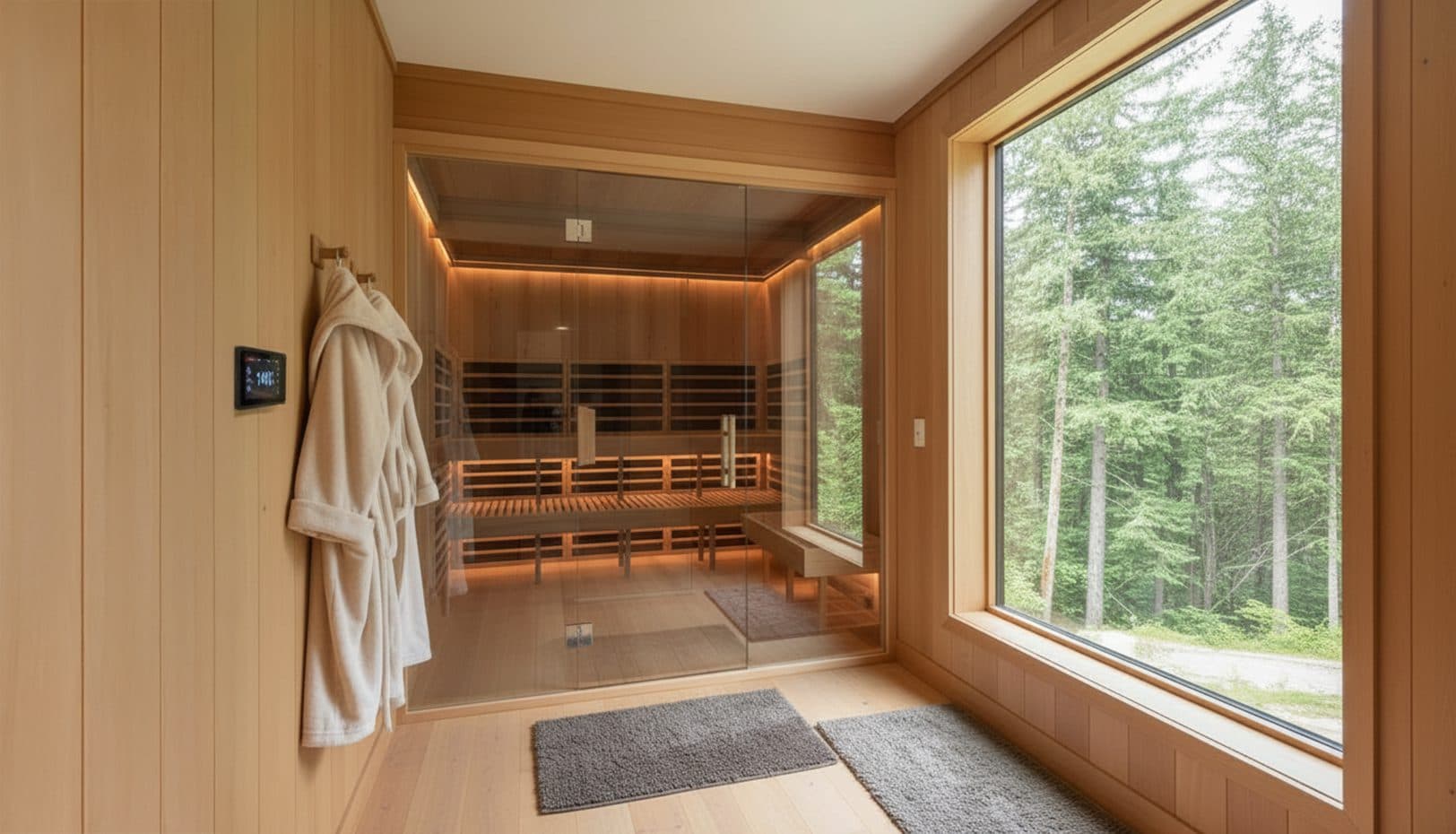
What Makes a Sauna Infrared? The Science of Radiant Heat vs. Steam

Key Takeaways
- Infrared saunas operate at 110–130°F because that's the range where the heaters stay on continuously; above 130°F the panels cycle on and off, breaking the steady infrared exposure that makes them effective.
- Your body's response — sweating, widened blood vessels, faster heart rate, mimics a moderate walk, making sauna use an active cardiovascular stressor, not passive relaxation.
- The evidence for health benefits is still preliminary: most studies are small, short, and come from a single research group, and some of the observed cardiovascular changes may simply be dehydration effects.
In This Article
If you've ever stepped into an infrared sauna at the gym or a spa, you probably noticed it feels different from the steam room or a traditional sauna. The air isn't oppressively hot, yet you start sweating within a couple of minutes.
An infrared sauna uses light — specifically, infrared lamps, to warm your body directly without heating the air around you. The Mayo Clinic says it uses light to heat the body directly. That's radiant heat, the same way sunlight warms you on a cool day. A traditional sauna, by contrast, heats the air (usually with hot rocks), and that hot air then warms you through convection. That switch, radiant versus convective heating, explains nearly every practical difference between the two, from the lower temperature you sit in to the way your body responds. for a stronger effect.
How Infrared Saunas Heat the Body Directly
The key difference between infrared and traditional saunas is how the heat reaches you: infrared uses radiant energy, while traditional saunas rely on convection.
Radiant heat vs. heated air
Here's a way to think about it: standing in an infrared sauna is like standing in sunlight; sitting in a traditional sauna is like being inside a hot oven. Sunlight warms you directly — your skin absorbs the energy, and you feel warm even when the surrounding air is cool. An oven heats the air, and then that hot air warms you from the outside in.
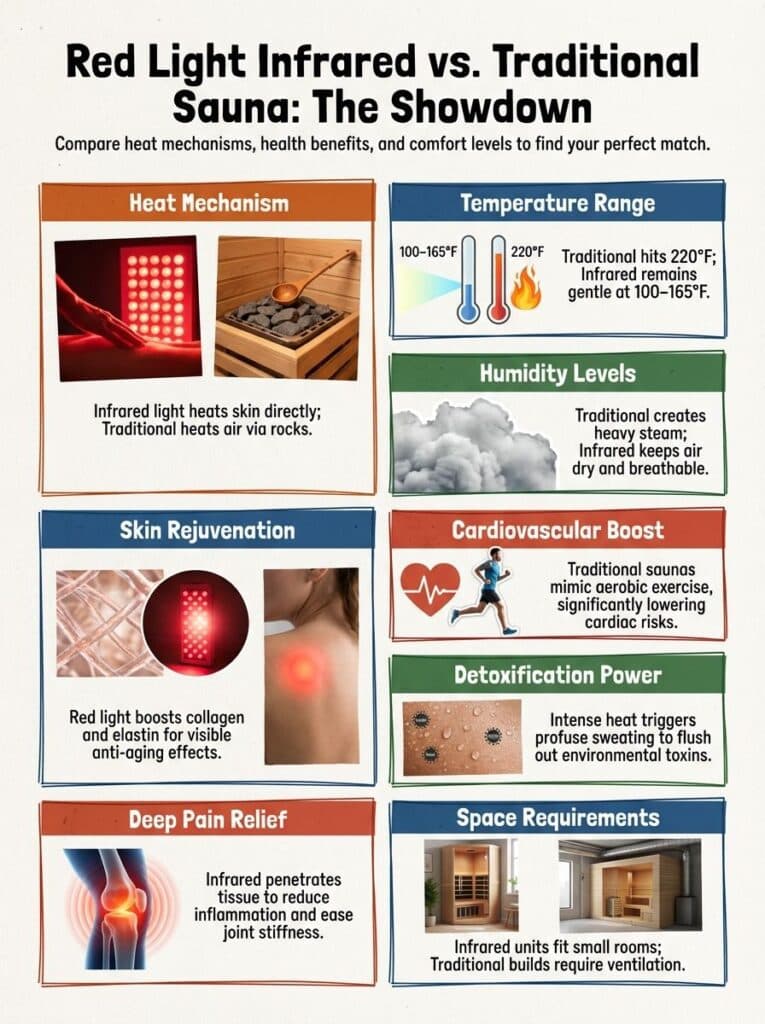
That's why you can sit in a 120°F infrared sauna and sweat buckets, while a traditional sauna typically needs to hit 170°F or higher before it feels hot. In an infrared unit, your body is absorbing the light energy directly. The air stays relatively cool, which makes breathing easier and the whole experience more tolerable for people who can't handle blast-furnace heat.
Far-infrared wavelength and why it matters
The specific type of light used in these saunas is far-infrared, at around 10 micrometers. That wavelength happens to be the one your skin absorbs most readily. Near-infrared and mid-infrared have different penetration depths and are used for other applications (like red light therapy), but the far-infrared band at 10 micrometers is the sweet spot for comfortable, deep heating.
The wavelength matters because it determines how the heat interacts with your body. At 10 micrometers, the energy penetrates beneath the skin's surface, warming tissues directly rather than just cooking the surface layer.
Temperature: Why Hotter Isn't Better for Infrared Saunas
To understand why higher temperatures backfire, you need to look at how infrared saunas are designed to operate within a specific range.
The 110–130°F sweet spot
Infrared saunas run cool compared to traditional ones. The standard operating range is 110–130°F (43–60°C). Traditional saunas, by contrast, operate at 150–195°F (70–110°C). That's a difference in air temperature, and it's the marquee feature of infrared: you get the sweat and the physiological response without feeling like you're in a furnace.
The heater cycling problem
Here's the counterintuitive bit: cranking the temperature above 130°F makes the sauna less effective. Above that threshold, the infrared panels start cycling on and off to prevent overheating. Instead of a steady stream of radiant energy, you get bursts with gaps — which is exactly what you don't want.
A common mistake for new users is to turn the thermostat way up, thinking hotter equals stronger results. You lose the continuous infrared exposure that makes the thing work. The panels can't run at full power indefinitely when the ambient temperature is too high, so they take breaks. Your body gets less consistent heating, and the session feels less effective. The fix: keep it in the 110–130°F zone and let the radiant heat do its job.
A Brief History of Radiant Heat Therapy
Infrared saunas aren't a trendy wellness fad. They have a long history, starting with John Harvey Kellogg — yes, the cereal guy. In 1891, Kellogg invented the "radiant heat bath," an incandescent electric light bath that used the same basic principle of direct radiant heating. He displayed it at the 1893 Chicago World's Fair, and patented it in 1896.
Both King Edward VII of England and Kaiser Wilhelm II of Germany had radiant heat baths installed in their palaces.
The modern revival came in the 1970s in Japan, where the practice was called Waon Therapy — "soothing warmth." That's where the current wave of infrared saunas really kicked off. So the technology has about 130 years of history, even if the commercial home-sauna market is much younger.
What Happens to Your Body in an Infrared Sauna
Within minutes of sitting down, you'll start sweating. Your blood vessels widen (vasodilation), and your heart rate climbs. Researchers describe the physiological response as similar to walking at a moderate pace — not a sprint, just a steady cardiovascular effort.
It feels soothing, but your heart and circulatory system are working. That's why people with unstable heart conditions are advised to check with a doctor before starting a sauna routine. It's also why you can't just zone out the same way you do in a warm bath — your body is actually doing something.
The practical implication: if you're using a sauna for muscle recovery after exercise, keep sessions moderate. A 20-minute session at 110–115°F is enough to promote blood flow without adding fatigue, though infrared vs traditional saunas operate at different temperature ranges.
What the Science Says (and Doesn't Say)
While many claims circulate about infrared saunas, the scientific literature offers a more cautious picture of what is actually known.
Potential benefits and the evidence gap
The list of conditions that sauna use might help with is long: high blood pressure, heart failure, dementia, Alzheimer's, headaches, type 2 diabetes, arthritis. That's a lot of potential, but "might" is doing lifting here.
A 2019 survey found that using a sauna 5–15 times per month was linked to higher mental well-being, which is a data point — feeling good is a valid benefit. Some smaller studies have shown improvements in markers of heart strain (reduced BNP and cardiothoracic ratio) and better left-ventricular ejection fraction. But the catch: many of those studies used traditional saunas, not a custom infrared sauna designed for comfort exclusively, so we can't be sure the benefits come from the infrared part specifically.
Why the evidence is still preliminary
A 2009 literature review on far-infrared saunas said all the studies were limited by tiny sample sizes, short duration, unvalidated measurement scales, and — critically, they often came from a single research group. The 2018 systematic review and meta-analysis that looked at nine clinical trials raised the quality bar, but still rated the evidence as "moderate to insufficient" for heart failure, and questions remain about infrared sauna vs microwave safety since both are electromagnetic radiation at completely different wavelengths.
Neurologist Steven Novella, writing for Science-Based Medicine, has questioned whether the cardiovascular changes seen in these studies are genuine improvements or just temporary effects of dehydration — reduced blood volume from water loss could explain the drop in blood pressure. That's a hypothesis, not a proven explanation, but it underscores how much we don't know.
The Detox Myth and Other Unsupported Claims
Despite widespread marketing, the idea that infrared saunas can flush toxins from the body is not supported by scientific evidence.
Why the detox myth persists
Sweating feels like you're flushing something out. This subjective experience is powerful, and marketing uses it. But the science says your body's real detox organs are your liver and kidneys, not your sweat glands. You sweat out an insignificant amount of toxins — and in fact, sweating more can reduce your urine output, which is actually how your body gets rid of most waste.
Steven Novella at Science-Based Medicine calls detox claims pseudoscientific. The idea that infrared saunas "pull toxins out through your skin" doesn't hold up.
Dangerous claims: Autism, cancer, and COVID-19
Some naturopaths recommend infrared saunas for cancer and autism. Gwyneth Paltrow drew criticism for suggesting them as a post-COVID treatment — the NHS actually warned against her advice. Fire departments in Texas and Indiana even purchased infrared saunas for not-so-brief relief for the elderly, hoping to "sweat out" inhaled pollutants from smoke exposure.
There is no evidence that sweating in an infrared sauna can treat or prevent cancer, autism, or COVID-19. The Federal Trade Commission has warned practitioners about making false COVID-19 claims. If someone tells you otherwise, ask for the studies.
How to Use an Infrared Sauna for Maximum Benefit
Getting the most out of an infrared sauna means more than just turning it on — you need proper technique and gradual adaptation.
Starting out: Temperature, duration, and adaptation
If you're new to infrared saunas, don't expect a breakthrough. It takes roughly 5–7 sessions for your body to adapt to the direct heat. For the first two weeks, set the temperature at 105–115°F — that's comfortable enough to let you adjust. Start with 20-minute sessions, then gradually work up to 30–45 minutes.
The 110–130°F zone is where you get steady, continuous infrared exposure.
Building a sustainable routine
Consistency matters more than intensity. Three to four sessions per week is ideal for most people. Only consider daily sessions after you've been using the sauna for at least a month, and even then, it's not necessary.
Hydration and safety protocols
You're going to sweat, so pre-hydrate. Drink 16–20 ounces of water about 30 minutes before your session. Afterward, drink another 20–30 ounces over the next hour to replenish. Avoid large meals within two hours of your session — your body will be busy enough managing the heat.
If you feel dizzy or nauseated, get out. That's your body saying you've gone too far. Skip the sauna entirely if you have a fever, are pregnant, have heart disease, or have been drinking alcohol. If you have any chronic health condition, have a conversation with your doctor before starting a routine.
Infrared vs. Traditional Sauna: Which Should You Choose?
Each sauna type offers distinct advantages, and the right choice depends on your priorities.
What each sauna type does well
Infrared saunas are easier to install, cheaper to run, and carry a lower fire risk. They're also more accessible for people who can't tolerate the high heat of a traditional sauna. The lower ambient temperature makes extended sessions comfortable.
Traditional saunas have a larger body of scientific evidence behind them. They also offer the löyly — that burst of steam when you throw water on hot rocks, which infrared can't replicate. If you're someone who loves that humid, foggy heat, you'll miss it in an infrared unit.
Here's a twist: traditional saunas actually emit far-infrared radiation themselves, sometimes in greater amounts than dedicated infrared units. The technology isn't as distinct as the marketing suggests.
Tradeoffs and considerations
One concern for infrared buyers: electromagnetic fields (EMF). Low-cost or poorly constructed units can have high EMF levels. Reputable brands offer low-EMF or zero-EMF models, so check before you buy. At SaunaCloud, the design philosophy prioritizes low-EMF construction and wavelength-specific heaters — that's the kind of engineering you want to look for.
Cost-wise, infrared saunas win on upfront price and ongoing energy use. Traditional saunas have decades of safety research behind them. Neither is superior; it depends on what you value — the cultural ritual and well-established evidence of traditional, or the lower heat, easier installation, and modern convenience of infrared.
Conclusion: What Makes Sauna Infrared and What That Means for You
Here's the three-part takeaway: infrared saunas use radiant heat from far-infrared light at 10 micrometers to warm your body directly at 110–130°F. The evidence for health benefits is promising but preliminary — the studies are too small and too few to call it proven. And the choice between infrared and traditional comes down to your priorities: lower temperature and easier installation versus a richer sensory experience and a deeper evidence base.
Infrared saunas are a safe, comfortable option for relaxation and mild cardiovascular conditioning. Enjoy the experience for what it is — a warm, sweat-inducing session that feels good and might offer some health perks. Approach the bolder health claims with healthy skepticism.
Frequently Asked Questions
What is healthier, an infrared sauna or a regular sauna?
Neither is definitively healthier based on current evidence. Traditional saunas have a larger body of scientific research behind them, while infrared saunas offer a more tolerable lower heat that may be easier for some people to use consistently. The choice depends more on your personal tolerance and preferences than on proven health superiority.
Does infrared sauna help lower cortisol?
Some research suggests sauna use may be linked to improved mental well-being, which could indirectly affect cortisol levels, but the evidence is preliminary. Most studies are small and short-term, and it's unclear whether any observed changes are genuine physiological effects or simply temporary responses like dehydration. More research is needed before drawing firm conclusions.
How does an infrared sauna heat your body differently than a traditional sauna?
An infrared sauna uses radiant heat from far-infrared light at around 10 micrometers to warm your body directly, similar to how sunlight warms you on a cool day. A traditional sauna heats the air around you using convection, typically requiring much higher air temperatures of 150–195°F to feel hot. This is why you can sweat at 110–130°F in an infrared sauna without the oppressive heat.

Founder & Lead Designer, SaunaCloud®
SaunaCloud: 3,000+ installations since 2014 · Author of The Definitive Guide to Infrared Saunas · Featured in Forbes, Inc., and MSN
Christopher designs every SaunaCloud sauna. His work brings the room, heaters, controls and installation plans together so you can review the project before committing. His professional expertise is sauna design and construction, not clinical medicine.
Custom 3D renderings and a proposal in 24-48 hours.

Ready to Design Your Sauna?
Every project starts with a conversation. Tell us about your space and we'll create your custom plan — free, no obligation.
Custom 3D renderings and a proposal in 24-48 hours.