Should You Do Red Light Therapy or Sauna First?
Key Takeaways
- Sauna boosts blood flow 180–390% in major arteries, which primes cells for light absorption — making the sauna-first sequence ideal for recovery, skin, and sleep.
- Red light therapy before sauna acts as a gentle cellular warm-up without raising core temperature, best for pre-workout preparation and building heat tolerance.
- Doing both at the same time creates biological conflict because your body can’t optimize stress and recovery pathways simultaneously — separate them with a 10–15 minute cool-down.
In This Article
If you’ve got both a red light panel and an infrared sauna at home, you’ve probably stood there wondering which button to press first. It’s a fair question — and one we hear constantly from people who’ve invested in both devices and want to get the most out of them.
No single order for combining red light therapy and sauna has been proven superior by direct research; consistency and adherence are more important than forcing a specific sequence. The ideal sequence is whatever you can maintain regularly without cutting sessions short or feeling unwell. A sauna cranks up your blood flow by 180 to 390 percent in major arteries — that’s a physiological shift. Red light therapy, on the other hand, doesn’t heat you up at all; it energizes your cells at the mitochondrial level. Those are two different signals, and your body handles them best when you give each its own moment.
So the question isn’t which order is right — it’s which order is right for your goal today. Let’s break it down.
How Each Therapy Works on a Biological Level
One heats you up. The other lights you up. They’re not the same thing, and understanding that difference is the foundation for getting the order right.
Sauna: Thermal Stress and Hormesis
Saunas work by stressing your body — in a controlled, beneficial way. Traditional Finnish saunas have been around for thousands of years, heating the air to 160–200°F. Infrared saunas skip the hot air and heat your body directly using far infrared wavelengths (IR-C, in the 3 µm to 1 mm range). That longer wavelength penetrates deeper into your tissues.
The heat raises your core temperature, triggering heat shock factors and heat shock proteins. This is hormesis — a mild stress that your cells adapt to, kind of like exercise. The payoff: your heart and muscles get a cellular tune-up, and your circulation skyrockets. After a good sauna session, blood flow in major arteries can increase by 180 to 390 percent. That’s not a bump.
Red Light Therapy: Photobiomodulation and Cellular Energy
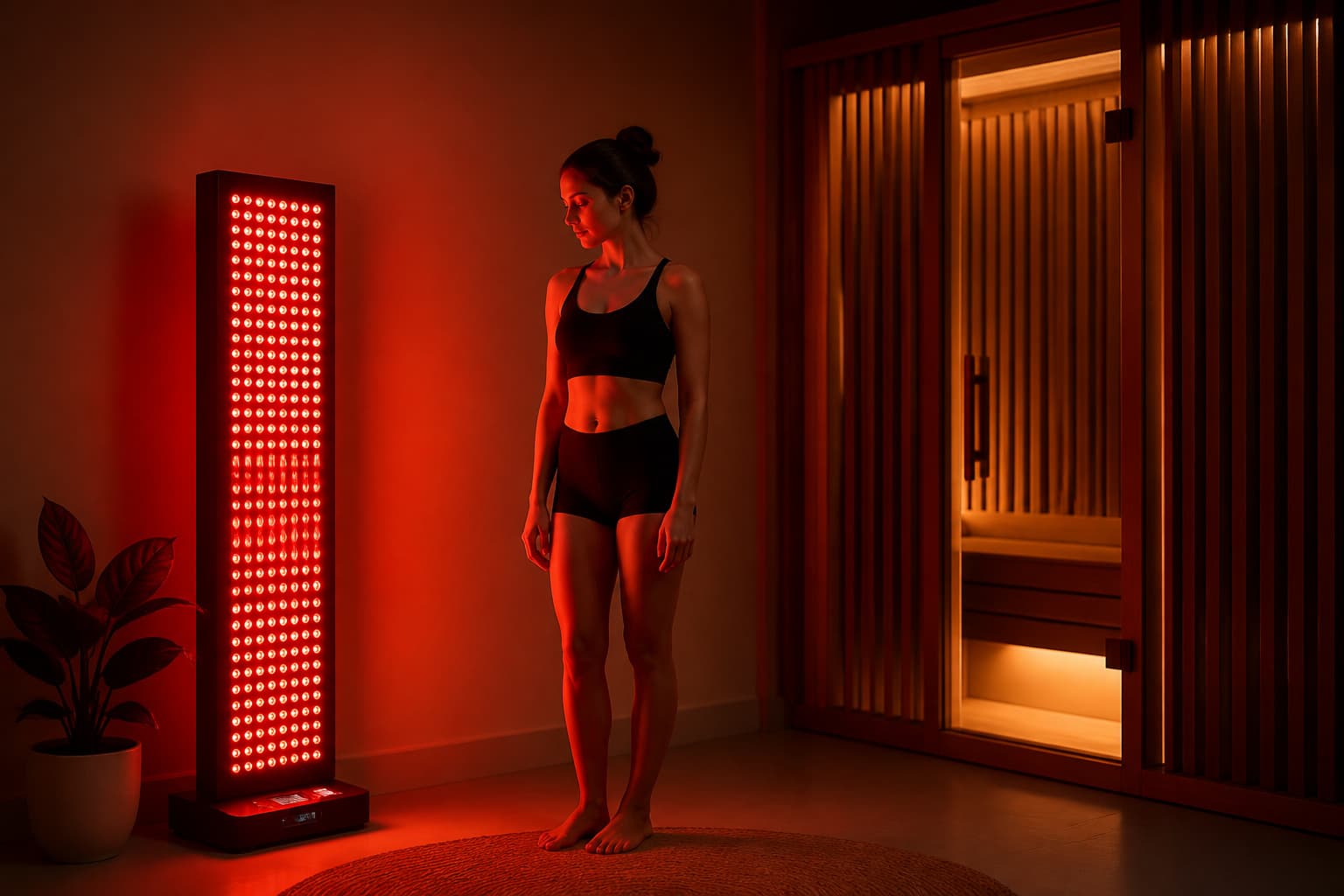
Red light therapy works through an entirely different mechanism. It uses visible red light (600–700 nm) and near-infrared light (700–1200 nm) from LEDs. There’s no significant heat involved. Instead, the light is absorbed by the mitochondria — the energy factories inside your cells, which then produce more ATP.
Think of it as plugging your cells into a charger. Sessions are short, typically 10–15 minutes, and you keep the device 6 to 12 inches from your skin. The result is a boost in cellular energy, reduced inflammation, and increased collagen production, all without raising your body temperature.
Why Doing Both at Once Is Inefficient
Your body can’t optimize stress and recovery pathways simultaneously. I get the temptation — you’re short on time, and both devices are right there. But running them together creates biological conflict.. Your body can’t optimize stress and recovery pathways simultaneously.
When you’re in the sauna, your body is in a stress-response mode — producing heat shock proteins, pumping blood, and mobilizing resources. Red light therapy sends a recovery signal: charge up, repair, reduce inflammation. Those are opposite instructions. As one source puts it, Trying to create stress and energize and recover simultaneously would not be ideal.
Doing both at the same time creates biological conflict because your body can’t optimize stress and recovery pathways simultaneously. Heat-related symptoms such as dizziness, headache, nausea, or cramps may occur if sessions are too long or hydration is neglected. The safer, more effective approach is to separate them with a proper gap.
Option 1: Sauna First → Red Light Therapy Second
If your goal is recovery, better skin, or deeper sleep, this is the sequence that makes the most sense.
Start with 15–20 minutes in the sauna. Your blood vessels dilate, circulation surges, and heat shock proteins kick in. Then take a 10–15 minute cool-down to let your core temperature normalize. Finally, do 10–15 minutes of red light therapy.
The extra blood flow primes your cells to absorb the red light effectively. You’re essentially opening the door and then sending in the repair crew.
The Recovery Benefits: Why This Sequence Works
The sauna’s heat stress triggers adaptation pathways that support cellular repair. The increased circulation delivers oxygen and nutrients to your tissues. Then the red light therapy amplifies that repair by boosting mitochondrial energy and reducing inflammation. This combination is especially powerful after a workout or any physical stress.
Skin and Sleep: Added Benefits of the Sauna-First Order
The sauna opens pores and increases blood flow to the surface; the red light then boosts collagen production and reduces fine lines. Your skin gets a double benefit — together they’re an anti-aging routine.
Red light therapy can improve sleep by supporting melatonin production; sauna heat reduces stress hormones, preparing the body for rest. Used in that order with a cool-down in between, they set you up for a restful night.
Option 2: Red Light Therapy First → Sauna Second
Now flip the script. If you’re about to exercise, or if you find saunas intense and want to ease into them, try red light first.
A 10-minute red light session acts as a gentle warm-up for your muscles and joints without raising your core temperature. Research shows that applying red light before physical stress reduces muscle soreness afterward. Then you can head straight into the sauna for 15–20 minutes.
Pre-Workout and Muscle Priming
Red light therapy primes your muscles at the cellular level — more ATP, less inflammation. That makes it a pre-workout tool. Then the sauna afterward helps with recovery by increasing blood flow and flushing out metabolic waste. You get a warm-up and a cooldown in one session.
Building Heat Tolerance for Sauna Beginners
Red light therapy relaxes muscles and joints while keeping your core temperature normal, so if you’re new to saunas and find the heat overwhelming, it helps you adjust gradually. When you step into the sauna, the transition feels less drastic. For those on medication, it’s wise to check can you use an infrared sauna while on medication before starting; this is also helpful for people with arthritis or chronic stiffness who need a gentle lead-in.
Which Order Is Right for You? A Goal-Based Decision Framework
Direct research has not yet identified a single superior order for red light therapy and sauna. The best sequence is whatever you can do consistently without cutting sessions short or feeling unwell. Here’s a way to decide: if choosing one, far infrared has the strongest evidence base, including 20-year Finnish data.
- Recovery, skin, sleep → Sauna first, then red light after a cool-down.
- Pre-workout, heat tolerance, gentle joint warming → Red light first, then sauna.
- Weight loss → There’s no proven protocol for synergy. Sauna may temporarily boost metabolism, and red light supports mitochondrial function, but don’t expect results. Try either order consistently.
- Heat-sensitive individuals → Separate sessions on different days. Don’t push through discomfort.
Your Weekly Protocol: A Sample Routine
Here’s what a balanced week might look like for someone starting out:
- Monday & Thursday: 10 minutes red light therapy → 10 minutes sauna (with a cool-down between if you want, or straight in for the RLT-first approach).
- Tuesday & Friday: Standalone red light therapy, 10–15 minutes.
- Rest days: Rest, or a very short sauna session (5–10 minutes) if you feel good.
Adjust based on how you feel. The goal is consistency, not a rigid schedule.
Session Length and Frequency Guidelines
- Red light therapy: 5–20 minutes per session, typically 10–15. Keep the device 6–12 inches from your skin. You can use it daily or several times per week.
- Infrared sauna: 15–45 minutes for experienced users; beginners start at 5–15 minutes. Aim for 2–5 times per week.
- Cool-down: Rest 10–15 minutes between therapies to let your body temperature return to baseline.
Equipment Considerations
Red light therapy devices range from $100 handheld units to $1,000 full-body panels. Infrared saunas are a bigger investment — basic 1–2 person models run $1,000 to $2,500, with higher-end units exceeding $5,000.
Device quality matters. Higher-end saunas use far infrared (IR-C) for deep tissue heating. Brands like SaunaCloud design their systems around that specific wavelength with proprietary low-EMF heaters — and you can use your infrared sauna every day, as daily use is safe for most healthy adults and produces the maximum cumulative benefits (read more). On the red light side, you’ll see names like Joovv, Lifepro, and Lumi Visage, plus combination units from Jacuzzi that integrate both therapies in one cabinet. If you’re buying separate devices, make sure your red light panel delivers the right wavelengths (600–700 nm and 700–1200 nm) and that your sauna uses IR-C if deep penetration is your priority.
Safety First: Risks and Precautions
The best protocol is the one you can do without hurting yourself. Here’s what to watch for.
Heat-Related Symptoms and Dehydration
Dizziness, headache, nausea, muscle cramps, or confusion — if you feel any of these, stop immediately. Heat stress hits harder when you’re dehydrated. Drink water before, during, and after your sauna session. Avoid alcohol, which impairs judgment and worsens heat effects. The CDC and Cleveland Clinic both emphasize staying hydrated.
Medication Interactions and Contraindications
Some medications — heart drugs and antidepressants in particular, can impair your body’s ability to regulate heat. Columbia University’s Sorensen warns that healthcare professionals need to educate patients about these risks. If you’re on any prescription, check with your doctor before regular use. Skip sessions entirely if you have a fever, active infection, or unusual fatigue.
Eye Protection and Medical Consultation
High-output red light devices near your face can damage your eyes. Always wear protective goggles. And if you have an eye condition, cardiovascular concerns, are pregnant, or experience persistent discomfort, talk to a healthcare professional before starting either therapy.
Myths and Misconceptions
There’s confusion out there. Let me clear up a few things.
Myth: Red Light Therapy Treats Seasonal Affective Disorder
Nope. Red light therapy works on your mitochondria; bright light therapy for SAD works on melanopsin receptors in your eyes to reset your circadian rhythm. Different mechanisms, different outcomes. Red light won’t help with SAD.
Myth: Infrared Sauna and Red Light Therapy Are the Same
They both use light, but that’s where the similarity ends. The sauna uses long infrared wavelengths (up to 3,000 nm) to generate heat; red light therapy uses shorter wavelengths (600–850 nm) for photobiomodulation. One heats you up, the other charges your cells.
Myth: More Heat Equals Better Sauna Results
Benefits depend on temperature, humidity, and duration — not marketing buzzwords like “full spectrum.” High-quality saunas use IR-C (3 µm to 1 mm) because that wavelength penetrates deepest. That’s the real indicator of quality, not a vague label.
Myth: Red Light Therapy Causes Pigmentation Problems
Red light is generally safe for people with melasma or hyperpigmentation. Red light therapy is generally safe for melasma/hyperpigmentation, but some wavelengths may stimulate melanin production. It’s a nuance general advice misses. If you’re prone to dark spots, test a small area first or consult a dermatologist.
Expert Endorsements and the Bottom Line
You don’t have to take my word for it. The researchers who actually study these therapies use them themselves.
What the Experts Say
- Dr. Michael Hamblin, a red light therapy pioneer, uses it daily on his elbow, knee, or forehead — wherever he’s feeling sore or tired.
- Dr. Rhonda Patrick points out that sweating in an infrared sauna can help eliminate toxic metals like cadmium and aluminum.
- Dr. David Sinclair from Harvard cites a roughly 30% reduction in heart attack risk from regular sauna use.
- Dr. Will Cole says the sauna is “worth the investment in your health.”
- Dr. Daniel Amen calls sauna “the most effective way to detoxify.”
- Dr. Eric Berg explains the hormetic effect — a light stress that makes your cells stronger.
Cultural Relevance: Gwyneth Paltrow and Mainstream Adoption
Gwyneth Paltrow uses both therapies regularly and says they give her energy and keep her skin glowing. It’s not a scientific endorsement, but it reflects how mainstream these tools have become.
The Takeaway: Consistency Over Perfection
Here’s what I want you to remember: don’t overthink it. Your goal determines your order, and your consistency determines your results. Recovery, skin, and sleep? Sauna first. Pre-workout, heat tolerance, or gentle joint warming? Red light first.
Separate the therapies by a 10–15 minute cool-down, listen to your body, stay hydrated, and use eye protection. The protocol is the one you’ll actually do without feeling awful. Everything else is just fine-tuning.
Frequently Asked Questions
How long should you wait between sauna and red light therapy?
A 10–15 minute cool-down is ideal to let your core temperature return to baseline. This gap allows your body to shift from stress mode to recovery mode, making each therapy more effective.

Founder & Lead Designer, SaunaCloud®
SaunaCloud: 3,000+ installations since 2014 · Author of The Definitive Guide to Infrared Saunas · Featured in Forbes, Inc., and MSN
Christopher designs every SaunaCloud sauna. His work brings the room, heaters, controls and installation plans together so you can review the project before committing. His professional expertise is sauna design and construction, not clinical medicine.
Custom 3D renderings and a proposal in 24-48 hours.
Continue Reading

Tips & Routines
The Infrared Sauna Daily Routine: Five Session Types for Every Day of Your Week (2026)
Read article
Tips & Routines
What Happens After One Week of Daily Infrared Sauna Use: Day-by-Day Guide (2026)
Read article
Tips & Routines
Can an Infrared Sauna Cure a Hangover? The Honest Answer (and Why You Need to Hydrate First) (2026)
Read articleReady to Design Your Sauna?
Every project starts with a conversation. Tell us about your space and we'll create your custom plan — free, no obligation.
Custom 3D renderings and a proposal in 24-48 hours.