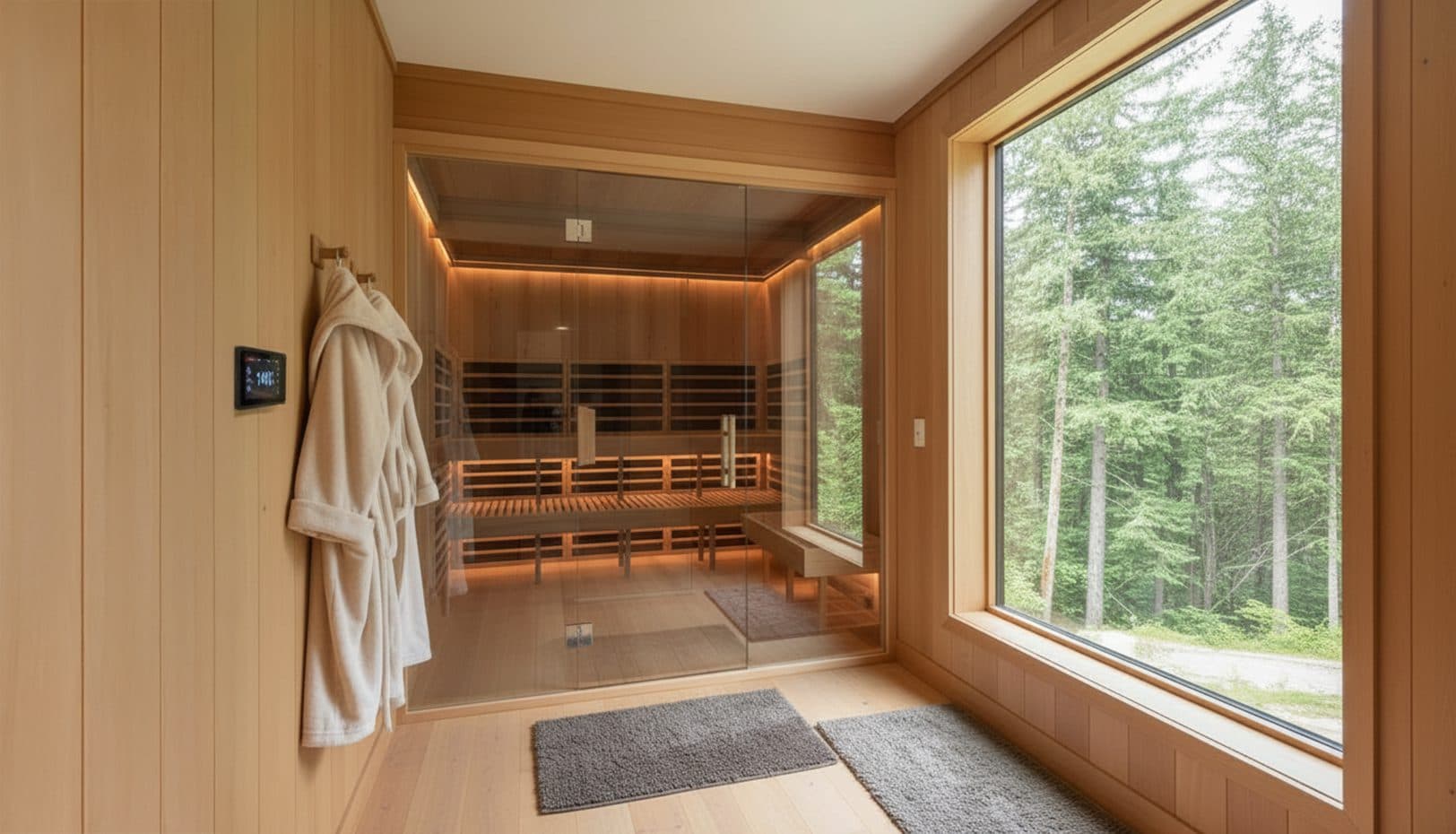
Infrared Sauna Electrical Requirements: NEC Article 424 Explained
Key Takeaways
- Standard 1- to 2-person plug-and-play infrared models generally require a strictly dedicated 15-amp or 20-amp, 110-volt circuit, with 20-amp units demanding a specialized turned-plug and 12-gauge wire.
- Custom in-wall infrared sauna installations are legally classified under NEC Article 424 for fixed electric space heating, which necessitates dedicated 240V/30A or 50A infrastructure and professional licensed installation.
- Converting a traditional convection sauna to an integrated infrared system slashes your electrical footprint, dropping power demand from an inefficient 6–9 kW down to 1.5–3 kW for substantial daily energy savings.
In This Article
If you've ever tripped a breaker just by running a hairdryer and a space heater at the same time, you already know your home's electrical panel has strict limits. We tend to naturally assume that to get a deeply therapeutic sweat going, a sauna just needs more power. We picture traditional hot-rock saunas dumping raw wattage into an enclosed room to heat the air via convection. But infrared sauna electrical requirements are a different animal.
Infrared systems rely on radiant thermodynamics, which means they use precise electromagnetic radiation to warm your body directly, rather than just baking the air around you. If you push high-voltage elements to aggressively heat your sauna's air up to 150°F or more, you run directly into a physics principle known as Wien's Law. This dictates that as a heater gets fundamentally hotter, its wavelength shifts. Recognize that utilizing high-voltage components to drive air temperatures to 150°F+ causes the infrared wavelength to drift away from the therapeutic 7.9-micron peak.
This is why we engineer SaunaCloud® VantaWave® heaters to hit their ideal 7.9-micron far-infrared state within an optimal operating temperature range of 130–145°F. You don't need an overloaded power dump; you need targeted placement. Because infrared heaters operate on the inverse square law, cutting the distance to your body by half actually quadruples the radiation intensity. Thoughtful designs like the Atlas™ placement system optimize your therapeutic dose without sky-high voltage inputs.
The ultimate trade-off? Because the therapy relies on wavelength stability rather than raw heat, your sauna demands dedicated, uninterrupted electrical delivery to perform correctly.
Circuit capacity and configuration: Prescriptions for 110-volt plug-and-play models
If you're buying a freestanding residential unit, it's tempting to unpack the infrared sauna, string the power cord to the nearest spare bedroom outlet, and start your session. But the baseline electrical infrastructure your home requires will depend entirely on the unit's size, and you can't safely share the electrical load with your other household appliances.
15-amp versus 20-amp capacity
Compact, standard 1- to 2-person units—like the Good Health Saunas GSE-1 and GE-2—generally run perfectly on a dedicated 15-amp/110-volt circuit. However, stepping up to mid-to-large multi-person models (such as the GSE-2, GSE-3, GSE-3C, GSE-4, and Hybrid series) universally requires a dedicated 20-amp/110-volt circuit.
In our review of common DIY installation mistakes for red light infrared saunas, the biggest failure pattern arises from assuming a standard, shared household outlet can handle a multi-person model's sustained draw. The clearest "tell" of an overloaded circuit is the recurrent tripping of breakers as your session nears completion, right when the heaters are pulling their maximum sustained continuous amperage. This must be a dedicated circuit; sharing the line guarantees mid-sweat power failures.
Bottom line: Dedicate a circuit exclusively to your sauna to prevent nuisance tripping and ensure heaters reach their full therapeutic potential every single time.
The 12-gauge wire requirement
To safely hold a 20-amp draw, you can't rely on thin, standard residential wiring. Verify that your selected 20-amp infrastructure relies on a specialized turned-plug configuration and mandatory 12-gauge wire before approving a residential multi-person unit delivery. Using standard 14-gauge household wiring for a 20-amp system chokes the power, reducing the effectiveness of your heaters and creating an overheating risk behind your drywall.
Custom builds: 240-volt system architecture and voltage drop mitigation
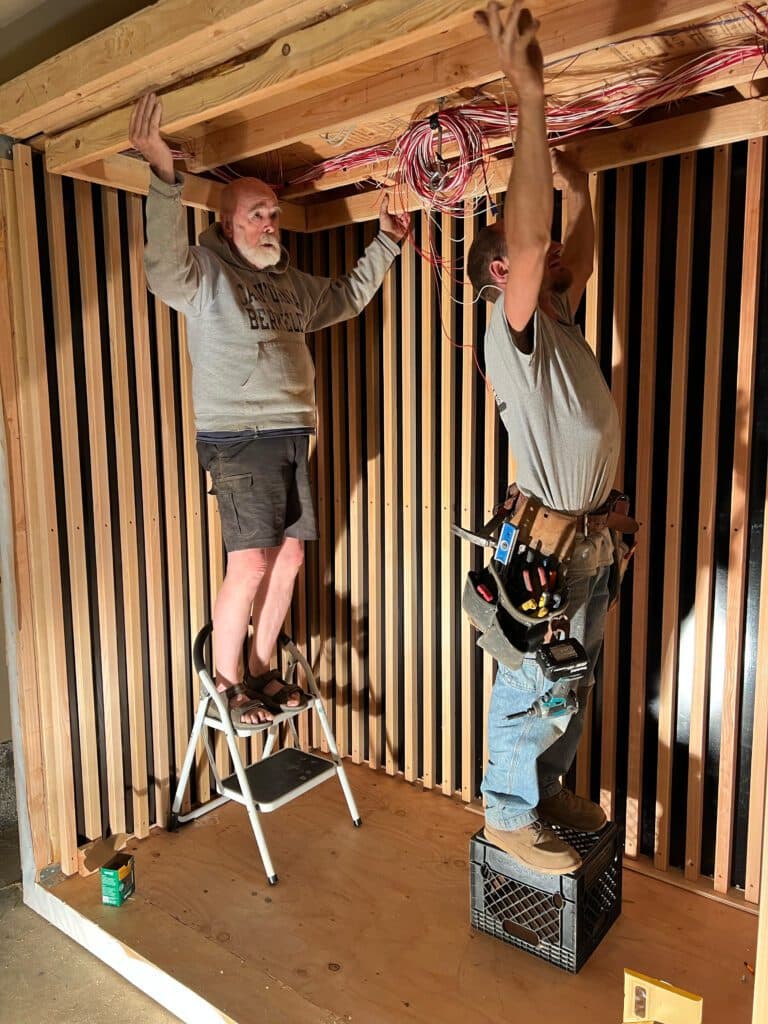
When you move up from plug-and-play models to large-scale, in-wall custom sauna projects, you leave the standard 110-volt plug in the rearview mirror. These larger architectural builds require a dedicated 240V/30A or 50A circuit hardwired directly into your main electrical panel.
One of the most insidious technical hazards in advanced infrared sauna installation is distance-based voltage drop. This invisible performance killer typically occurs due to excessively long wire runs out to an outdoor sauna or using undersized wiring between sub-panels. Voltage drop actively reduces your heater performance by restricting the flow—for example, your sauna might end up pulling only 105V from a line that needs 120V to function properly. When this happens, the heaters physically cannot reach their intended therapeutic output. Calculate and compensate for distance-based voltage drops during custom installations to prevent your pristine new heaters from attempting to perform on just 105V.
To mitigate these heavy localized power demands safely, an advanced 240-volt high-amp circuit uses centralized architecture. In our custom builds, we utilize the SaunaCloud CORE 5™ power supply. This hub handles the main power distribution down the line, pulling the heavy load safely while providing sophisticated overcurrent protection at the individual heater level. The system is rigorously engineered to match VantaWave power curves and thermal responses, ensuring every heater gets exactly the stable current it needs for the full duration of your session.
Regulatory realities: Fixed space heating codes and professional installation
If you search for guides on how to build a custom infrared sauna, you'll see hundreds of generic DIY articles treating in-wall saunas just like regular household appliances. Wiring a built-in room based on an appliance framework is misguided; it exposes you to safety and liability risks.
A portable box that plugs into a wall might fall under standard appliance regulations, but an integrated custom build requires strict National Electrical Code oversight. Specifically, NEC Article 424 covers fixed electric space-heating equipment, while NEC Article 422 covers standard appliances. Custom sauna builds legally fall under the much more rigorous 424 oversight. Specify NEC Article 424 rather than Article 422 on your electrical permits when building an integrated custom infrared unit to ensure the inspection complies with the correct legal threshold.
Because you are introducing sustained, high-amperage heat into a wood-framed, highly insulated room, professional electrical installation is a non-negotiable safety requirement. Trying to wire everything yourself to save a few dollars can lead to devastating consequences, preventing distinct physical risks such as electrical burns, house fires, and the immediate voiding of your homeowner's insurance policy. Budget for a licensed professional—installation costs typically range from $200–$800, which pays for code compliance and total peace of mind.
Sauna conversion economics: Radically lowering your electrical footprint
Upgrading an outdated, sweltering hot-rock room doesn't just transition your therapy from surface-level convection to deep electromagnetic radiation; it fundamentally re-writes your home's energy consumption.
Traditional rock heaters place continuous burdens on a residential electrical panel, ordinarily pulling 6–9 kW just to preheat the dead air inside the room. Converting traditional saunas to infrared systems effectively slashes that electrical footprint, dropping the requirement safely down to 1.5–3 kW. You can reduce 6–9 kW legacy power demands down to 1.5–3 kW by converting outdated convection room frames into modernized radiant infrared systems.
This drop represents a 40–60% daily operational energy savings compared to new custom convection builds. The conversion mechanics are so economically powerful that luxury commercial properties—like the wellness setups at Cavallo Point, Westin, and Marriott properties—are abandoning the energy waste of 6–9 kW traditional setups. They achieve an immediately superior therapeutic experience without forcing expensive commercial panel upgrades, proving that optimizing your wavelength therapy is also the smartest electrical decision you can make.
Frequently Asked Questions
Do infrared saunas run on 110 or 220?
It depends on the unit size and installation type. Compact 1- to 2-person freestanding models typically run on a 110-volt circuit, while large-scale custom or built-in sauna projects require 240-volt infrastructure to handle the higher power demand.
Do infrared saunas need 240V?
You only need 240V for custom, in-wall installations or very large multi-person units. Smaller plug-and-play saunas are engineered to run safely on standard 110-volt dedicated circuits.
Why does the temperature of my sauna affect its therapeutic quality?
Infrared heaters are calibrated to produce a specific wavelength, typically around 7.9 microns, which is most effective for therapy. If you force the air temperature too high using excessive power, the wavelength shifts and loses its therapeutic precision, making moderate temperatures between 130–145°F more effective than extreme heat.
Can I plug my infrared sauna into a standard wall outlet?
While you technically can plug it in, you must ensure the outlet is on a dedicated circuit that is not shared with other appliances. Sharing a circuit often leads to tripped breakers when the heater pulls its maximum continuous amperage, especially toward the end of a session.
What is the importance of 12-gauge wire for 20-amp sauna units?
Standard 14-gauge household wiring is insufficient for a 20-amp load and can create a fire hazard by overheating behind your walls. Using 12-gauge wire ensures the circuit can safely handle the sustained power draw, preventing voltage drops and ensuring the heaters perform at their full intended capacity.
How much does professional installation for an in-wall infrared sauna cost?
Expect to pay between $200 and $800 for a licensed electrician to handle the installation of an integrated custom sauna. This investment is necessary to ensure the build complies with strict NEC Article 424 safety codes and protects your home insurance coverage.
What is the difference between NEC Article 422 and 424 for sauna installations?
Article 422 applies to standard portable household appliances, whereas Article 424 covers fixed electric space heating. Because custom in-wall saunas involve permanent integration into a building's structure, they legally fall under the more rigorous oversight of Article 424.

Founder & Lead Designer, SaunaCloud®
SaunaCloud: 3,000+ installations since 2014 · Author of The Definitive Guide to Infrared Saunas · Featured in Forbes, Inc., and MSN
Christopher designs every SaunaCloud sauna. His work brings the room, heaters, controls and installation plans together so you can review the project before committing. His professional expertise is sauna design and construction, not clinical medicine.
Custom 3D renderings and a proposal in 24-48 hours.
Continue Reading

Safety & Best Practices
What Is the 200 Rule for Saunas? A Safety Guideline Explained with Real-World Heat Stress Examples
Read article
Safety & Best Practices
What Not to Do After an Infrared Sauna: 7 Post-Session Mistakes That Ruin Your Recovery
Read article
Safety & Best Practices
Will Red Light Therapy Fade Tattoos? Science Says No – Here’s Why
Read articleReady to Design Your Sauna?
Every project starts with a conversation. Tell us about your space and we'll create your custom plan — free, no obligation.
Custom 3D renderings and a proposal in 24-48 hours.