
Steam Room vs Infrared Sauna: Which Heat is Right for You?
Key Takeaways
- Traditional steam saunas: Convective heat
- Infrared saunas: Radiant heat and breathable air
- Does infrared hold up against steam for daily comfort
- Home installation: Construction vs plug-and-play
- Which environment is actually right for your home
You are about to invest thousands of dollars and permanently carve out space in your home for a daily wellness ritual. You want the deep relaxation, longevity, and health benefits that come with regular heat exposure. But before tearing up the basement, you need to settle the core divide: deciding whether an infrared or steam sauna guarantees you will actually use the room every single day.
As the founder of SaunaCloud, I have tried every hot box under the sun. I’m naturally biased toward red light infrared saunas, but it ultimately comes down to one basic human need: I find it hard to breathe in a steam room. It just isn’t comfortable for me. Finding the right fit for you means moving past raw temperature numbers to understand exactly how your lungs and body respond to different types of heat. If you’re leaning toward infrared, browse our sauna models or explore custom infrared sauna options.
Here is exactly how the two environments compare at a glance:
If you cannot tolerate the air inside the room, the biological benefits simply do not matter. To figure out which environment your body will embrace instead of fight, we first have to look at how they create heat.
Traditional steam saunas: Convective heat
Traditional steam saunas are high-humidity wooden rooms that utilize convective heat transfer by warming the oxygen around you. They rely on heated rocks and splashed water to create an intensely humid environment.
Thermoregulation and respiratory impact
These conventional rooms push ambient air heating to its absolute limits, frequently reaching air temperatures close to 200 degrees. When water hits the hot stones, it triggers dense, rolling steam. This extreme heat creates a distinct respiratory envelope—an immediate rush of moisture into the lungs that drastically alters your breathing patterns. For people with strong dry heat tolerance, this sudden wave of wet air can feel suffocating.
The human body is forced into heavy thermoregulatory strain to cope with the cardiovascular load of this dense environment. Your heart works overtime trying to cool you down, and your skin triggers a massive, immediate surface sweat response.
Pros and cons of steam
For some, that intensity is exactly the point. The aggressive moisture is fantastic for acute vasodilation on the skin's surface and is highly effective at clearing respiratory congestion and opening sinuses.
But that intense thermoregulatory strain carries a massive tradeoff. The "suffocation factor" limits how long the average person can stay inside. A punishing 15-minute session in 200-degree ambient moisture might feel like an endurance test rather than a daily habit.
Infrared saunas: Radiant heat and breathable air
Infrared saunas bypass the air in the room almost entirely. Instead of warming the space around you, they use specialized light waves to warm your body directly.
Subdermal penetration and cellular response
The mechanical shift from steam to a custom infrared sauna changes the biological outcome. Instead of aggressively raising your skin temperature through ambient moisture, infrared light relies on radiant tissue penetration. The body absorbs the heat subdermally.
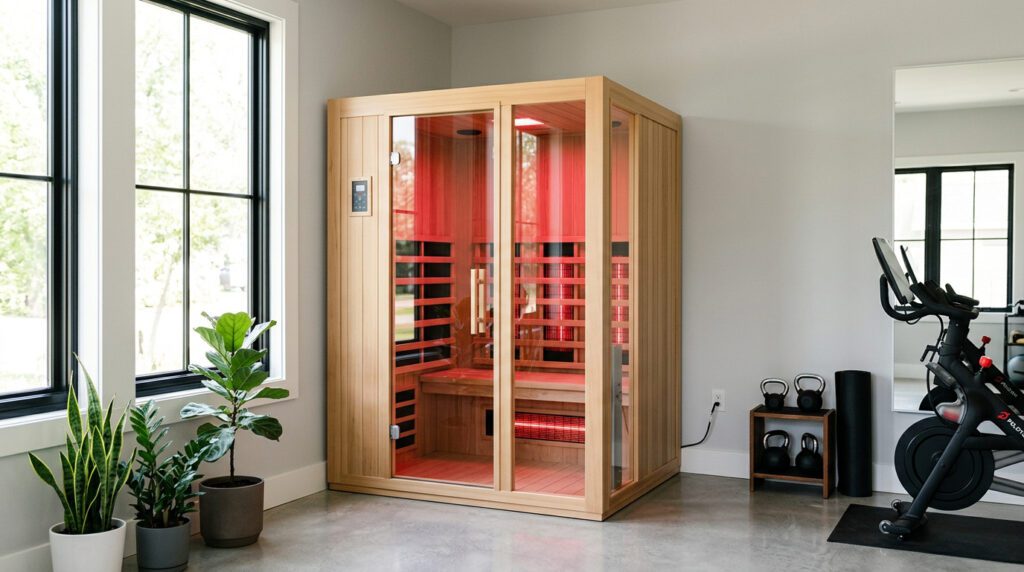
Because it warms the soft tissue directly, the room itself only needs to sit between 120 and 160 degrees. Modern clinical approaches often utilize a targeted red light spectrum to stimulate cellular mitochondria directly. This direct subdermal penetration creates profound systemic responses without demanding a frantic surface sweat response just to keep you alive.
Pros and cons of infrared
The immediate upside is pure respiratory comfort, allowing for much deeper physiological relaxation. Infrared heat keeps the air highly breathable. Asthmatics and those sensitive to extreme humidity can sit comfortably for 40 minutes or more, calmly reading a book or stretching after a heavy workout.
Modern residential technology also makes the experience incredibly frictionless.
The downside? Traditionalists often step into a 130-degree room and feel underwhelmed for the first ten minutes. It takes time for the deep tissue heat to build up to a heavy sweat.
Does infrared hold up against steam for daily comfort?
Mainstream red light infrared vs traditional sauna comparison articles often measure success purely by how fast you drip sweat. But physiological benefits compound purely through duration and consistency.
Overcoming the suffocation factor
As wellness writer Kimberly Truesdell noted in a review published on Sep 22, 2025, regular sauna therapy reduces inflammation and strengthens immunity, but only if you use it routinely. If your breathing is labored, the habit degrades over time.
A 140-degree red light room where you breathe freely is medically superior for long-term health than a 200-degree wet room you actively dread entering. The reduced cardiovascular load associated with lower ambient heat means your body spends its energy on deep tissue repair rather than scrambling to rapidly vent thermoregulatory strain.

"A 140-degree red light room where you breathe freely is medically superior for long-term health than a 200-degree wet room you actively dread entering."
Contrast therapy integration
Modern biohackers rely heavily on dry environments to support advanced recovery protocols. When you pair the deep tissue warmth of an infrared session with the intense vascular constriction of an Alpine Cold Tub, a Valaris Hot + Cold Tub, or a Chilly GOAT GO!, the biological response multiplies.
This protocol, widely known as Contrast Therapy, creates a massive pumping action in the cardiovascular system. The result is rapid, systemic vasodilation. A targeted session inside a SaunaCloud infrared unit perfectly complements a transition into a cold tub, efficiently flushing lactic acid from skeletal muscle.
Home installation: Construction vs plug-and-play
When you move wellness into your home, the architectural reality hits hard. The upfront sticker price of a cabin is only a fraction of what you will actually pay if you choose the wrong system for your floor plan.
Architectural burdens of steam
Unlike setting up outdoor cooking grills, maintaining backyard hot tubs, or building a stone wood-burning fireplace on a patio, bringing wet heat inside a house requires serious engineering.
A traditional steam room demands a heavy, permanent retrofit. Because it uses huge amounts of energy to boil water over rocks, it requires a 220v dedicated circuit. Beyond the electrical needs, you have to run external plumbing, drain lines, and high-powered ventilation systems to constantly cycle the heavy vapor. Heavy moisture mitigation is an absolute necessity. If you trap 100% humidity near standard household drywall, localized black mold is almost guaranteed.
Plug-and-play modular realities
Infrared units essentially eliminate this architectural nightmare. The modern market is built around simple, tool-free assembly that requires no plumbing or moisture barriers.
High-end direct-to-consumer models like the MP2 - 2 Person Sauna, the slightly larger MP3 - 3 Person Sauna, or the space-saving MP3C - 3 Person Corner Sauna from MasterSpas, LLC can be assembled in a living room in under an hour. Bypassing that 220v dedicated circuit in favor of a standard 110v outlet allows flawless integration anywhere in your home. Avoiding the massive burden of aggressive moisture mitigation provides crucial peace of mind. When you combine that structural relief with elegant, tool-free assembly, it is easy to understand what pushes homeowners firmly into the dry-heat camp.
This simplified power requirement also tackles a major concern: the ongoing expense to run the sauna. Firing up 220v steam rooms every day can cause massive monthly electricity spikes. In contrast, 110v infrared units are remarkably efficient, managing utility costs while still generating the profound deep tissue sweat required to activate your cellular detox pathways.
Which environment is actually right for your home?
Choosing the best sauna is not a static scientific absolute. It is about identifying the specific thermoregulatory environment that guarantees your daily compliance.
- Choose steam if you prioritize rapid surface sweating, need acute sinus clearing from high humidity, and are fully prepared to hire contractors for a complex, 220v-plumbed home remodel.
- Choose infrared if you prioritize deep cellular recovery, are sensitive to high respiratory humidity, and want a modular system that plugs directly into your wall without risking structural damage to your home.
Buy the machine that encourages an unbroken daily habit. If you want profound recovery without the suffocating side effects, a breathable, targeted light room will serve you quietly and comfortably for years to come.
Need help deciding on the perfect setup? Feel free to call me today with any questions about our custom red light infrared saunas. Let’s talk about your health goals and create a personalized wellness sanctuary that fits seamlessly into your everyday life.
— Christopher Kiggins
Frequently Asked Questions
Traditional steam saunas use convective heat to warm the air around you to nearly 200 degrees, forcing your body to rapidly sweat to cool down. Infrared saunas bypass the room's air completely and use specialized light waves to warm your tissue directly subdermally. This means a radiant cabin only needs to comfortably reach 120 to 160 degrees to trigger deep cellular recovery.
Infrared technology relies on deep radiant tissue penetration rather than hitting you with an extreme wall of ambient moisture. It simply takes a few minutes for this targeted subdermal warmth to build up internally and trigger a heavy sweat, which often underwhelms traditionalists for the first ten minutes. However, your body is still achieving compounding physiological benefits without scrambling to vent severe thermoregulatory strain.
Absolutely, as pure respiratory comfort is the primary advantage of infrared heat. Rather than forcing a rush of dense, humid air into your lungs, a red light room keeps the ambient oxygen dry and highly breathable. Those who find the steam room 'suffocation factor' intolerable can easily sit in a 140-degree infrared cabin for upwards of 40 minutes.
The architectural burden entirely depends on the environment you choose to build. Traditional steam rooms require a severe, permanent retrofit with heavy moisture mitigation, plumbing, and a dedicated 220v circuit to prevent localized black mold from destroying your drywall. Conversely, modern infrared saunas like MasterSpas' MP2 or MP3 models are tool-free, modular cabins that can be assembled in an hour and run off a standard 110v outlet.
Contrast therapy pairs extreme deep tissue heat with an immediate plunge into cold water to force an aggressive pumping action within your cardiovascular system. Stepping from the systemic vasodilation of an infrared cabin directly into cold water forces rapid vascular constriction, which efficiently flushes lactic acid from skeletal muscle. Biohackers frequently pair a Sweaty GOAT infrared unit with a Chilly GOAT or Matterhorn cold tub for this precise physiological outcome.
It is exactly worth the cost if you demand rapid surface sweating, need acute sinus clearing from dense vapor, and happen to have a massive renovation budget. If your goal is daily compliance and cellular repair, it is a terrible investment. You are far more likely to maintain a daily wellness habit with an infrared system because it guarantees breathable air and simple engineering.
Frequently Asked Questions
Mainstream red light infrared vs traditional sauna comparison articles often measure success purely by how fast you drip sweat. But physiological benefits compound purely through duration and consistency.
Choosing the best sauna is not a static scientific absolute. It is about identifying the specific thermoregulatory environment that guarantees your daily compliance.

Founder & Lead Designer, SaunaCloud®
3,000+ custom saunas built since 2014 · Author of The Definitive Guide to Infrared Saunas · Featured in Forbes, Inc., and MSN
Chris has been designing and building custom infrared saunas since 2014. He wrote one of the first comprehensive books on infrared sauna therapy and is personally involved in every SaunaCloud build — from design consultation through delivery and beyond.
Continue Reading
Infrared Sauna vs. Traditional Sauna: Which Is Better for You?
Read article
Custom vs Portable Infrared Sauna: The Complete 2025 Buyer’s Guide
Read article
Custom Infrared Sauna Buying Guide: What I’ve Learned Building 3,000+ Saunas
Read articleReady to Design Your Sauna?
Book a free consultation with our founder and get custom 3D renderings for your space.