
Infrared Sauna Workouts: What Works, What Doesn't, and Why Exercise THEN Sauna Beats Exercise IN Sauna (2026)

Key Takeaways
- Vigorous exercise inside a sauna REDUCES performance — strength, endurance, and coordination decrease because your cardiovascular system manages two competing demands. You get a worse workout in the sauna than at room temperature. 'More sweat = more results' doesn't hold up
- Research supports exercise THEN sauna, not exercise IN sauna. Ahokas 2025 showed post-exercise infrared improved recovery and reduced DOMS. The protocol: full workout at normal temp → 20-30 min sauna after → recovery, HSP activation, cardiovascular extension
- What DOES work inside a sauna: gentle stretching, restorative yoga, breathwork, meditation. Heat makes collagen fibers more pliable above 104°F — flexibility work is safer and more effective in heat
- The 'burn 2x calories' claims are misleading. Extra expenditure from heat: roughly 10-20% more than room temp. Most dramatic 'weight loss' is water that returns when you rehydrate
- For endurance athletes, post-exercise sauna is a legitimate performance enhancer: increased plasma volume, improved sweat efficiency, reduced core temp at given intensity. Works best as RECOVERY tool, not training environment
'Infrared sauna workouts' — exercising inside a heated cabin — are trending, popularized by studios like HOTWORX. The concept is appealing: combine exercise and heat for amplified results. The reality is more nuanced. Some movements benefit from heat. Others are actively worse. And the research consistently shows that exercise THEN sauna beats exercise IN sauna.
The honest assessment
What works in heat: Light stretching, gentle yoga, static holds, breathwork, and meditation. Heat pre-warms tissue for flexibility — collagen fibers become more pliable above 104°F. The combination of gentle movement + heat produces a stronger parasympathetic and endorphin response than either alone. These movements BENEFIT from heat without requiring peak performance.
What doesn't work well: Vigorous exercise — HIIT, heavy resistance, intense cardio — inside a sauna. Your cardiovascular system is already managing thermoregulation from the heat. Adding intense exercise creates competing demands: blood to muscles for work AND blood to skin for cooling. Core temperature rises dangerously fast. Strength decreases. Endurance drops. Coordination suffers. You get a WORSE workout than at room temperature.
Exercise THEN sauna: the superior protocol
The Ahokas 2025 study showed post-exercise infrared sauna improved neuromuscular recovery (jump height, sprint times) and reduced delayed-onset muscle soreness — without blunting muscle growth adaptation. The sauna AFTER training supports recovery. Training IN the sauna compromises the training.
The optimal protocol: full workout at normal temperature (maximum performance, full training stimulus) → 20-30 minutes infrared sauna within 30-60 minutes after → recovery benefits, HSP activation, cardiovascular conditioning extension, and parasympathetic rebound. You get the best of both without the compromise of either.
The calorie burn myth
Studios claim exercising in infrared heat 'burns 2x the calories.' The reality: the extra calorie expenditure from heat is modest — roughly 10-20% more than the same exercise at room temperature. Your body does work harder to manage thermoregulation, which costs metabolic energy. But most of the dramatic 'weight loss' after a heated workout is water loss from sweating that returns when you rehydrate.
Infrared sauna supports weight management through cardiovascular conditioning, metabolic effects, and improved sleep/stress (which affect body composition). But not through dramatic per-session calorie burns. If calorie burning is your goal, a harder workout at room temperature burns more than an easier workout in heat.
Heat acclimation: the legitimate performance edge
For endurance athletes, post-exercise sauna produces real performance adaptations: increased plasma volume (more blood to carry oxygen), improved sweat efficiency (cool more effectively), reduced core temperature at a given exercise intensity, and improved performance in both hot AND temperate conditions. This is the 'sauna as legal performance enhancer' — and it works best as a RECOVERY tool after training, not as the training environment.
Safe movement inside your sauna
If you want movement during your sauna session, keep it gentle: gentle stretching and flexibility work (heat-enhanced tissue extensibility). Restorative yoga poses (supported, no balancing poses — coordination decreases in heat). Breathwork and pranayama (controlled breathing enhances parasympathetic activation). Light resistance band work focused on mobility, not strength. Self-massage if space allows. Keep temperature moderate (120-130°F) when combining with movement — you're adding metabolic heat on top of radiant heat.
Safety considerations
Exercise + heat = additive cardiovascular stress. Heart rate from exercise PLUS heart rate increase from heat can spike dangerously high. Dehydration accelerates (exercise sweat + heat sweat). Core temperature rises faster. People with cardiovascular conditions should NOT do vigorous exercise in a sauna. Even healthy individuals should keep sauna-based movement gentle and hydrate aggressively.
The cold exposure timing caveat: If you follow exercise → sauna → cold plunge, be aware that cold exposure immediately after resistance training may blunt muscle growth (Piñero 2024). Separate cold from training by 4+ hours. Sauna after training does NOT have this blunting effect.
Frequently asked questions
Frequently Asked Questions
For gentle movement (stretching, yoga, breathwork) — yes, heat enhances flexibility and deepens relaxation. For vigorous exercise (HIIT, heavy lifting, intense cardio) — no, heat reduces performance and increases risk. The best protocol: full workout at normal temperature, then infrared sauna after for recovery. You get better training AND better recovery.
Modestly — about 10-20% more than the same exercise at room temperature. But most post-workout 'weight loss' is water from sweating, not fat. And you get a worse workout in the heat (reduced strength, earlier fatigue), which may mean fewer total calories than a harder workout at normal temperature. The calorie argument doesn't hold up when you account for performance reduction.
After. The Ahokas 2025 study specifically validated post-exercise infrared sauna for recovery. Before: a brief 10-15 minute warm-up session at low temperature can pre-heat tissues for flexibility, but a full sauna session before intense training may impair performance through dehydration and pre-fatigue. The evidence strongly favors the sequential approach: train first, sauna second.
Gentle stretching, restorative yoga (no balancing poses — coordination decreases in heat), breathwork/pranayama, meditation with body scanning, and light resistance band mobility work. Keep temperature at 120-130°F when moving (lower than static sitting). Avoid anything requiring coordination, balance, or maximum effort. The sauna is for recovery and flexibility, not for replacing your gym.
For the heat-enhanced flexibility and endorphin response from gentle movement in infrared — yes, that component is legitimate. For the 'burn 2x calories' and dramatic weight loss claims — those are overstated. The water weight returns. The extra calorie burn is modest. For optimal results, a full-intensity workout OUTSIDE the heat followed by infrared sauna recovery would produce better training adaptations and similar recovery benefits.
10-15 minutes — enough to let your heart rate start normalizing from exercise (cool-down walk, light stretching) before adding the heat stimulus. Don't go straight from a max-effort set into a 140°F sauna. The recovery window for maximum benefit: within 30-60 minutes of training completion, per the Ahokas study protocol.

Founder & Lead Designer, SaunaCloud®
3,000+ custom saunas built since 2014 · Author of The Definitive Guide to Infrared Saunas · Featured in Forbes, Inc., and MSN
Chris has been designing and building custom infrared saunas since 2014. He wrote one of the first comprehensive books on infrared sauna therapy and is personally involved in every SaunaCloud build — from design consultation through delivery and beyond.
Continue Reading
Infrared Sauna for Muscle Recovery: What a 40-Athlete Study Actually Found (2026)
Read article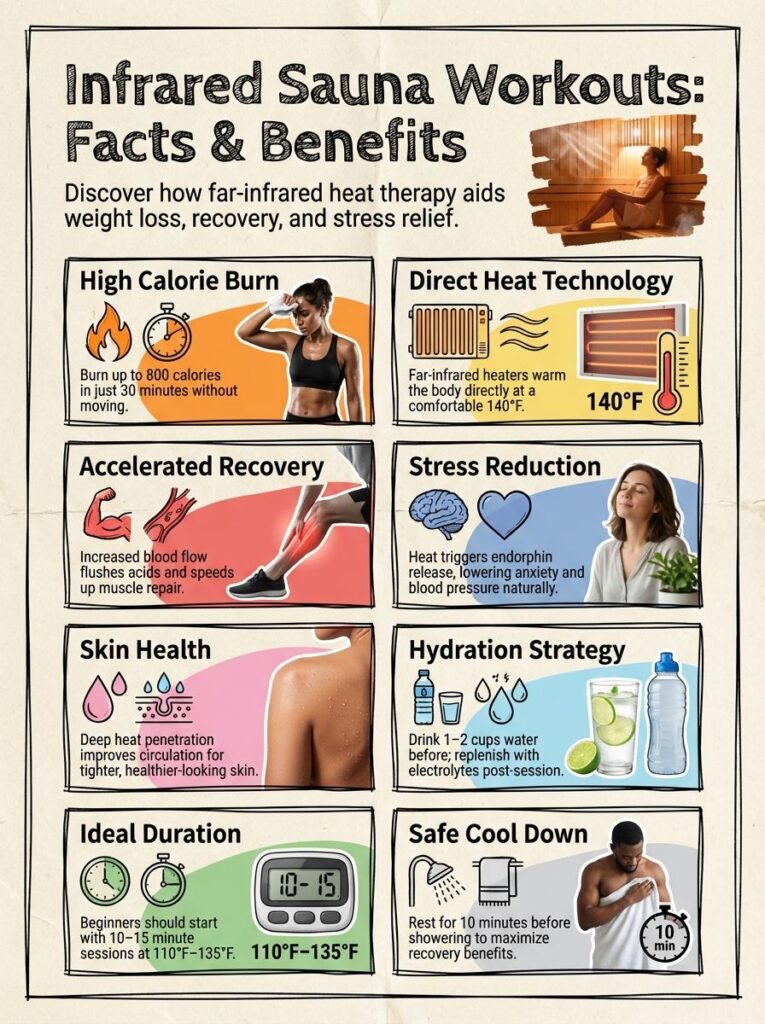
Hot Yoga and Infrared Sauna: Why Radiant Heat Changes the Practice (2026)
Read article
Cold Shock Proteins & Cryotherapy: The Other Side of the Temperature Equation (2026)
Read articleDesign a Sauna Sized for Movement and Recovery
Custom dimensions for gentle yoga and stretching. VantaWave heaters for post-workout recovery. The training happens outside — the recovery happens inside.