How to Prepare for an Infrared Sauna: A 3-Session Beginner Protocol
Key Takeaways
- Drink 16–20 ounces of water 30–60 minutes before your session — your body needs that fluid reserve to sweat effectively and regulate its core temperature
- Your first session should be just 5–10 minutes at 100–110°F; build to 20–25 minutes at 120–130°F over your first three sessions, and never exceed 45 minutes or 150°F
- Cool down for 5–10 minutes after stepping out, then rehydrate with 16–20 ounces of water or an electrolyte drink within the first hour
In This Article
You've probably heard the general advice: hydrate, start slow, listen to your body. But if you're like most people stepping into an infrared sauna for the first time, the specifics are what you actually need. How much water? How long after eating?
What temperature should you aim for on session number one versus session number ten? And please — should you take a cold shower after or not?
Infrared saunas work differently than traditional saunas. They heat your body directly rather than warming the air around you, which means they run at lower temperatures — typically 110–145°F — but still get you sweating hard. Your body can lose about 2% of its fluid weight during a single session. That matters, and it means preparation matters more than most guides let on.
The benefits include relaxation, stress reduction, and some research pointing to potential heart health and recovery support. But none of that happens by accident. Here's the full protocol — exactly what to do before, during, and after your session.
Before the session — hydration, timing, skin prep, and what to wear
Drink 16–20 ounces before you step in
The single most important prep step is getting enough water into your system ahead of time. Aim for 16–20 ounces about 30–60 minutes before your session. Some sources say 8 ounces is the minimum, but the more generous target works better for most people. You're about to sweat a lot, and starting with a full tank makes a difference in how you feel.
Drinking 16–20 ounces of water 30–60 minutes before your session gives your body the fluid reserve it needs to sweat effectively.
Alcohol is a hard no. It affects blood pressure, slows circulation, and can be dangerous when combined with the heat. Save the drink for after.
Wait 1–2 hours after eating
A full stomach diverts blood to your digestive system. In the sauna, you want that blood available for heat regulation — helping your body cool itself and distribute the infrared heat where it's useful. Give yourself a 1–2 hour window after a meal before you head in. That's the sweet spot between being comfortable and maximizing the session.
Shower to remove lotions, makeup, and sweat
Infrared light penetrates your skin directly. Anything sitting on top of it — lotion, makeup, dirt, leftover sweat from a workout, blocks some of that absorption. You also don't want to bake whatever chemicals are in your skincare products into your pores. Think of it as starting with a clean canvas. A quick rinse is all it takes.
Quick test: Run a clean towel over your arm. If anything comes off — product, oil, dirt — you haven't rinsed enough.
What to wear — and what to leave out
Minimal, breathable clothing is the goal. Cotton or a towel works best. Skip synthetics — they trap heat and moisture in ways that aren't comfortable. If you're at a spa, they'll provide a robe and wrap, and covering is required for the whole session. The wrap can go above the chest or at the waist, your choice.
Leave these outside: shoes, phone, jewelry, food, plastic water bottles, lotions, and oils. The sauna should be a clean, simple environment.
If you're going to a spa, arrive 10–15 minutes early to change and settle in. Starting rushed defeats the purpose.
Before the session — light exercise to boost circulation
Gentle movement before you step in helps the infrared heat penetrate more effectively. The reason is straightforward: moving gets your blood flowing, which dilates your blood vessels. Think of it as opening the highways so the heat can reach deeper tissues.
Ten to fifteen minutes of gentle movement before stepping in helps dilate blood vessels so infrared heat penetrates more effectively.
You don't need a full workout. Ten to fifteen minutes of gentle yoga or a brisk walk is plenty. Five to ten minutes of light stretching works too. Even a minute of jumping jacks gets things moving. Qi Gong is another option — slow, deliberate movements that prime your circulation without exhausting you.
The key is to warm up, not wear yourself out. You want your body ready to receive the heat, not already asking for a break.
One nuance worth knowing: a short sauna session of 5–10 minutes before exercise can help warm up your muscles. But a long sauna session before intense exercise is counterproductive — it can increase fatigue, contribute to dehydration, and reduce your performance. If you're working out, save the longer sauna session for after.
During the session — posture, rotation, and duration
Sit up straight — and rotate every 7 minutes
How you position yourself in the sauna matters more than you'd think. Sit upright so the infrared heaters can reach your front and back. If the heaters are only on one side, rotate a quarter turn every 7 minutes for even coverage. Lying down feels comfortable, but it reduces the surface area exposed to the heat. Maximize skin exposure — the more skin the infrared light can reach, the more effective the session, so prepare post-session water and electrolytes so they're ready when you step out.
A 3-session progression protocol
If you're new to infrared saunas, follow this exact progression: For your first session, stay in for 5-10 minutes at 100-110°F. For your second session, increase to 15-20 minutes at 110-120°F. By your third session, aim for 20-25 minutes at 120-130°F.
The absolute max for any session is 45 minutes, and the temperature should never go above 150°F. Infrared saunas run cooler than traditional ones anyway, but to manage safety properly, respect the ceiling. For a quick reference: beginners start at 10-15 minutes, intermediate users 15-25 minutes, and experienced users 20-30 minutes.
If your sauna has pre-set programs — Cardio, Detox, Weight Loss, Relaxation, Pain Relief, Anti-Aging — use them as a guide, or explore how infrared saunas bypass the room's air to warm your tissue directly subdermally. Each program adjusts the light and heat blend for a different goal. It takes the guesswork out.
Listen to your body and know when to stop
This is the golden rule, and it bears repeating: stop immediately if you feel dizzy, nauseous, extremely fatigued, or if you get flu-like symptoms. Discomfort is your body telling you something. Don't push through. You can always try again another day.
During the session — mindfulness, chromotherapy, and digital detox
Leave your phone outside. The light and heat can damage the hardware, but more importantly, the point is to disconnect anyway. The sauna is one of the few places in modern life where doing nothing is the whole assignment.
Leaving your phone outside and using the time for meditation or deep breathing turns the sauna into a rare space for true stillness.
Use the time for meditation, deep breathing, or just sitting quietly. I know it's hard to actually meditate — I struggle with it too, but the sauna gives you a built-in excuse to be still for 20 minutes. Let your mind wander. That counts.
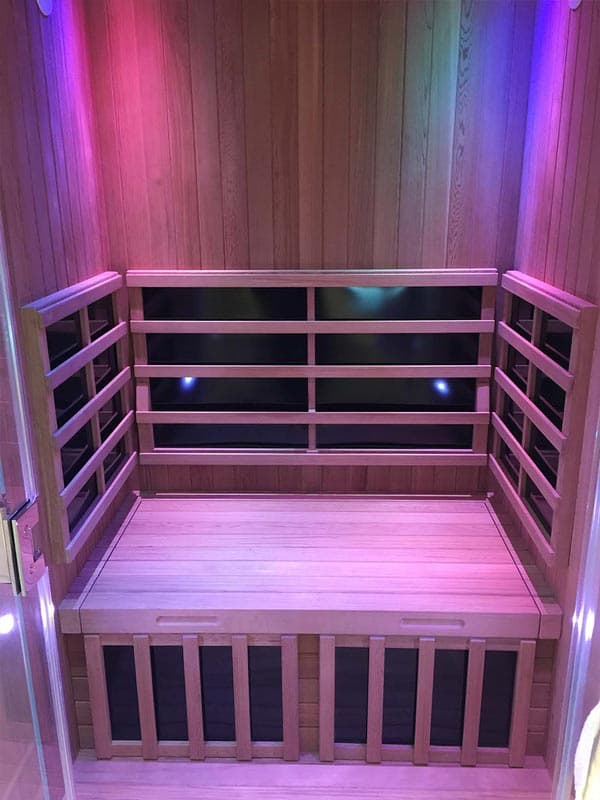
If your sauna has chromotherapy lights, you've got an extra layer to play with. Most systems offer around 12 color options, and spending 3–5 minutes per color is enough for a noticeable effect. Green light is good for relaxation. Yellow light targets stress relief.
Sit directly under the lights to get the full effect. It's not essential, but it adds a nice sensory dimension to the session.
After the session — cool-down and the cold vs. room-temperature shower
Step out and give yourself 5–10 minutes to cool down gradually. Don't rush back into your day. Your core temperature needs time to come down naturally, and skipping this step shortcuts the relaxation benefits.
Now for the question everyone asks: cold shower or not?
A cold shower will close your pores, rinse away the sweat so you don't reabsorb anything your body released, and give your circulation a boost. It's refreshing and effective.
Your first session should be just 5–10 minutes at 100–110°F — the goal is simply to see how it feels, not to push limits.
A room-temperature shower is gentler and still does the job. Some sources actually recommend this over cold, especially if you're sensitive to temperature shock or just don't enjoy cold showers.
Both are valid. Pick the one that feels right for you in the moment. You're not failing by choosing warm water.
If you want to take it a step further, use an exfoliating scrub, loofah, or bath brush to remove dead skin cells during your cool-down. A chilled towel infused with eucalyptus or essential oils can also feel amazing for cooling off.
After the session — rehydration, nutrition, and rest
Drink 16–20 ounces within the first hour
You just lost fluid. Drink 16–20 ounces of water within the first hour after your session. If it was an intense sweat session, consider an electrolyte drink instead of plain water.
Replacing lost fluids with 16–20 ounces of water or an electrolyte drink within the first hour after your session prevents post-sauna fatigue.
Replenish electrolytes
Sweat isn't just water — it contains potassium, sodium, and zinc. You need to replace those to avoid feeling drained. A commercial electrolyte drink or coconut water works. So does this simple DIY mix: raw honey plus a pinch of Himalayan or sea salt in warm water. It's cheap, effective, and you probably already have the ingredients.
Setting aside at least 30 minutes to rest in a temperature-controlled space after your session is part of the process, not an optional add-on.
Eat light snacks
Bananas, watermelon, and avocados are perfect for restoring potassium and hydration. They're easy to digest and won't weigh you down. Avoid heavy or processed foods — your body needs gentle recovery, not a digestive marathon.
Rest for 30–60 minutes
Set aside at least 30 minutes to relax in a temperature-controlled space after your session. No strenuous activity. This is part of the process, not an optional add-on. Read a book, lie down, or just sit and notice how you feel.
Common mistakes and safety warnings
The one thing you must never do: pour water on the heaters
This is different from a traditional sauna. Never pour water on infrared heaters. It can damage the panels, create an electrical hazard, and void your warranty. Water and electricity do not mix.
Red flag: If you see anyone pour water on infrared panels, stop the session. That's a safety hazard, not a steam trick.
Alcohol, pregnancy, and medications — when to skip
No alcohol before or during the session. It taxes your heart, affects blood pressure, and can lead to burns if your judgment is impaired. Skip the sauna entirely if you've been drinking.
Do not use an infrared sauna while pregnant. Your core body temperature is already elevated, and the additional heat could push it into unsafe territory. Always check with your doctor.
If you're on medications, have heart conditions, neurological issues, or open wounds, consult a doctor before using a sauna. This is basic safety.
Minimum age is 18. Saunas are for adults.
Listen to your body
This keeps coming up because it's the most important rule. Dizziness, nausea, extreme fatigue, flu-like symptoms — stop immediately. You can try again another day.
Don't use long sauna sessions before intense exercise
Short sessions of 5–10 minutes before working out are fine for warming up. Longer sessions before intense exercise can increase fatigue, contribute to dehydration, and reduce performance. Save the longer session for after your workout.
Optional — contrast therapy for advanced users
Once you're comfortable with the basic protocol, contrast therapy is worth exploring. The idea is simple: alternate sauna heat with cold exposure, like a cold shower or ice bath. Advocates say it helps with reduced inflammation, improved recovery, and better circulation. The cold constricts your blood vessels, then the heat makes them dilate — it's like a workout for your circulatory system.
Contrast therapy — alternating sauna heat with cold exposure, gives your circulatory system a workout, but it's optional and best for advanced users.
This is optional and not for beginners. Start with the basic protocol for a few weeks. If you're curious, try adding a short cold exposure at the end of a session and see how it feels. There's no pressure to go all-in with ice baths.
How often to use an infrared sauna and when to expect results
Kelly Simms, ND, recommends 2–3 sessions per week for at least a month before deciding whether it's working for you. Give it a real try. One session will tell you if you like the feeling, but consistency is what produces results.
Many healthy adults can use an infrared sauna daily if they stay hydrated and listen to their bodies. A good target for regular use is 3–4 times per week for 30–40 minutes.
Don't worry if you don't sweat much in your first few sessions. That's completely normal. Sweating increases with regular use as your body adapts. Some people sweat buckets, others barely a drop. Both are fine.
Final thoughts — building your infrared sauna routine
The preparation and recovery are just as important as the time inside the sauna. The whole thing works best as a ritual: hydrate and move beforehand, sit intentionally during the session, then cool down, rehydrate, and rest afterward.
Consistency and gradual progression are what lead to cumulative benefits. You're not looking for a single magic session. You're building a practice that your body learns to respond to over time.
You've got a clear roadmap now. Use it, adapt it to what feels right for you, and see how it fits into your life. And when in doubt, listen to your body and check with your doctor. That's the whole protocol, and it's all you need.
Frequently Asked Questions
What not to do before an infrared sauna?
Don't drink alcohol, eat a heavy meal within 1–2 hours, or apply lotions, makeup, or oils to your skin. Alcohol affects blood pressure and can be dangerous with heat, a full stomach diverts blood away from heat regulation, and skincare products block infrared absorption and can bake chemicals into your pores.
What do 10 minutes in an infrared sauna do?
Ten minutes at a moderate temperature (100–110°F) is a solid starting point for beginners — it gets your body used to the heat, starts your sweat response, and can promote relaxation without overwhelming your system. It's enough to feel the effects but short enough to stay safe while you adapt.
How much water should I drink before an infrared sauna?
Drink 16–20 ounces of water about 30–60 minutes before your session. This gives your body the fluid reserve it needs to sweat effectively and regulate core temperature. Some sources say 8 ounces is the minimum, but the larger amount works better for most people.
Should I shower before using an infrared sauna?
Yes — a quick rinse removes lotions, makeup, dirt, and sweat that can block infrared light absorption. Infrared heat penetrates your skin directly, so you want a clean surface. You also don't want to bake skincare chemicals into your pores during the session.

Founder & Lead Designer, SaunaCloud®
SaunaCloud: 3,000+ installations since 2014 · Author of The Definitive Guide to Infrared Saunas · Featured in Forbes, Inc., and MSN
Christopher designs every SaunaCloud sauna. His work brings the room, heaters, controls and installation plans together so you can review the project before committing. His professional expertise is sauna design and construction, not clinical medicine.
Custom 3D renderings and a proposal in 24-48 hours.
Ready to Design Your Sauna?
Every project starts with a conversation. Tell us about your space and we'll create your custom plan — free, no obligation.
Custom 3D renderings and a proposal in 24-48 hours.