The Complete Commercial Infrared Sauna Guide: What Every Wellness Business Owner Needs to Know
Commercial Infrared Sauna Installation Guide: 7 Steps From Code Compliance to Opening Day
When I started building commercial infrared saunas over a decade ago, I learned fast that what works in someone’s spare bedroom absolutely fails in a commercial environment. The stakes are different. The demands are relentless. And the cost of cutting corners? It shows up in ways that destroy your reputation and your bottom line.
This is the guide I wish someone had handed me before my first hotel installation—everything you actually need to know to design, install, and operate commercial-grade infrared saunas that perform flawlessly for 15+ years of daily abuse.
The Commercial Reality Nobody Talks About
Here’s what I’ve learned from building over 3,000 custom saunas: most infrared saunas aren’t built for commercial use. They’re residential units that manufacturers slap a “commercial-grade” label on, and they catastrophically fail under the stress of 8-12 sessions per day.
What fails first:
- Power supplies that overheat after 6 months of continuous operation
- Heaters that stop working because they were never designed for this duty cycle
- Western Red Cedar that warps and cracks from humidity cycling
- Warranties that mysteriously don’t cover “commercial use.”
I’ve personally replaced failed hotel installations where the imported power supply died 18 months in. The repair cost? $12,000-$18,000 per unit in labor alone, plus lost revenue during the 3-week downtime while we rebuilt the electrical system.
The SaunaCloud® Principle: Commercial-grade construction isn’t a marketing term. It’s an engineering requirement. Every component must be purpose-built for continuous commercial operation, or you’re just creating an expensive maintenance nightmare.
Is Your Facility Ready for Commercial Infrared?
Before we get into the installation steps, let’s make sure you have the baseline infrastructure in place. Commercial sauna projects fail in the planning phase more often than anywhere else.
Minimum Requirements Checklist:
- 200A main electrical service panel (minimum)
- Dedicated floor space: 4’×4′ minimum per sauna unit
- Ceiling height: 6’6″ minimum (7′ preferred for ADA compliance)
- Budget: $12,000-$25,000 per installed unit for proper commercial construction
- Licensed electrician availability for dedicated 240V circuits
- Building permit processing timeline: 2-4 weeks
Project Timeline Expectations:
- Design & Permitting: 2-4 weeks
- Manufacturing: 4-6 weeks
- Installation: 3-5 days per unit
- Inspection & Commissioning: 1 week
- Total: 10-15 weeks from contract signature to first client session
If you don’t have these basics in place, stop now and get them sorted. Everything downstream depends on this foundation.
The 7-Step Commercial Infrared Sauna Implementation Plan
This is the actual blueprint we use for every commercial project, from boutique gyms to luxury hotel spas.
Step 1: Verify Code Compliance and Electrical Capacity
Before any design work begins, you must establish the legal and electrical parameters. This is where most DIY commercial projects crash and burn.
1. Determine ADA Requirements
If your facility requires ADA compliance (and most commercial spaces do), your sauna design must immediately integrate these specifications:
- 36-inch minimum entry door width (standard 32″ residential doors are non-compliant)
- Adequate internal turning radius for wheelchair maneuverability
- Accessible bench heights and grab bar placements
- Non-slip flooring surfaces
Don’t try to retrofit ADA compliance later. Design it in from day one.
2. Assess Existing Electrical Capacity
This is the step that kills more projects than anything else. You need a licensed electrician to confirm your building’s main panel can support dedicated 240V, 50A circuits.
Key word: dedicated. These circuits cannot share load with HVAC, lighting, or any other loads. One sauna = one dedicated breaker.
For multi-unit installations (like a gym with three saunas), you’re looking at a minimum of 150A of additional capacity. If your building doesn’t have it, you’ll need a service panel upgrade before you can proceed, which can add $8,000-$15,000 and 4-6 weeks to your timeline.
3. Confirm Fire Safety & Inspections
Review local Fire Code requirements:
- Fire sprinkler system integration (required in some jurisdictions)
- Heat-rated smoke detectors outside sauna doors
- Emergency shutdown systems
- Maximum temperature limits (varies by jurisdiction)
Know which Authorities Having Jurisdiction (AHJs) will sign off on your installation. In some cities, you’re dealing with the Building Department, Fire Marshal, AND the Health Department—budget time for this bureaucracy.
4. Plan Ventilation Strategy
Commercial facilities often require active ventilation systems, especially if you’re installing in:
- Pool houses or high-humidity environments
- Basement locations
- Multi-unit installations in small spaces
You may need 4-6 air changes per hour for humidity control. This usually means dedicated HVAC integration, not just a cheap bathroom exhaust fan.
Step 2: Design Custom Layout with 360° Heat Coverage
Your custom sauna design must prioritize performance and durability—not aesthetics or cost-cutting. I’ve seen too many beautiful saunas that don’t actually work because nobody understands the physics of heater placement.
1. Complete Site Survey
Conduct detailed measurements and note structural obstacles:
- Wall stud locations and load-bearing requirements
- Electrical conduit pathways
- HVAC vent locations
- Door swing clearances
- Glass panel structural support points
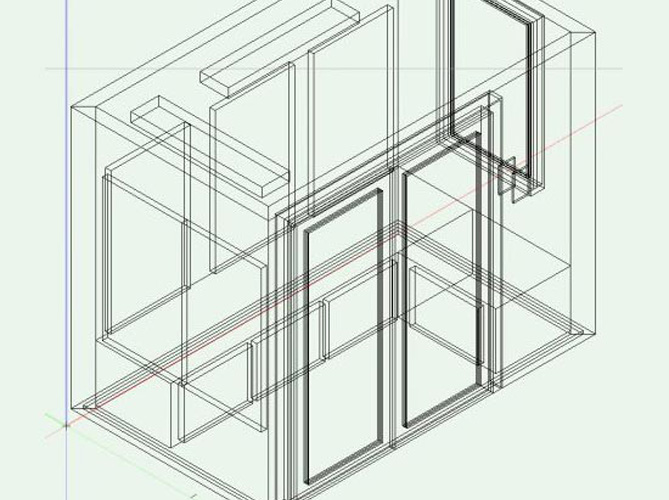
2. Generate Custom CAD Renderings
We use 3D CAD models and technical blueprints to finalize:
- Bench configuration for target capacity (1-6 people)
- Glass layout and tempered glass specifications
- Door swing direction and ADA clearances
- Heater placement for complete coverage
This step eliminates field surprises. Everything is measured twice and built once.
3. Optimize 360-Degree Heat Coverage
This is where engineering matters more than marketing. VantaWave® heater panels must be positioned to achieve complete infrared coverage:
- Full back panel coverage: lumbar, mid-back, upper back
- Side wall panels: targeting core and shoulders
- Calf heaters: leg and lower body coverage
- Front panels (optional): for couples or larger units
The goal is uniform heat delivery across the entire body surface. Cold spots = poor therapeutic effectiveness = disappointed clients.
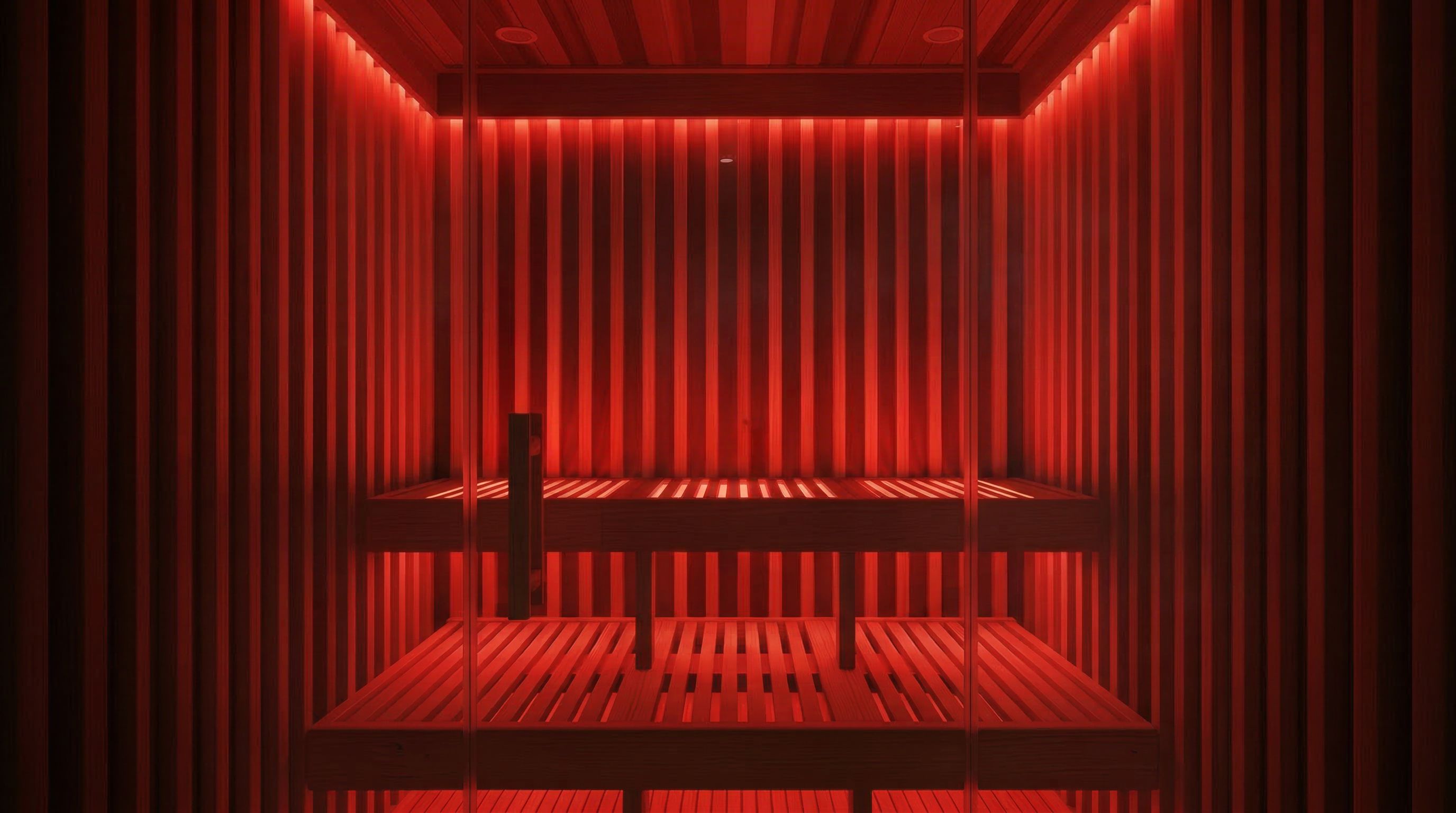
4. Integrate Red Light Benches
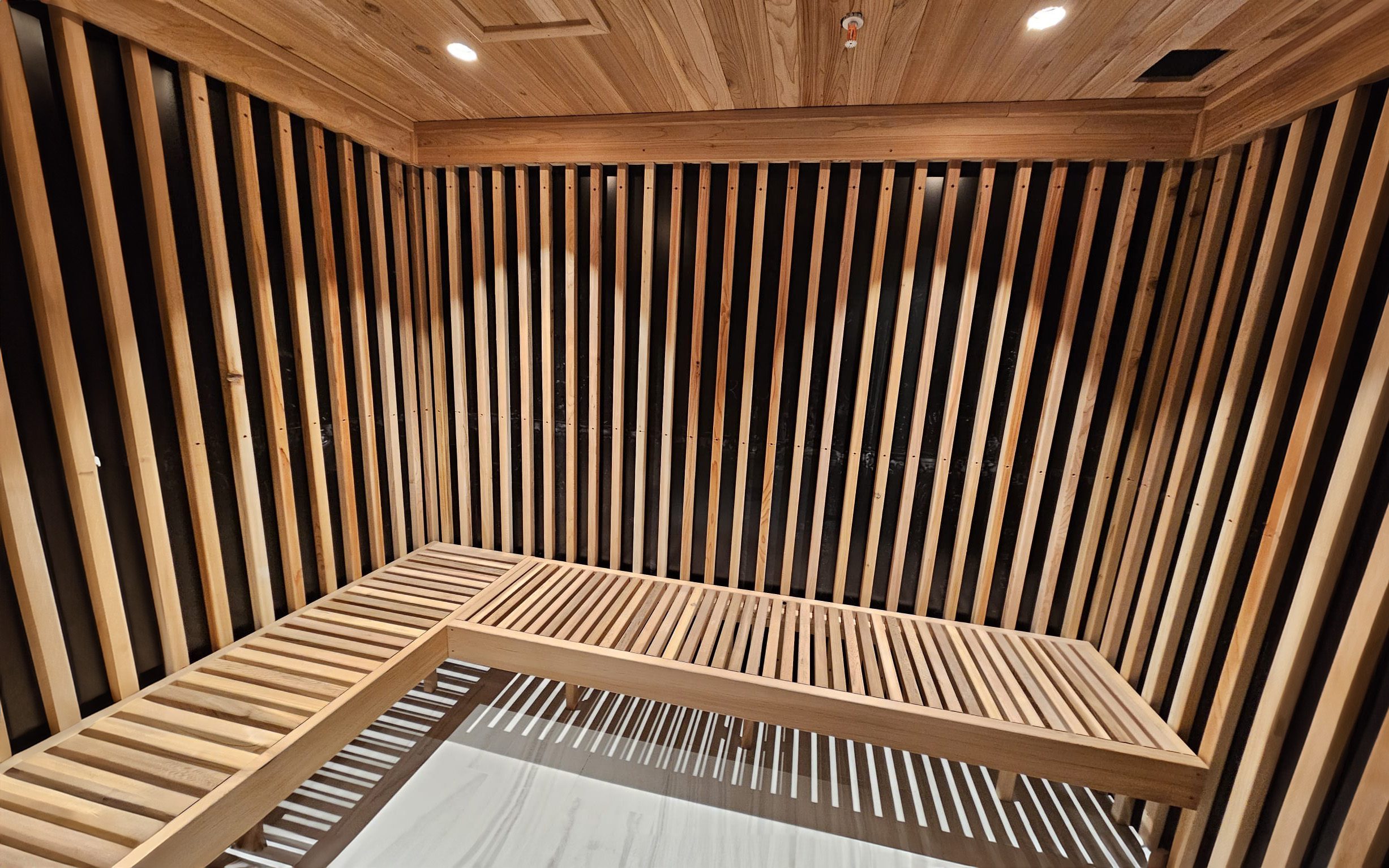
This is our patent-pending innovation that separates SaunaCloud from every competitor: Red Light Therapy LEDs integrated directly into the bench slats, positioned at the clinically-correct 1-3-inch distance from the user’s skin.
Why does proximity matter? The therapeutic effectiveness of red light drops exponentially with distance. Most competitors mount panels 18-24 inches from walls, which delivers only about 15% of the clinical efficacy. Ours delivers 100%.
The bench design requires:
- LED heat dissipation channels
- Separate power circuits for RLT control
- Reinforced slat construction for weight-bearing plus electronics
- Cedar slat spacing optimized for light transmission
Step 3: Specify Commercial-Grade Components
This is where you save money or lose money over the 15-year lifespan of your sauna. Every dollar you cheap out on components costs you $10-$50 in repairs, downtime, and reputation damage.
1. Specify VantaWave® Heaters
Our carbon-blend heaters are purpose-engineered for continuous commercial operation:
- Surface temperature: 190°F sustained (compared to 140-160°F for residential heaters)
- Peak wavelength: 7.9 microns (optimal far-infrared therapeutic range)
- Power density: optimized for 25-30 minute commercial session cycles
- EMF levels: <3 milligauss at seated position (ultra-low EMF)
Commercial duty cycle rating: 12+ sessions per day, 365 days per year.
Generic imported heaters are rated for residential use (3-4 sessions per week). Run them commercially, and they fail within 12-18 months.
2. Demand Commercial Power Supplies
The power supply is the heart of the system. It’s also the most common failure point in commercial installations.
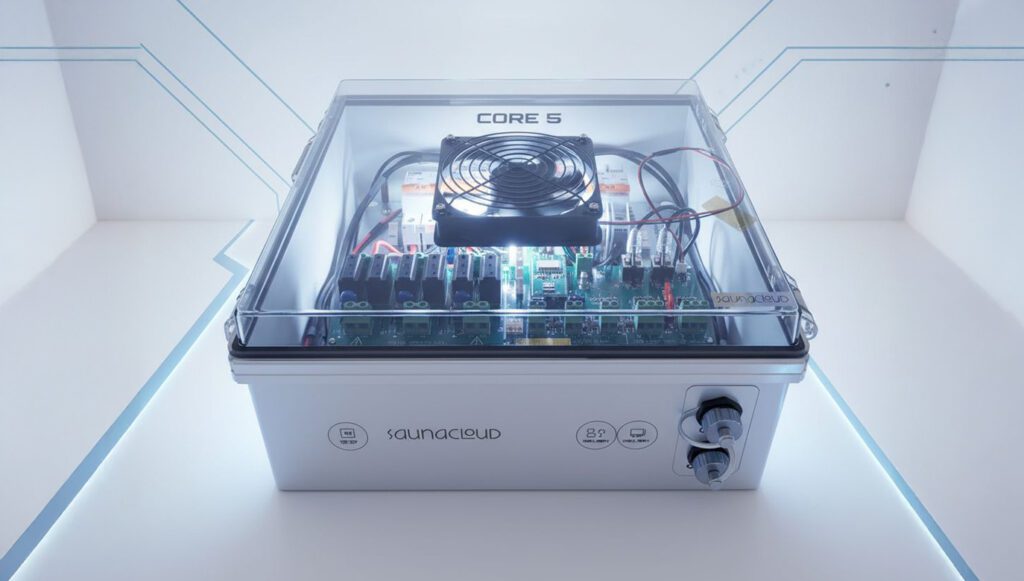
SaunaCloud CORE 5™ specifications:
- USA-manufactured, engineered in-house
- Continuous thermal management system (active cooling, not passive heat sinks)
- Remote monitoring capability for diagnostics
- Modular component design for field serviceability
- 7-year commercial warranty (industry standard is 1-3 years)
Imported power supplies from China cost $200 less up front. They also fail within 18 months of commercial operation, requiring complete replacement at a cost of $3,000-$5,000 per unit.
Do the math.
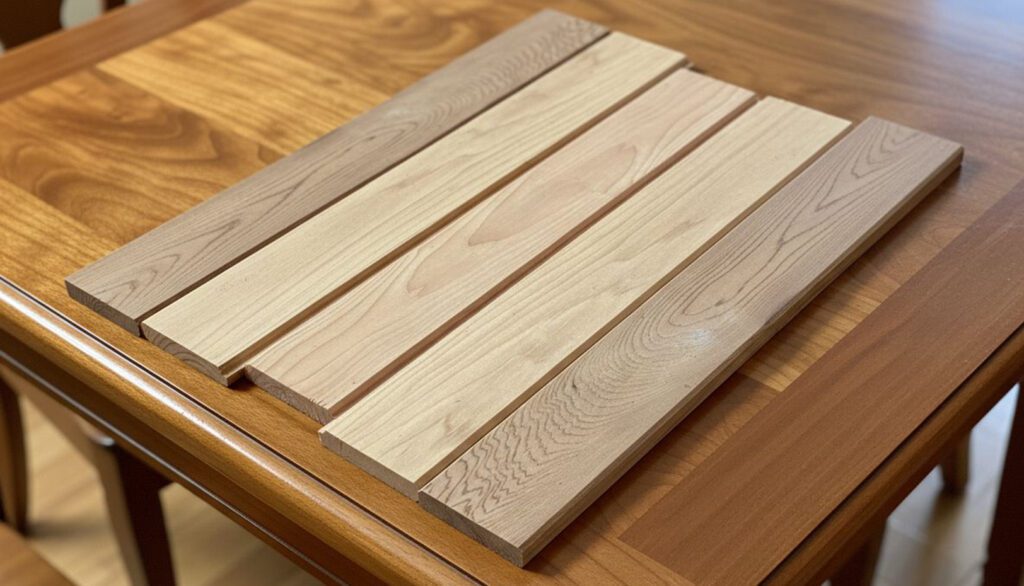
3. Procure Premium Western Red Cedar
Cedar wood quality determines durability under daily heat and humidity cycling.
Specification requirements:
- Kiln-dried to 6-8% moisture content
- Clear-grade (no knots, no sap pockets)
- Western Red Cedar (not Eastern Red Cedar or other species)
- Vertical grain orientation for dimensional stability
Why Western Red Cedar specifically?
- Natural antimicrobial properties (resists bacteria and mold)
- Aromatic oils don’t off-gas harmful VOCs when heated
- Dimensional stability under thermal cycling
- Low density = comfortable seated contact at 140°F
Cheap cedar alternatives (hemlock, pine, Chinese cedar) warp, crack, and require replacement within 3-5 years. Proper Western Red Cedar lasts 15-20 years with minimal maintenance.
Step 4: Install Electrical System (Licensed Electrician Required)
A licensed electrician must execute this phase. This is not optional. This is not negotiable. Unlicensed electrical work in commercial spaces:
- Voids your insurance
- Violates building codes
- Creates liability exposure
- Will fail inspection
1. Install Dedicated Circuits
The electrician installs:
- Dedicated 240V, 50A circuit from the main panel
- Appropriate double-pole breaker (50A minimum, 60A for larger units)
- 6-gauge wire (minimum) for circuit run
- GFCI protection (if required by local code)
The circuit must be dedicated—no shared loads.
2. Mount Power Supply Box
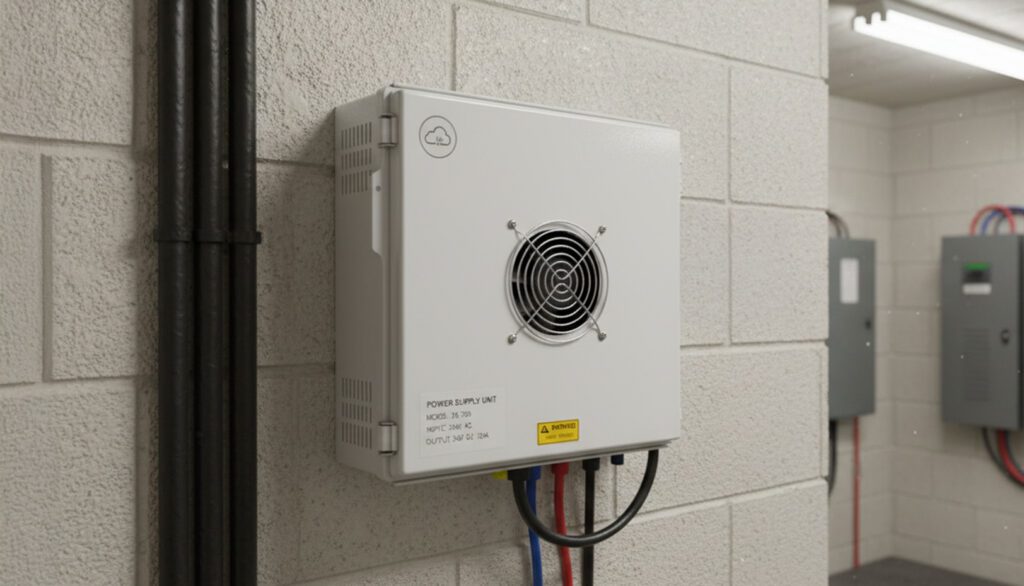
The commercial-grade CORE 5 Power Supply must be:
- Mounted outside the sauna enclosure (never inside)
- Located in an easily accessible location for service
- Positioned for ventilation (minimum 6″ clearance on all sides)
- Protected from moisture exposure
3. Route Electrical Conduit
All high-voltage wiring must run through fire-rated conduit:
- EMT (Electrical Metallic Tubing) or MC cable from the power supply to the junction boxes
- UL-rated junction boxes mounted inside the wall framing
- Proper strain relief at all connection points
- Labeled circuits for future service
4. Wire Low-Voltage Controls
Install the low-voltage control harness:
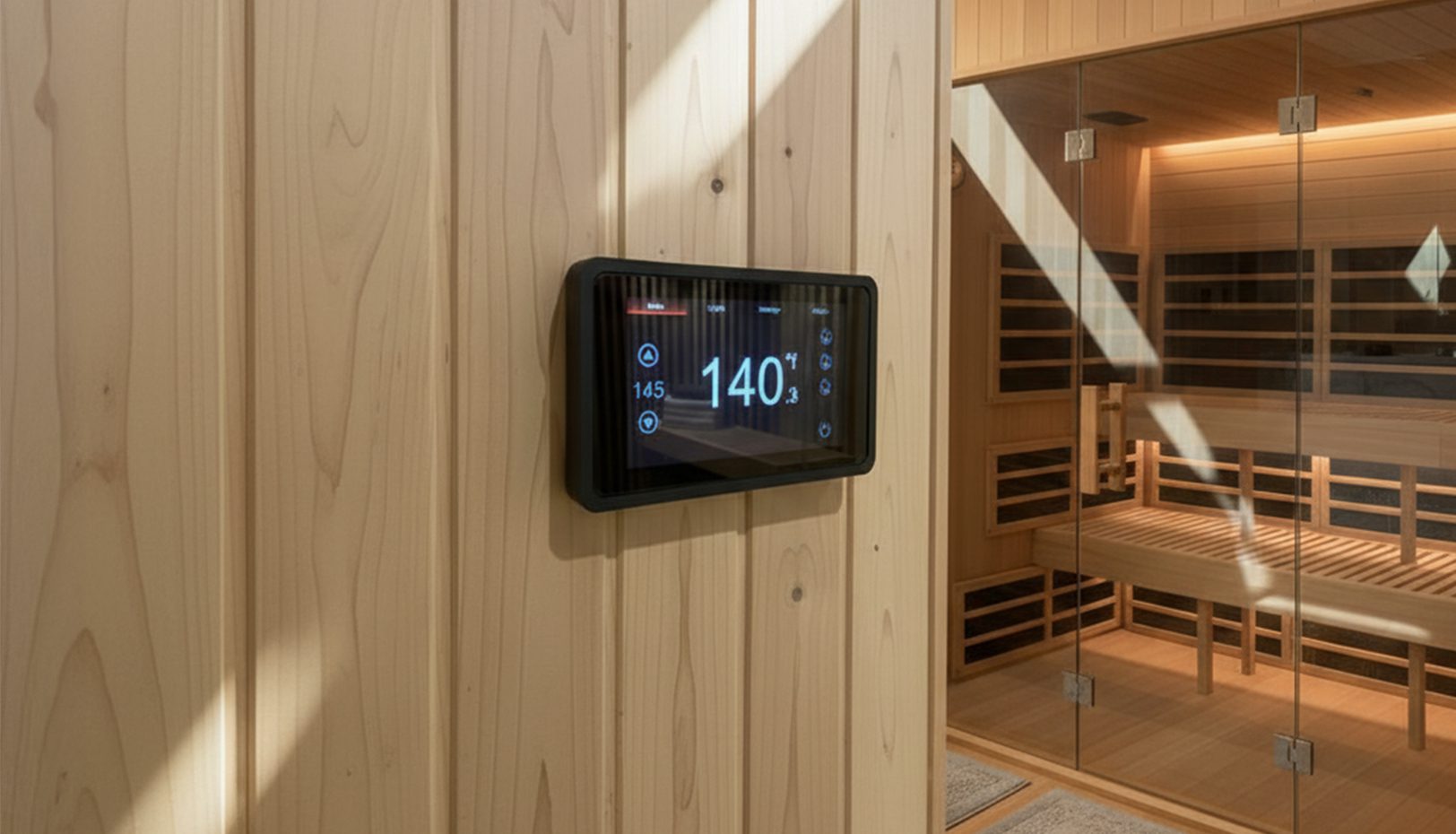
- 24V DC control wiring from the power supply to the digital control panel
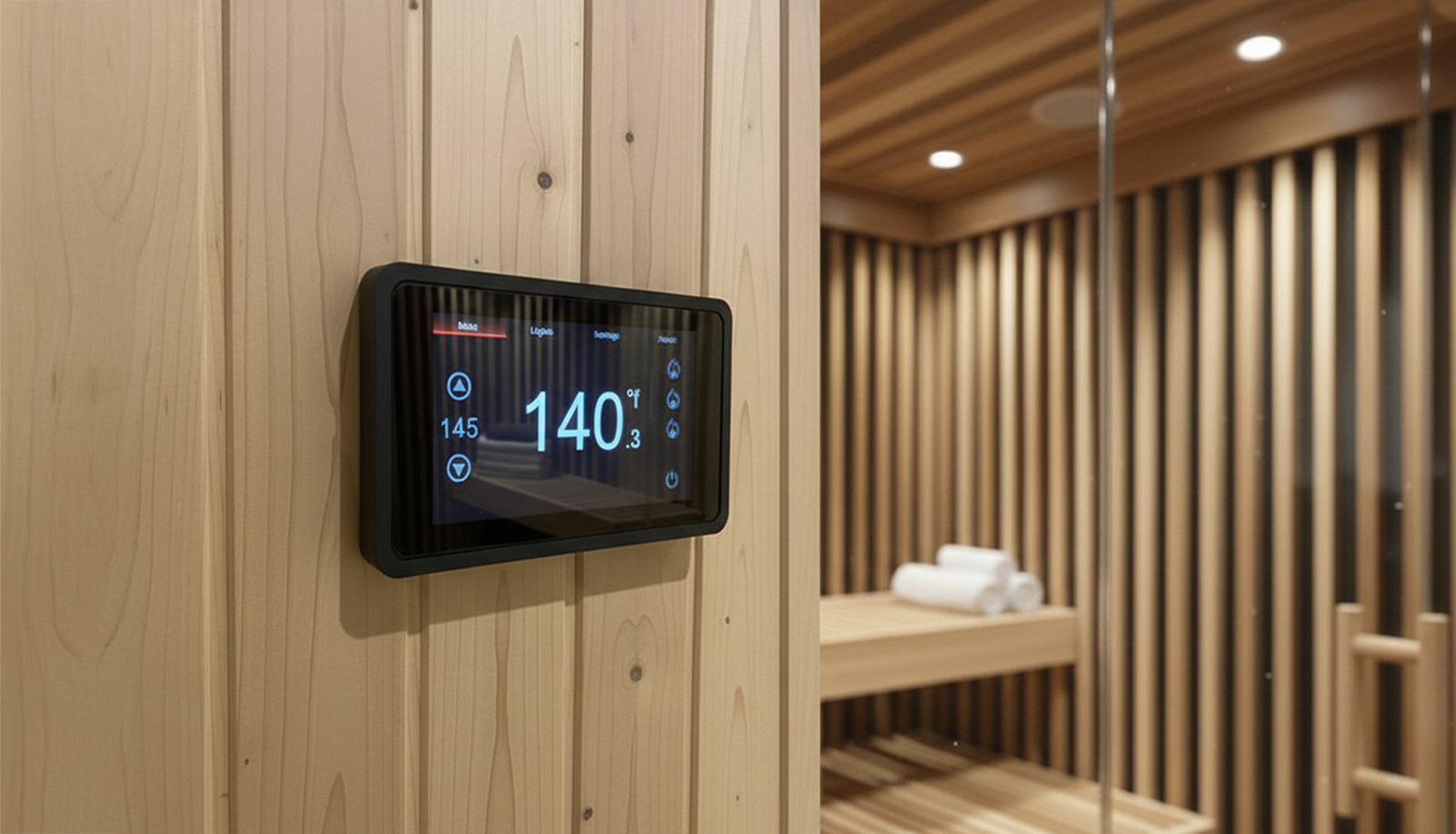
- Control panel mounted outside sauna door (never inside, where heat damages electronics)
- Separate control circuits for heaters and RLT benches
- Remote monitoring integration (if applicable)
Step 5: Build Structure with Vapor Control and Heater Integration
This phase transitions from electrical rough-in to physical construction.
1. Install Insulation & Vapor Barrier
This is critical for commercial installations:
- R-13 insulation minimum in all walls and ceilings
- Continuous foil vapor barrier over studs on warm side of insulation
- All seams taped with aluminum foil tape (not duct tape)
- The vapor barrier must be continuous with zero gaps
Why does this matter commercially? Moisture migration into the building structure can lead to mold growth, structural damage, and health code violations. A proper vapor barrier costs $200 in materials. Mold remediation costs $10,000-$30,000.
2. Install Interior Cedar Paneling
Tongue-and-groove cedar paneling installation:
- Maintain 3-inch minimum clearance around all heater panels (fire code requirement)
- Use stainless steel fasteners (regular nails rust and stain cedar)
- Concealed fastening for aesthetic finish
- Leave expansion gaps at the ceiling (cedar expands/contracts with humidity)
3. Mount VantaWave® Heater Panels
Heater installation requires precision:
- Mount at precise angles for 360-degree coverage
- Maintain minimum clearances per fire code
- Secure to structural framing (not just cedar paneling)
- Wire all heaters to the central junction boxes
Heater positioning angles:
- Back wall: vertical orientation, full coverage lumbar to upper back
- Side walls: angled 15-20° toward seated position
- Calf panels: horizontal orientation, 12″ above floor
4. Build Reinforced Bench Structure
Commercial benches must be engineered for:
- 500+ pound load capacity (for liability and safety codes)
- Decades of daily weight cycling
- Integrated RLT LED systems
- Easy disassembly for service access
Construction specifications:
- 2×4 framing on 12″ centers minimum
- Concealed fasteners (no exposed screw heads)
- Rounded edges (splinter-free)
- Removable slat sections for electronics access
Step 6: Commission, Test, and Activate Remote Monitoring
Before clients enter your sauna, you must validate that everything works correctly and safely.
1. Perform Electrical Inspection
The licensed electrician validates:
- Amperage draw under full load matches specifications
- 240V supply voltage stability (no voltage drop under load)
- GFCI protection is functional (if installed)
- No ground faults or short circuits
- All junction boxes are properly secured and labeled
2. Thermal Performance Verification
Run the sauna to full operating temperature and verify:
- VantaWave® heaters reach target surface temperature (190-200°F)
- Chamber reaches 140-150°F within 30 minutes
- Temperature distribution is uniform (no cold spots)
- Thermometer accuracy calibrated
Use a calibrated infrared thermometer to verify heater surface temperatures. If they’re running cool (<180°F), there’s a wiring or power supply issue.
3. Activate Remote Monitoring System
Integrate the control system with your facility’s operations:
- Front desk staff can start/stop sessions remotely
- Usage tracking and session logs
- Diagnostic alerts for maintenance issues
- Energy consumption monitoring
This is critical for commercial operations. You need visibility into usage patterns, maintenance needs, and system health without having staff physically check every sauna multiple times per day.
4. Obtain Final Code Sign-Off
Schedule and pass final inspection with local AHJs:
- Building Department final inspection
- Fire Marshal approval (if required)
- Health Department review (for spa/wellness facilities)
- Certificate of Occupancy amendment (if applicable)
Do not open to clients until you have all required sign-offs. Operating without proper permits creates massive liability exposure.
Step 7: Train Staff and Establish Maintenance Protocols
The best-built sauna in the world will fail if operated improperly.
1. Staff Certification on System Operation
Train all staff who will operate the saunas on:
- Digital control system operation (separate controls for heat and RLT)
- Proper pre-heating procedures (30-minute minimum for optimal therapy)
- Emergency shutdown procedures
- Client safety protocols and contraindications
- Session timing and scheduling best practices
Pro tip: Create laminated instruction cards posted at each sauna. Staff turnover is real, and you need consistent operation regardless of who’s working.
2. Establish Daily Cleaning SOPs
Approved cleaning protocol for cedar:
- Water and white vinegar solution (1:1 ratio)
- Soft cloth application (never spray directly on electronics)
- Wipe bench slats, walls, and glass after every 2-3 sessions
- Floor mopping daily
NEVER use:
- Bleach (destroys cedar and off-gasses toxins when heated)
- Commercial disinfectants with harsh chemicals
- Abrasive scrubbers (damage cedar finish)
Why this matters: I’ve seen commercial saunas destroyed within 6 months because someone used Lysol or bleach spray. The chemicals soak into the cedar, then off-gas toxic fumes when heated to 140°F. That’s a health code violation and a lawsuit waiting to happen.
3. Document Warranties and Service Requirements
Provide facility management with complete documentation:
- 1-Year Commercial Warranty on VantaWave® heaters and CORE 5 power supply
- Parts list and reorder information
- Troubleshooting guide for common issues
- Service contact information for technical support
The 7-year commercial warranty is possible because we engineer and manufacture our own components. We’re not relying on some Chinese factory that goes out of business in 18 months.
4. Schedule Annual Professional Service
Establish annual maintenance checkups:
- Electrical system inspection (connections, wire integrity)
- Heater performance testing and calibration
- Power supply diagnostics and cleaning
- Wood condition assessment and treatment
Annual professional service costs $400-$800 per unit. Compare that to emergency repairs at $3,000-$8,000 when something fails during peak season because it wasn’t properly maintained.
The Real Cost of Cutting Corners
I get monthly emails from spa owners who bought “commercial” saunas from big-box brands (companies that white-label Chinese imports and mark them up by 300%). The story is always the same:
“Our saunas worked great for the first year. Now the heaters keep failing, the power supply overheats and shuts down, and the wood is cracking. The warranty doesn’t cover commercial use. Can you fix it?”
Usually, the answer is no, or more accurately, the cost to rebuild their sauna properly exceeds the cost of buying a proper commercial unit from the start.
Penny-wise, pound-foolish example:
- Imported “commercial” sauna: $8,000 purchase price
- Fails after 18 months of daily use
- Repair quote: $6,000 (power supply, heaters, rewiring)
- Lost revenue during 3-week downtime: $4,000-$8,000
- Total cost: $18,000-$22,000 for a sauna that’s still built on failing components
Compare that to:
- Purpose-built commercial sauna: $16,000-$22,000
- Runs 15+ years with minimal maintenance
- 7-year comprehensive warranty
- Total cost: $16,000-$22,000 for 15 years of reliable operation
The math isn’t complicated.
Why SaunaCloud for Commercial Installations
Here’s what makes us different:
1. We engineer and manufacture our own components
- VantaWave® heaters are designed in-house for commercial duty cycles
- CORE 5 power supply engineered and built in California
- No reliance on imported Chinese components that fail under load
- 100% control over quality and serviceability
2. We’ve built over 3,000 custom saunas since 2014
- Hotels: Westin, Cavallo Point Resort, boutique properties
- High-profile clients: Tony Robbins, professional athletes
- Commercial gyms and wellness centers
- Medical practices and recovery facilities
3. We personally review every commercial design
- No sales team pushing generic configurations
- Direct access to engineers and builders
- Custom solutions for unique architectural challenges
- Real-world experience with code compliance across jurisdictions
4. We stand behind commercial installations
- 7-year warranty on heaters and power supplies (industry-leading)
- Direct technical support (you talk to people who built your sauna)
- Parts availability guaranteed for 15+ years
- Service training for your maintenance staff
Ready to Start Your Commercial Project?
We don’t sell saunas. We build them.
There’s a difference.
If you’re ready to discuss your commercial sauna installation—whether it’s a single unit for a boutique gym or a 10-unit installation for a resort—let’s talk about what you actually need (not what some sales guy wants to sell you).
Request Free Commercial Consultation & CAD Design***
We’ll provide:
- Detailed electrical capacity assessment
- Preliminary CAD renderings for your space
- ADA compliance review (if applicable)
- Realistic timeline and budget expectations
- No-obligation technical consultation
Why do we offer this for free? Because we’d rather spend 2 hours educating you properly than spend 2 weeks dealing with change orders from a poorly planned project.
The difference in quality, performance, and longevity will be evident the moment your first client steps inside.
Related Resources:
Quick Answers
These are the questions almost every client asks before they begin — so we’ve made them easy to find.
Is the warranty valid for continuous commercial operation (12+ hours/day)?
Answer: Yes, our 1-Year Commercial Warranty covers VantaWave® heaters and CORE 5 electronics specifically because they are engineered for a commercial duty cycle (10-12+ hours per day). This protection is a core differentiator, as most competitors void their warranty upon commercial use.
What is the actual expected lifespan of a commercial SaunaCloud® unit?
Answer: We engineer our systems for an operational lifespan of 5+ years. This is achieved by using the CORE 5 power supply (designed for thermal management), clear-grade Western Red Cedar (which resists warping and cracking), and commercial-rated, low-voltage accessories.
Do you provide the necessary documentation for electrical permit submission?
Answer: Absolutely. We supply all documentation required by the Authorities Having Jurisdiction (AHJs), including detailed electrical Load Calculations, custom CAD Wiring Diagrams, and complete UL/CSA certification documentation. We help you pass your electrical inspection the first time.
Why are hotter heaters better?
Infrared therapy depends on radiant energy, not air temperature.
When the heater runs too cool, it produces more convection (air heat) and less true infrared. VantaWave®’s higher surface temperature increases radiant intensity, giving you a more efficient, full-body therapeutic effect in less time.
In simple terms: A properly engineered hot heater delivers the same benefits in 30 minutes that a cheap carbon panel may not achieve in an hour — if ever.
Why we make our own power supplies, hardware, and software
Most sauna companies buy generic power supplies and control boards from overseas — and that’s where most failures start.
When a sauna fails, it’s almost always the power supply that goes.
At SaunaCloud, we design and manufacture our own power supplies, printed circuit boards (PCBs), and Wi-Fi-enabled control systems. These form the central nervous system of every sauna and are built to NEC standards for reliability and safety.
Vertical integration matters: Because we make the hardware and the software, we can test and optimize everything as one ecosystem.
That gives us total control over:
- Reliability: Every board is tested in-house before shipping.
- Consistency: No overseas delays or mismatched components.
- Precision: Our heaters, power supplies, and app work in perfect synchronization.
- Speed: Production runs smoothly and on schedule — even when others face supply-chain delays.
No other sauna company in North America manufactures its own power systems or app — and that’s why our saunas don’t just look beautiful; they work beautifully.
Our In-House Red Light & Near-Infrared Therapy System
SaunaCloud is one of the only sauna companies in the world that designs and builds its own red-light and near-infrared systems — right alongside the sauna itself.
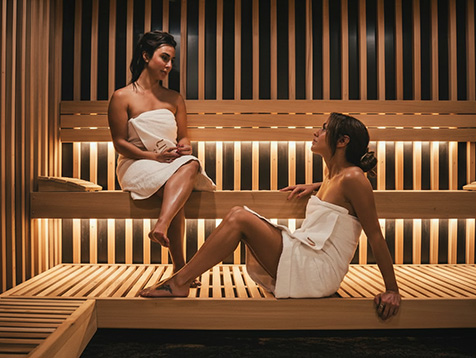
Our red-light arrays are fully integrated into the bench and backrests, allowing full-body exposure while seated comfortably.
Each system combines 660 nm red light (for skin, collagen, and circulation) with 850 nm near-infrared light (for mitochondrial repair, muscle recovery, and cellular energy).
Because we build the LEDs, PCBs, and control software in-house, our system is perfectly calibrated to work with our heaters and power supplies — all managed through a single Wi-Fi-enabled control panel or app.
Dual-mode flexibility: You can run the red-light therapy independently for a quiet, cool session, or combine it with far-infrared heat to save time and amplify the benefits.
Red-light therapy provides different benefits than far-infrared heat — improving cellular energy, skin health, hormone balance, and muscle recovery.
When used together, they create a synergistic wellness effect: infrared drives heat adaptation and circulation, while red light stimulates cellular rejuvenation and repair.
All in unison: Because we design every part — hardware, LEDs, software, and app — we can ensure everything works seamlessly, safely, and reliably.
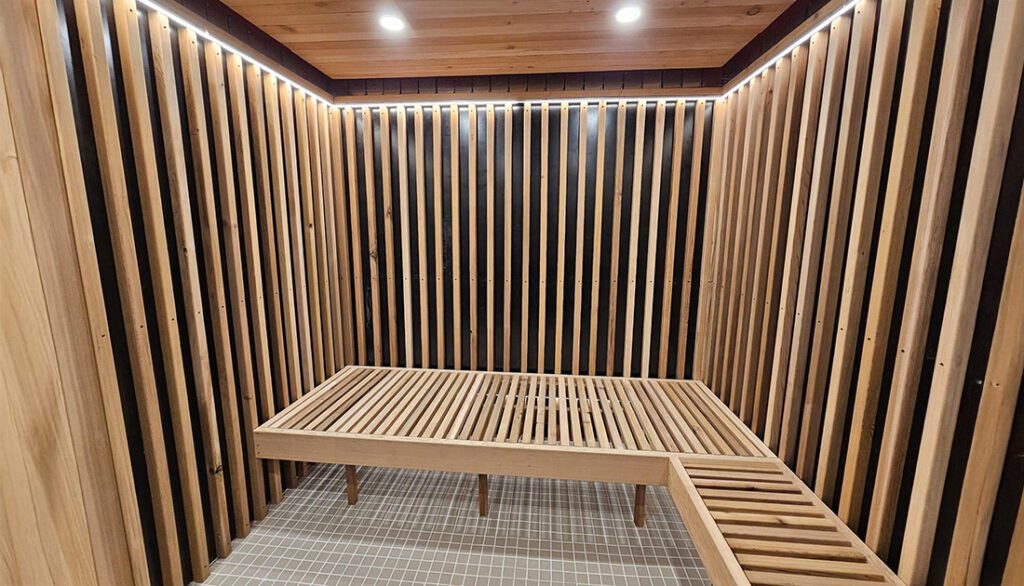
What's the difference between the Atlas and Sierra sauna lines?
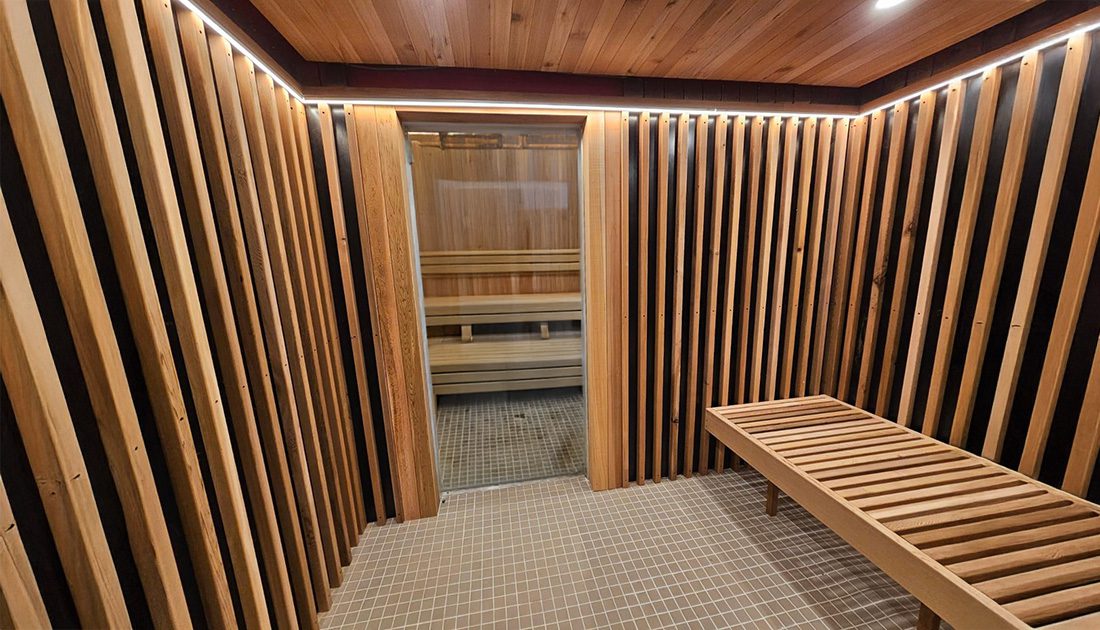
- Atlas Series: Modern design with vertical heater slots and optional integrated red-light therapy benches. Perfect for residential or commercial wellness spaces.
- Sierra Series: Classic window-pane design emphasizing craftsmanship and visibility. Ideal for traditionalists and larger installations.
Both feature VantaWave® heaters, our in-house power systems, and smart Wi-Fi controls.
How does SaunaCloud® assist with ADA compliance for my facility?
Answer: We integrate all necessary ADA requirements directly into the custom blueprint during Step 2. This includes designing for the 36-inch door clearance, adequate internal turning radius, and safe, accessible bench heights and grab bar placements.
Can I remotely monitor the saunas from my front desk or office?
Answer: Yes. Our proprietary control system allows for complete remote monitoring and diagnostics via a desktop or mobile interface. Your staff can remotely start/stop sessions, adjust temperature, track usage patterns, and receive diagnostic alerts, eliminating the need to physically check every room.
What is the ROI of using VantaWave® over standard residential carbon heaters?
Answer: The ROI is longevity and efficacy. VantaWave® heaters maintain a peak wavelength of 7.9 microns and a 190°F surface temperature over long periods, guaranteeing superior therapeutic performance. The cost of a few dollars more upfront is offset by the $10,000–$18,000 repair cost and lost revenue associated with replacing failed residential systems.
Why is a foil vapor barrier critical for a commercial installation?
Answer: A continuous, foil vapor barrier is essential for commercial settings because of the high cycling of temperature and humidity. It prevents moisture migration into the building’s internal structure and insulation, protecting against costly mold growth and structural damage over time.
Do your saunas require installation or an electrician?
Yes — our saunas are designed for licensed electricians to complete final hookups easily.
We provide detailed electrical drawings, installation manuals, and remote support.
Safety built in: Every SaunaCloud system is fully NEC-compliant and ready for inspection.
What are the material specifications for your Western Red Cedar?
Answer: We use only premium, kiln-dried clear-grade Western Red Cedar (not knotty, hemlock, or pine). This wood is specified for its stability, natural antimicrobial properties, and its ability to withstand constant temperature cycling without warping or cracking, ensuring a clean, long-lasting surface.
What kind of wood do you use?
We use clear-grade Western Red Canadian Cedar, kiln-dried for dimensional stability and aroma.
No veneers or plywood — just solid cedar that naturally resists bacteria, mold, and warping.
Why cedar matters: Its antimicrobial oils, aroma, and heat tolerance make it the most premium sauna wood available
What's the difference between far, mid, and near infrared?
Far-infrared penetrates deepest and drives core heating, detoxification, and circulation.
Mid-infrared affects soft tissue, while near-infrared (delivered through LEDs) targets mitochondria and collagen synthesis.
Real science, not marketing: Halogen “full-spectrum” saunas rarely deliver true near-infrared; only LED arrays within a few inches of the skin can do that effectively.
What electrical requirements do your saunas have?
- Atlas One (1-person): 240 V, 30 A
- Outdoor Sauna: 240 V, 60 A
- Commercial models: 240 V or 208 V, 40 A + depending on configuration
Full specs are provided with every quote.
Do your saunas emit EMFs?
No. All VantaWave® heaters, red-light systems, and power supplies are ultra-low EMF and zero ELF.
Wiring is shielded and grounded throughout.
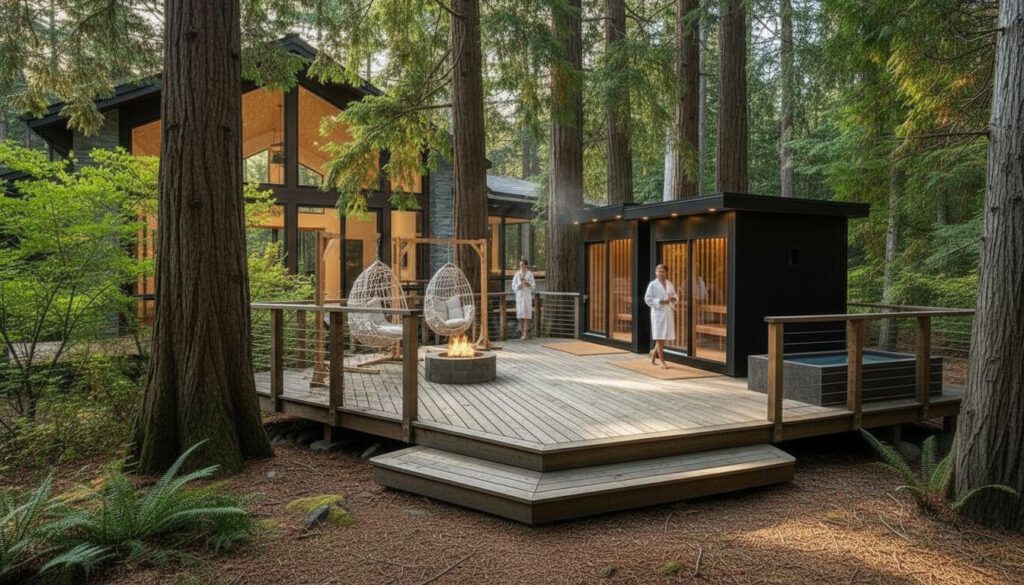
Are your saunas safe for outdoor use?
Yes. The Atlas Outdoor is fully insulated, weather-sealed, and capped with stainless fasteners and a roof system.
An optional canvas weather cover adds extra protection in rain or snow.
Where can I see a SaunaCloud in person?
We have installations across the U.S. and Canada. In select regions, we can arrange private viewings or connect you with current SaunaCloud owners. Our most recent installations are in Cavallo Point, in Sausalito, California and The Westin, in Fort Lauderdale, Florida. You can also come to our warehouse/showroom in Diamond Springs, California.
How does the Red Light Bench integration benefit my clients?
Answer: Our system delivers clinically-correct photobiomodulation (RLT) by positioning LEDs 1–3 inches from the skin. This dual therapy (FIR heat + NIR light) maximizes client recovery, skin health, and muscle repair, providing a superior therapeutic result that leads to higher client retention and better reviews.
Do you offer discounts?
Yes — 10% seasonal promotions such as Black Friday, Memorial Day, and Labor Day.
All pricing is transparent — no inflated mark-ups or false “sales.”
Our Service Promise
Customer service isn’t an afterthought — it’s the backbone of SaunaCloud.
Trusted by luxury wellness and design firms: