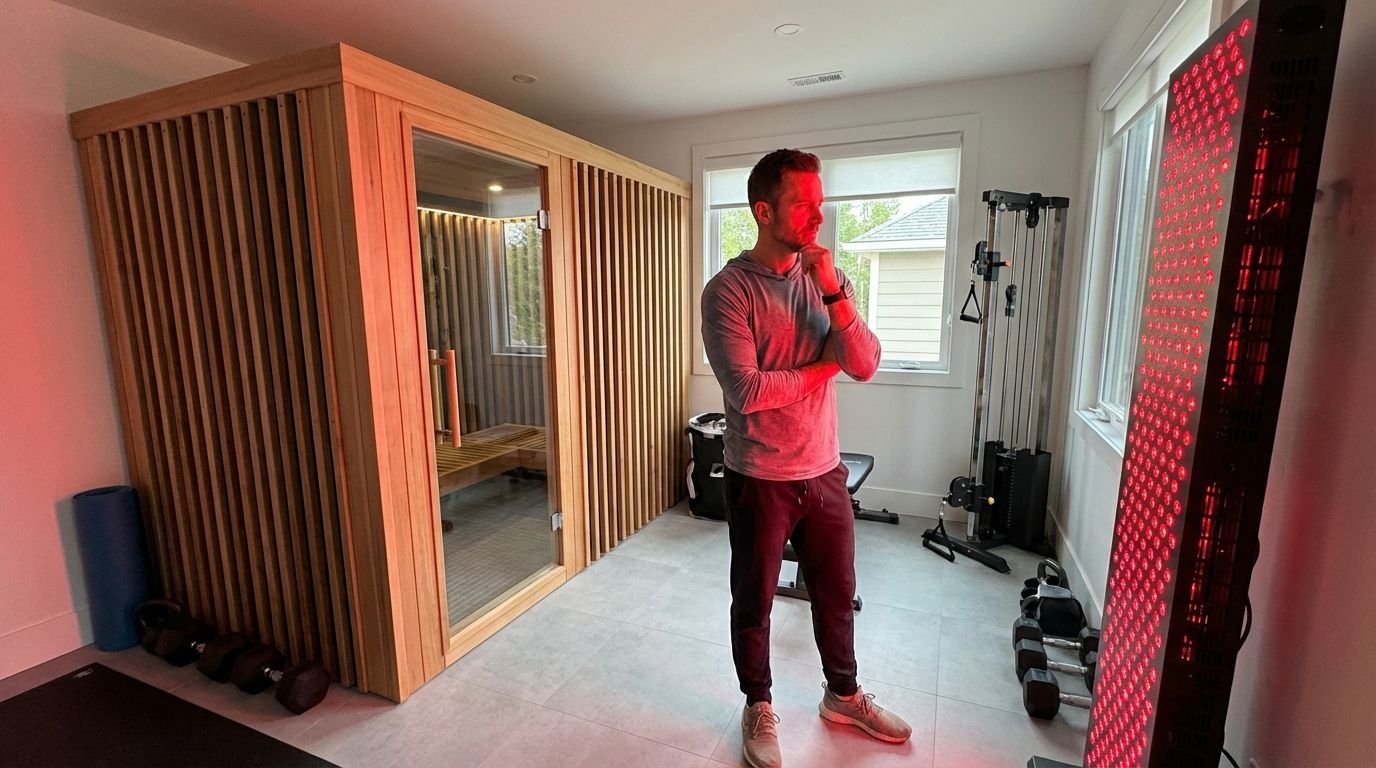
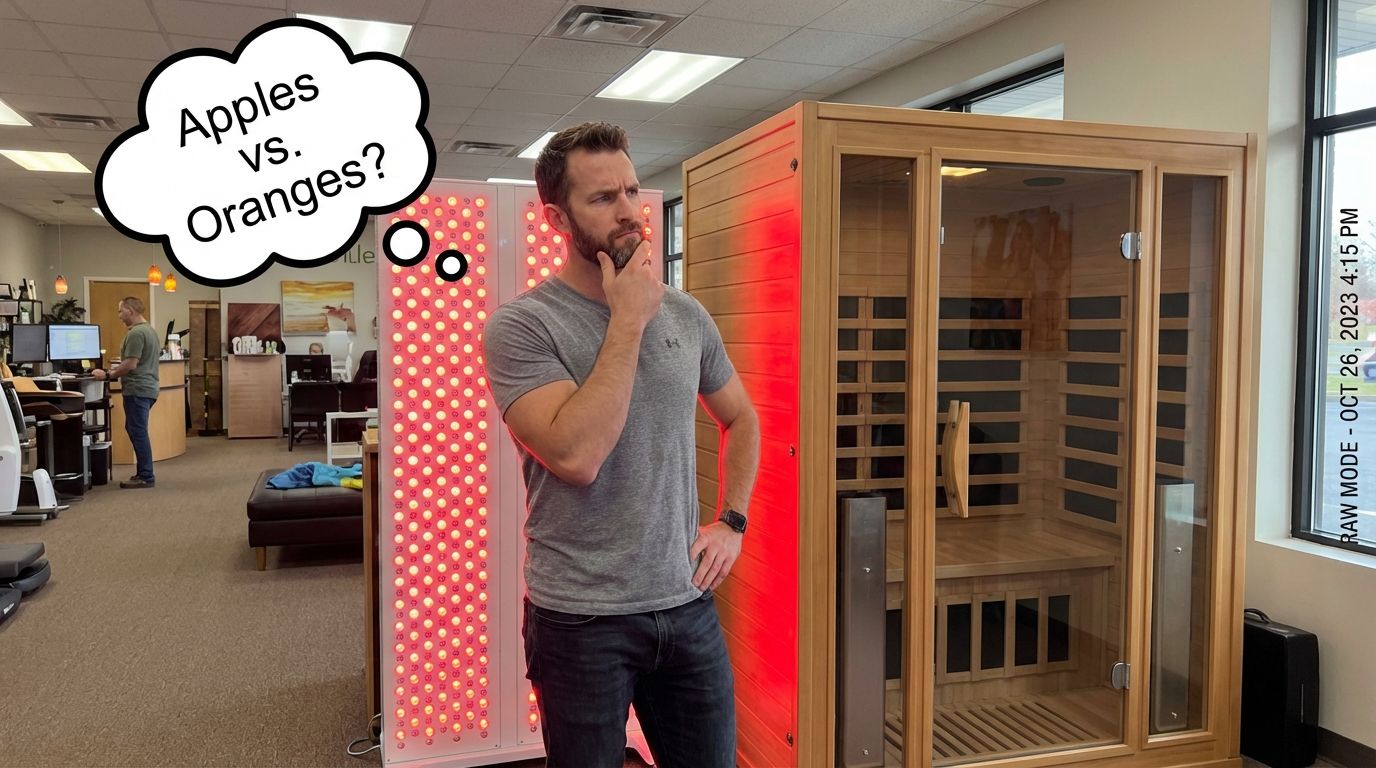
Have you been shopping for wellness gear and realized you might be comparing apples to oranges?
Red light therapy and infrared saunas both use light, but they work in totally different ways, and that difference can make or break your buying decision.
Red light therapy uses low-level red and near-infrared light for skin rejuvenation, collagen production, pain relief, and wound healing.
Infrared saunas use infrared rays and radiant heat for relaxation and cardiovascular support, and yes, they also make you sweat.
I’m Christopher Kiggins, founder of SaunaCloud, and I’ve been using saunas since 2012.
I’ll keep this practical, so you can pick the right tool for your goals and your space.
Key Differences Between Red Light Therapy and Infrared Sauna
Red light therapy uses visible red and near-infrared light to stimulate cellular processes. The main goal is to support cellular repair and collagen production without turning the session into a heat event.
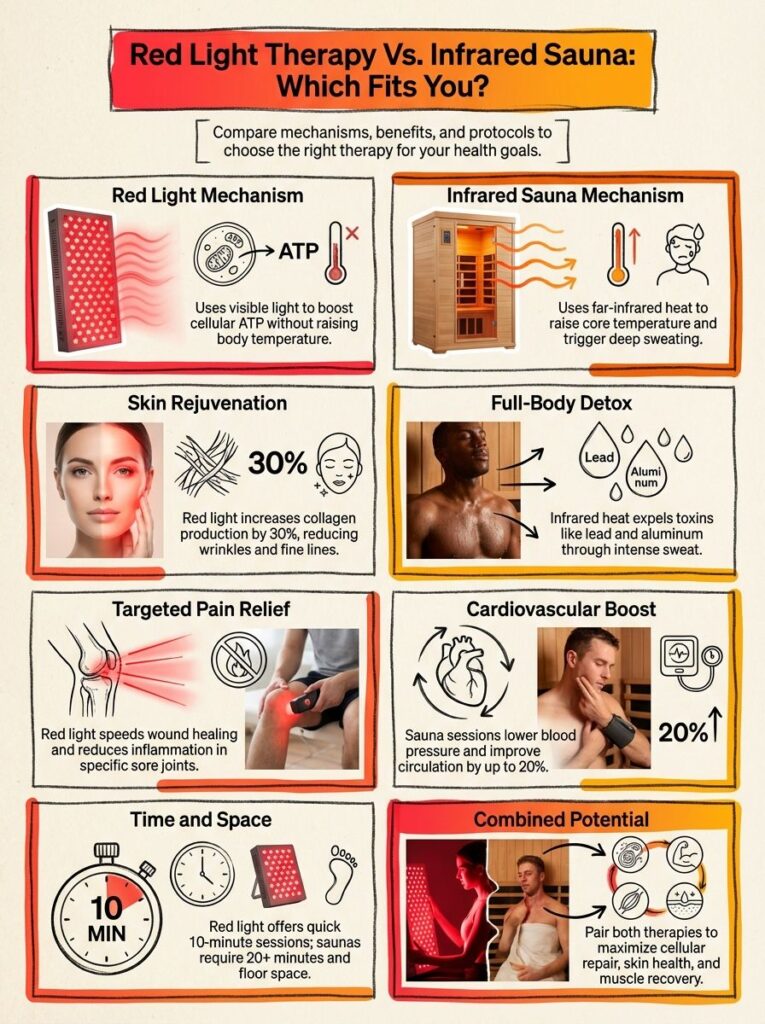
Infrared saunas use infrared energy to warm your body through radiant heat. The goal is to raise body temperature, trigger a sweat response, and create a full-body relaxation effect.
If you’re a sauna buyer, here’s the real-world difference: red light therapy feels like targeted light exposure, while an infrared sauna feels like a workout-adjacent heat session.
Quick “Which One Sounds Like You?” Check
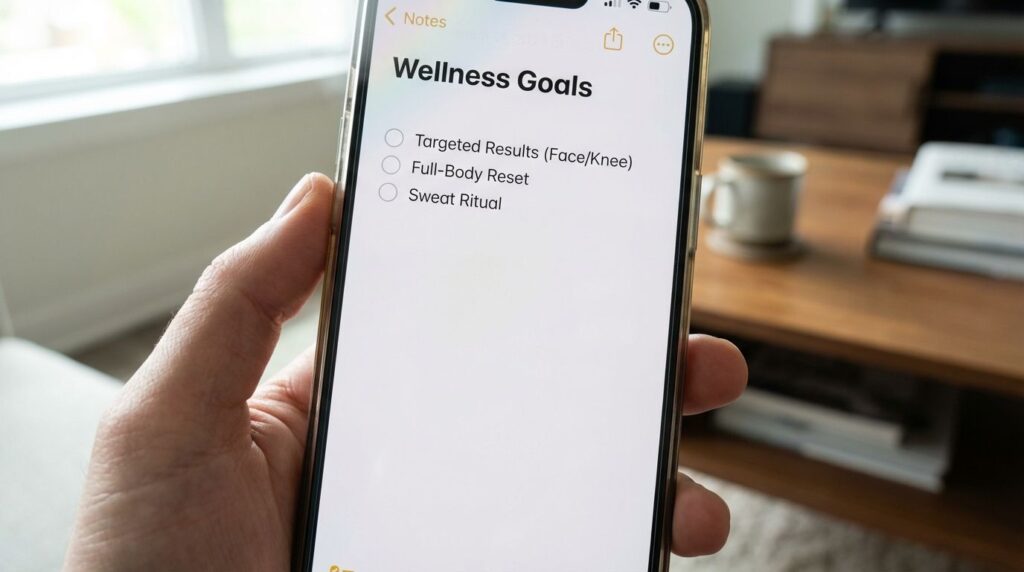
- You want targeted results (face, knee, shoulder, scar): start with red light therapy.
- You want a full-body reset (stress, sleep quality, post-workout looseness): start with an infrared sauna.
- You dislike heat or you get lightheaded easily: red light therapy is usually the safer first step.
- You already love sweating and you want a ritual: an infrared sauna is often the better buy.
How Does Each Therapy Work?
Red light therapy is often called photobiomodulation. The basic idea is that specific red and near-infrared light waves interact with parts of the cell involved in energy production (ATP), which can support tissue repair and help calm chronic inflammation in some use cases.
In a February 2025 update, Stanford Medicine pointed out that evidence is strongest for a few areas like hair growth and some skin outcomes, while other popular claims depend heavily on the device, wavelength, and dose.
My practical rule for buyers is this: if a device doesn’t publish its wavelengths and basic usage guidance (distance and session length), you’re guessing.
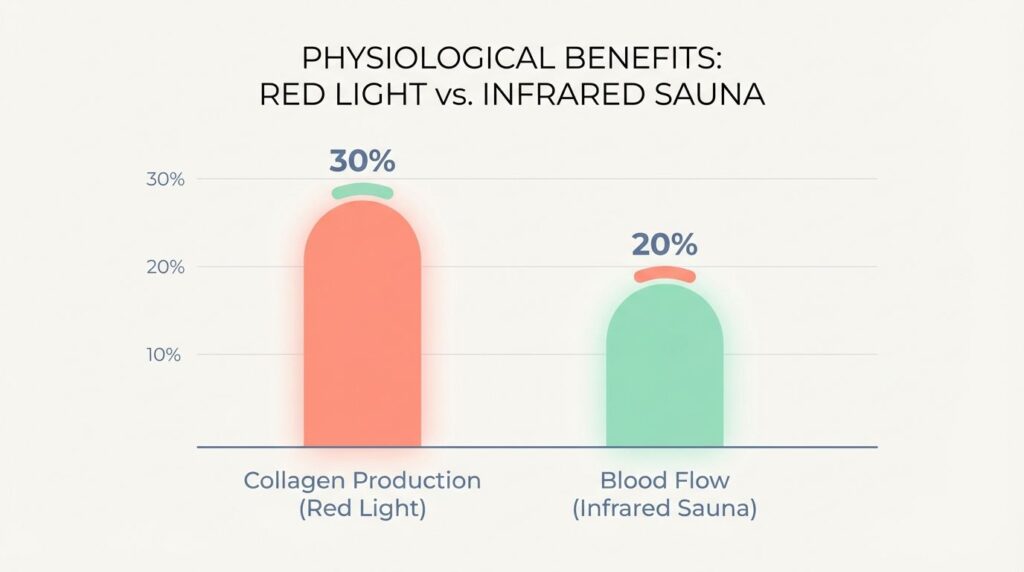
Infrared saunas heat the body directly at about 110 to 130°F. That heat can increase heart rate, promote sweating, and help loosen tight muscles, which is why many people describe it as “passive exercise” even though you’re sitting still.
Heat exposure also tends to support relaxation, especially if you treat it like a routine: warm up, sweat, cool down, rehydrate.
Read more about what an infrared sauna can do to your body, and next we’ll compare wavelengths and penetration depth.
What Are Their Wavelengths and How Deep Do They Penetrate?
Wavelengths and depth matter for results, but so does device output and how far you stand or sit from the emitter.
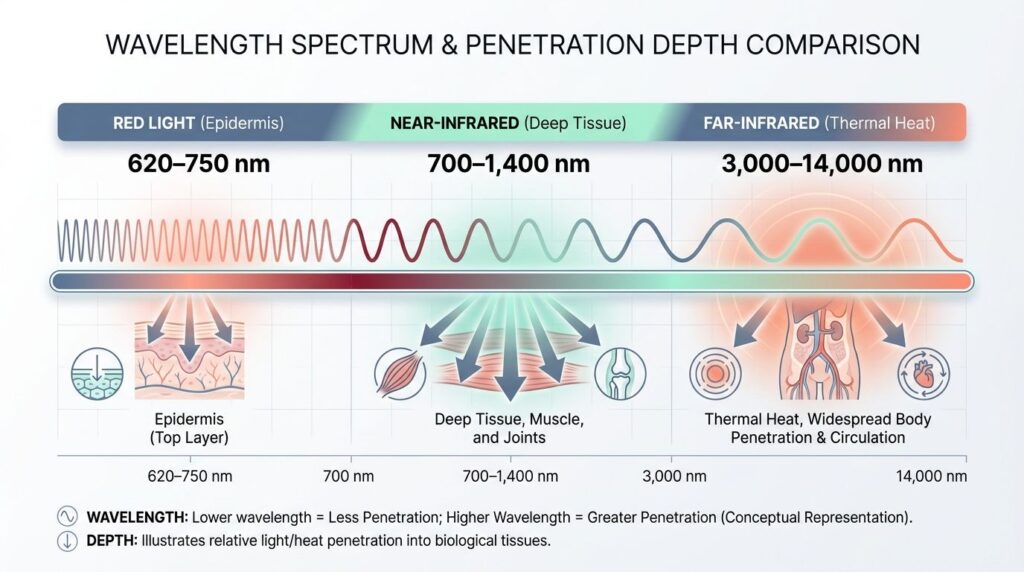
Here’s the buyer-friendly way to think about it: red light tends to be more “skin-forward,” near-infrared tends to be more “deeper tissue capable,” and far infrared is mostly about heating you through radiant heat.
| Therapy | Wavelength Range | Primary Penetration | What That Means for You | Tools and Concepts |
|---|---|---|---|---|
| Red Light Therapy (RLT) | 620–750 nm, best at 630 nm and 660 nm | Epidermis, superficial dermis | Targets skin layers for collagen, tone, and repair. Often chosen for fine lines, redness, and scar appearance. Works best when you can treat consistently at a repeatable distance. | LED arrays, handheld panels, facial masks. Chromophores, cellular signaling, collagen support. In my experience, smaller units can work, but only if you actually use them regularly. |
| Near-Infrared (NIR) | 700–1,400 nm (many devices use bands like 810–850 nm) | Deeper dermis, subdermal tissue, some muscle | Reaches deeper than visible red, which is why people use it for joints and post-exercise soreness. Better fit for “spot recovery” than full-body sweating goals. Device output and placement matter a lot at this depth. | High-output panels, hybrid cabins, targeted applicators. Research overview on mitochondrial function and circulation. I like NIR after training, because it’s easy to target the exact area that took the hit. |
| Mid to Far Infrared (FIR) | Mid and far infrared are commonly described in micrometers (about 3–14 µm, which is 3,000–14,000 nm) | Heat effect at the skin level with deeper warming through overall thermal load | Produces whole-body heat and a sweat response. Chosen for relaxation, muscle loosening, and the “sauna session” feel. Research often discusses circulation changes during and after heat exposure. | Carbon heaters, ceramic elements, infrared panels. Thermotherapy, relaxation response, circulation changes. Sauna buyers usually notice FIR most as a comfort and routine benefit. |
| General Notes | Overlap exists across ranges | Penetration depends on power, exposure time, distance, and tissue type | Longer wavelength does not automatically mean “better,” it depends on the goal. Heat is the main driver in infrared saunas, light energy drives red light therapy effects. Choose based on whether you want targeted treatment or a whole-body experience. | LED arrays versus heater panels. Concepts: targeted versus whole-body, consistency versus intensity. SaunaCloud offers consultation to match tools to goals. |
What Is the Difference Between Heat and Non-Heat Therapy?
Red light therapy is a non-heat therapy for most people. A typical session runs about 10 to 20 minutes, and you generally should not feel like you’re “cooking,” even if the device is bright.
That makes it a strong choice if you want skin work, spot pain management, or muscle recovery without sweating, dehydration, or overheating.
For home users, the most common mistake I see is overdoing it. Photobiomodulation can follow a “more isn’t always better” pattern, so the best plan is the one you can repeat comfortably.
Mayo Clinic describes infrared saunas as heating your body directly, and notes that larger, more-exact studies are still needed to prove many claimed benefits.
Infrared saunas are heat therapies that often run at about 110 to 130°F, and sessions commonly last about 20 to 40 minutes.
Because heat can lower blood pressure for some people, I always tell buyers to treat the first week like a “ramp up.” Start shorter, hydrate, and step out the second you feel dizzy.
Benefits of Red Light Therapy
Stanford Medicine’s overview of red light therapy highlights that it can change biology, but outcomes depend on the condition and on device settings.
For sauna buyers, red light therapy is a great add-on if you want targeted support for collagen production, skin rejuvenation, and localized recovery without adding more heat load to your week.
How Does Red Light Therapy Improve Skin Health?
Studies show red light therapy increases collagen production by up to 30% (Barolet & Boucher, 2010), which is why you’ll see it marketed for wrinkles and skin texture.
In practice, the wins usually come from consistency. If you use it on-and-off, you’re unlikely to notice much change.
If acne is one of your goals, know this: red light is often used for calming inflammation, while blue light is typically discussed for targeting acne-causing bacteria. That’s why some devices combine multiple “light therapies” rather than relying on red alone.
At home, look for two basics: published wavelengths (like 630/660 nm red, plus near-infrared if you want deeper tissue support) and clear distance guidance so you can repeat the same setup each session.
Can Red Light Therapy Provide Targeted Pain Relief?
After improving skin with red light, you can aim the light at a sore joint for focused help. Many people use photobiomodulation as a non-invasive therapy option for chronic pain routines, because it’s localized and doesn’t require full-body heat.
The best “buyer move” here is to match the tool to the spot. A small handheld can be perfect for wrists, knees, and elbows, while a larger panel makes more sense for back, hips, and bigger muscle groups.
One newer example is a 2025 randomized trial in knee osteoarthritis that followed WALT recommendations, using 790 nm with a defined dose per point, and it reported significant pain reductions versus placebo.
I used a handheld panel on a rib strain, and I felt relief after a few short sessions, which made it easier to keep up with physical therapy.
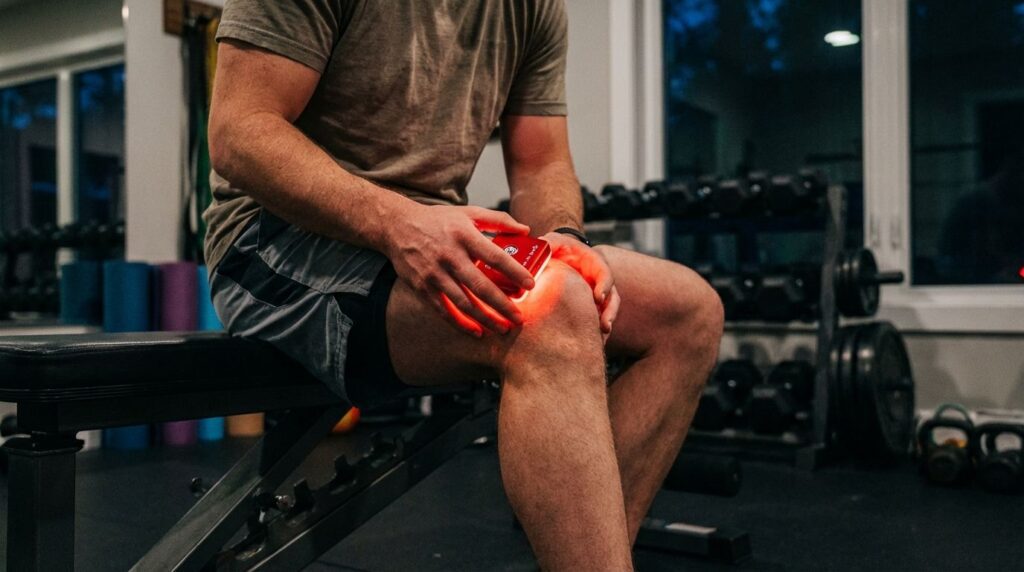
Targeted light is at its best when you can place it the same way, at the same distance, on the same spot.
How Does Red Light Therapy Support Cellular Repair?
Red light therapy is used to influence cellular energy pathways, which is why you’ll hear a lot about mitochondria and ATP.
Here’s the practical takeaway for buyers: the “dose” is a mix of time, distance, and device power. If you change one of those every session, it’s hard to know what’s working.
A common pitfall I see with home devices is chasing longer sessions. A 2020 photobiomodulation dose-response study on human fibroblasts found that lower doses increased mitochondrial activity, while higher doses reduced it.
So if you want results you can trust, pick a routine you can repeat, then stick with it long enough to judge it honestly.
Benefits of Infrared Sauna
SaunaCloud’s infrared saunas use infrared therapy to support relaxation, deep muscle loosening, and cardiovascular conditioning through controlled heat exposure.
If you’re buying a sauna, this is the big reason people stick with it: an infrared sauna changes your whole body state, not just one spot.
How Does Infrared Sauna Aid Full-Body Detoxification?

I started using saunas in 2012, and the biggest change I noticed first was how much better I felt after I made it a routine.
Let’s talk about “detox” in a grounded way. Sweating is real, and sweat can contain trace elements like arsenic, cadmium, lead, and mercury, as summarized in a 2012 systematic review.
At the same time, many detox claims get exaggerated. Your liver and kidneys still do the heavy lifting, so I treat sauna sweating as a support habit, not a substitute for medical care or exposure reduction.
For buyers, the action step is simple: if detox is a goal, prioritize comfort and consistency. A sauna you can tolerate three times a week usually beats a “hotter” setup you avoid.
- Start at a lower temperature and shorter time for the first week.
- Hydrate before and after, and skip alcohol before sessions.
- If you feel dizzy, step out, cool down, and end the session.
Can Infrared Sauna Help With Deep Muscle Relaxation?
Infrared saunas heat the body at 110–130°F, and heat exposure can increase blood flow and help muscles feel looser.
A small but well-known endurance study in six male distance runners found that adding post-exercise sauna bathing for three weeks increased run time to exhaustion by 32%, along with increases in plasma and blood volume.
If you’re a sauna buyer focused on muscle recovery, this is why the cabin experience matters. You want even heat, a comfortable bench, and a setup that makes you want to come back tomorrow.
From a design perspective, I also like when the heating layout avoids obvious “hot spots,” because it keeps sessions comfortable enough to stay consistent.
What Are the Cardiovascular Benefits of Infrared Sauna?
Heat exposure can raise heart rate and create a mild cardiovascular load, which is why people compare sauna time to moderate exercise.
A large 2015 observational study in JAMA Internal Medicine found that more frequent sauna bathing was associated with lower risks of sudden cardiac death and fatal cardiovascular events, though it was an association, not proof of cause and effect.
If your goal is cardiovascular health, the smartest buy is the sauna you can use regularly without feeling wiped out afterward. That usually means comfortable temperatures, predictable controls, and a routine you can maintain.
Choosing the Right Therapy for Your Needs
Pick red light therapy for targeted skin work, collagen production, wound healing support, and focused muscle recovery.
Pick an infrared sauna for a full-body experience geared toward relaxation, heat conditioning, and the kind of sweat session that feels like a reset.
Should You Choose Targeted Treatment or a Whole-Body Experience?
I’ve tested red light modules and infrared cabins side by side, and the feel is completely different.
Red light therapy gives targeted results. You place the device on a specific area, run a short session, then move on with your day.
Infrared saunas deliver a whole-body experience. You sit, heat up, sweat, and cool down, and it often becomes a ritual rather than a quick task.
If you’re choosing between the two, decide what you will actually use. Consistency is where most real-world results come from.
How Do Your Health Goals Influence Your Choice?
Pick therapy that matches your main aim. Decide on the goal first, then buy the tool.

- If you want whole-body cardiovascular benefits and a sweat-based relaxation routine, choose an infrared sauna.
- For skin rejuvenation and collagen production, choose red light therapy.
- If you need targeted pain relief for a specific joint, start with red light therapy or near-infrared light, because it’s easy to aim and repeat.
- If you want a stress reset that also supports sleep quality, many sauna buyers prefer infrared sauna routines because the heat and cooldown feel calming.
- If your goal is body contouring support, think “system plus spot”: sauna for overall routine, red light therapy for targeted areas.
- Choose based on convenience, smaller red light devices suit quick home use, while full-size infrared saunas need dedicated space.
What Are the Convenience and Accessibility Factors to Consider?
I built my first sauna in 2014 after I felt big health gains, so I always tell buyers to think about space, electrical setup, and time.
Red light therapy devices are compact and usually easy to store. That makes them a good option if you live in an apartment, share a bathroom, or want something you can use without changing your routine much.
Infrared saunas need floor space, airflow, and a bigger budget. They also require a real time block, because most people want a warm-up, a session, and a cooldown.
On the practical side, electrical requirements can be the deciding factor. For example, Clearlight lists many one- and two-person models that plug into 120V outlets (15A to 20A), while larger cabins often move to 240V circuits.
I run SaunaCloud and I balance product advice with real client feedback. If you want guidance on session length, read the ideal infrared sauna duration page for practical tips on timing and safety.
Can Red Light Therapy and Infrared Sauna Be Used Together?
Yes, and for some buyers, this is the best answer, because you can get targeted light benefits and the full-body heat experience in one routine.
SaunaCloud red light infrared saunas combine both, so you do not have to pick just one modality.
If you’re mixing them, start conservatively. A simple first week can be red light therapy on one target area, then a shorter sauna session, then a longer cooldown and hydration.
Some people prefer light first, because it’s easier to do while you’re dry and comfortable, then sauna second for relaxation. Heat-sensitive users may prefer separating them into different days.
- Keep your first combined sessions short, then build over time.
- Avoid stacking if you feel lightheaded, overheated, or wiped out afterward.
- For home setups, plan panel placement so it does not block airflow or create uncomfortable glare at eye level.
I tried a simple protocol last year: close-range red light on sore areas, then infrared sauna time. My muscles felt better the next day, and clients often report that combining targeted and systemic routines helps them stay consistent.
Red Light Therapy Vs Infrared Sauna
If you want targeted skin and joint support with minimal hassle, red light therapy is usually the better first buy.
If you want a full-body ritual that supports relaxation and heat conditioning, an infrared sauna is hard to beat.
If you can do both consistently, combining them can be a great long-term setup.
Have Questions About Which Setup is Right for You?
Choosing between red light therapy and an infrared sauna is a big decision for your home and your health. If you’re still not sure which technology fits your specific goals or your space, I’m here to help.
Contact me directly and I’ll personally help you navigate the specs, the benefits, and the installation process. Let’s make sure you get the results you’re looking for.
— Christopher Kiggins
People Also Ask
Red light therapy uses red and near-infrared light to stimulate cells, it is a non-invasive therapy that targets tissues directly. Infrared saunas warm your body with infrared waves, they act as a different treatment modality, and both are common modalities for wellness.
Red light therapy boosts collagen production and aids skin rejuvenation, it can also help wound healing for small wounds. Infrared saunas improve circulation, but they do less for direct collagen gains.
Yes, many people use infrared saunas for muscle recovery, and red light can ease soreness too. They may reduce symptoms of rheumatoid arthritis, or more general joint inflammation, though results vary. Researchers also look at neurodegenerative conditions, but evidence is early.
These options are usually safe, and they are offered as an alternative treatment, not a replacement for prescription drugs. They do not treat cancers or many serious diseases on their own, and the molecular mechanisms are still under study, so talk to your clinician.
Light timing matters, red and infrared can influence your circadian rhythm, and core circadian rhythms respond to bright light. The sun is the strongest cue, but strong light bulbs, even incandescent types, can confuse your clock at night. Some people use light for seasonal affective disorder (sad), talk to a provider before you try it.