Ever step out of an infrared sauna feeling lighter and wonder, “Did I actually burn fat, or is this just sweat?”
That quick scale drop is usually water weight, but your body does spend energy during heat exposure.
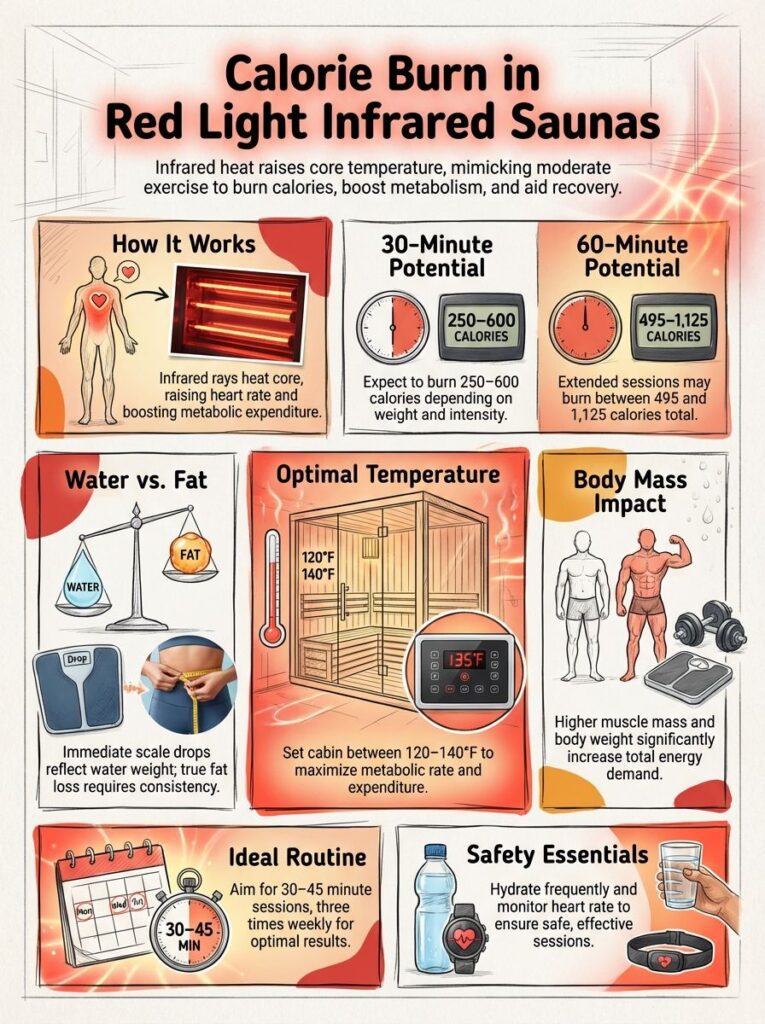
So how many calories do you burn in a red light infrared sauna? You’ll see big numbers online, sometimes 250 to 600 kcal in 30 minutes, but real-world results swing a lot based on your body size, your sauna temperature, and how hard your heart has to work to cool you down.
I’m Christopher Kiggins. I founded SaunaCloud in San Francisco in 2014 after I started using saunas in 2012 and felt real health benefits. Since then I’ve designed low-EMF infrared saunas and helped buyers get clear on hydration, weight loss, fat loss, muscle recovery, and cardiovascular health.
In this guide, I’ll show you what’s realistic, what’s hype, and how to estimate your own calorie burn without guessing.
How does a red light infrared sauna work?
Most people bundle “red light” and “infrared sauna” together, but they do two different jobs.
Infrared heaters warm your body primarily through radiant heat, which raises your core body temperature and triggers thermoregulation (your built-in cooling system). That’s what drives sweating and most of the calorie burn.
Red and near-infrared light (the visible LEDs) is typically used for photobiomodulation, which is more about local tissue and skin effects than “melting fat.” A 2024 overview of LED masks in Wired describes common red light bands around 600 to 660 nm and near-infrared bands commonly around 800 to 1,400 nm, which helps explain why brands market them for skin and recovery, not as a calorie burner.
Temperature matters for buyers because it changes the experience. Infrared saunas usually run at lower air temperatures than a traditional sauna, commonly 113 to 140°F, which is listed by Health.com as a typical range for infrared sessions.
What’s actually happening in your body during a session?
- Your skin blood flow rises to dump heat, which is why you look flushed and why your heart rate climbs.
- You sweat mostly water and electrolytes, not “fat leaving the body.” Chemical analysis summaries from Beckman Coulter note sweat is about 99% water, with small amounts of minerals and metabolites.
- Your core temperature and comfort set the ceiling: if the cabin heats unevenly or never reaches your target temp, your session feels easier, and your calorie burn usually drops with it.
- Red light can be a nice add-on for skin and recovery routines, but the “work” that costs calories is still thermoregulation.
Buyer tip: confirm real temperature, not the control panel number
This is one of the most common surprises I hear from new sauna owners: the control panel shows a target temperature, not always the air temperature where you’re sitting.
Pro tip from experienced owners: use an independent thermometer to verify cabin heat, especially if your sauna is in a garage or has a large glass front.
In a 2025 discussion on the r/infraredsauna subreddit, owners troubleshooting a sauna “stuck” near 110°F recommended checking with an independent thermometer first, then looking at installation issues like drafts and window sealing if the reading stays low.
How do infrared saunas help you burn calories?
Calorie burn in an infrared sauna comes from your body trying to keep your core body temperature in a safe range.
As heat exposure climbs, your circulatory system shifts more blood toward the skin for cooling. That pushes up heart rate and cardiac output, which raises energy expenditure above your basal metabolic rate.
One clean way to think about it: you are not doing mechanical work like walking or rowing, but your cardiovascular system is working harder than it does on the couch.
A 2019 physiology study published in a peer-reviewed journal found that heart rate and blood pressure responses during a 25-minute sauna session corresponded to a submaximal exercise load of about 60 to 100 watts, which helps explain why a sauna can “feel” like exercise even when you’re sitting still.
Heat forces your body to do extra work to cool itself, and that work costs calories.
Why trackers can disagree with each other in the sauna
Two people can sit in the same sauna, same time, and get wildly different calorie readouts.
- Heat raises heart rate without movement, and many wearables lean heavily on heart rate for calorie estimates.
- At lower intensities, heart-rate-only calorie estimates can be noisy. A 2020 wearable sensor study noted that heart rate is a strong predictor at higher intensities, but it becomes less precise at low intensities, which can lead to inaccurate energy expenditure estimates.
- Dehydration changes your physiology, which can also shift heart rate and perceived effort during later minutes of a session.
How many calories can you burn in a red light infrared sauna?
Here’s the honest answer: your calorie burn depends on heat, time, and how hard your body has to work to cool itself. That’s why estimates range from “not much more than resting” all the way up to numbers that look like a workout.
To ground this in something real, we can borrow a useful benchmark from sauna research on high-heat traditional protocols. A peer-reviewed study on repeated dry sauna rounds reported that participants expended about 73 calories in the first 10-minute round, and the burn rose to more than 134 calories by the last 10-minute round as physiological strain increased.
Infrared saunas often run cooler than those traditional protocols, so many buyers should expect the lower end of the ranges below unless they tolerate higher sauna temperature settings and longer sessions.
If you want to compare what you’re seeing to a research-backed anchor, a Binghamton University study is often cited in sauna discussions for using repeated heated sessions in a structured protocol. Treat it as a “program idea,” not as a guarantee of specific calorie burn in a single session.
How many calories are burned in a 30-minute session?
I track sessions using heart rate plus environmental measurements, because time alone does not tell the story.
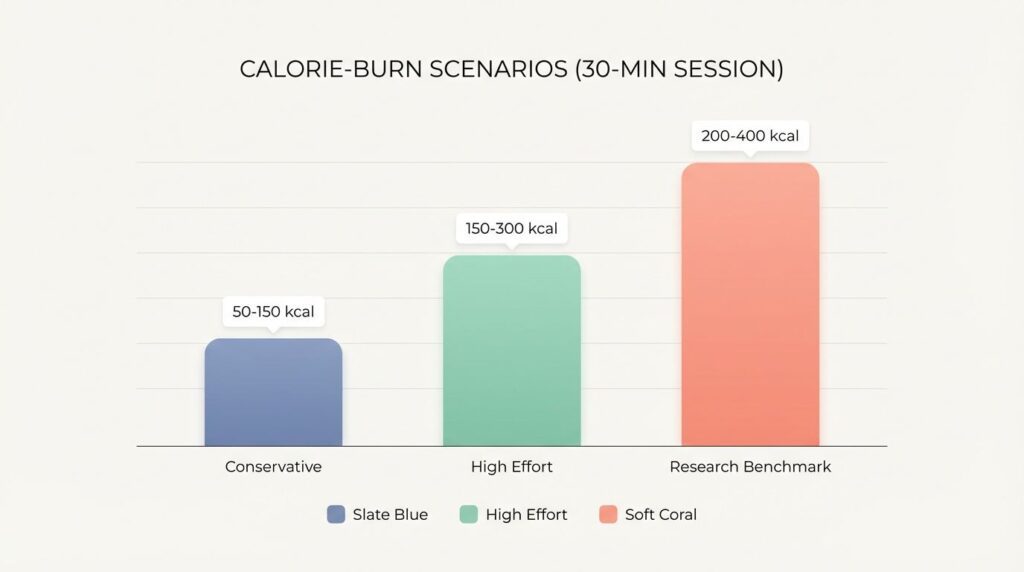
| What you’re estimating | What to expect (30 minutes) | Why it matters for buyers |
|---|---|---|
| Conservative planning range | About 50 to 150 kcal | If you run a typical home session at comfortable infrared temperatures, this is a safer expectation than “workout-level” claims. |
| Higher-effort heat response | About 150 to 300 kcal | This becomes more plausible if your heart rate stays elevated and you tolerate higher heat exposure without frequent cooldowns. |
| High-heat research benchmark (dry sauna rounds) | Roughly 200 to 400 kcal (benchmarked from measured 10-minute rounds) | A peer-reviewed dry sauna protocol reported ~73 calories in an early 10-minute round and >134 calories by a later 10-minute round, showing how much the burn can climb as your body heats up. |
| Immediate scale change | Mostly water weight from sweat | This is the number that confuses buyers the most. Scale drops can happen fast, but they are not equal to fat loss. |
| Tools I use | Heart rate sensor, a cabin thermometer, and session logs | If you want less guesswork, track the same three things: time, temperature, and heart rate. |
| Practical takeaway | Use 30 minutes as your baseline, then adjust based on comfort | If you can’t keep a steady session because the heat is uneven or too intense, your total calorie burn usually drops. |
How many calories are burned in a 40-minute session?
At 40 minutes, the biggest factor is whether you can keep your heart rate elevated without overheating. Many people do better with a split session (two rounds with a short cool-down) rather than forcing one long stretch.
| Measure | Value / Range | Notes |
|---|---|---|
| Conservative planning range | 70 to 200 kcal | Common for comfortable infrared sessions, especially if you take breaks or run the sauna at lower settings. |
| Higher-effort heat response | 200 to 400 kcal | More likely if you tolerate higher sauna temperature and stay in a steady heat exposure window. |
| Research anchor (dry sauna with repeated rounds) | About 333 kcal in 40 minutes | One frequently cited peer-reviewed protocol reported roughly 333 ± 58 calories across four 10-minute dry sauna rounds with breaks. |
| Real-world comparison | Often feels like light physical activity, not a hard workout | Your heart rate can climb, but you are not doing mechanical work like walking uphill or rowing. |
| My in-studio pattern | People vary a lot | Body size, heat tolerance, and hydration status can change the result even when time stays the same. |
Next, let’s cover what most strongly controls calorie burn, so you can set up your sauna sessions the smart way.
How many calories are burned in a 60-minute session?
A full hour is where I get the most safety questions from sauna buyers. The upside is a higher total burn. The downside is higher dehydration risk and more chance of feeling lightheaded, especially if you chase high temperatures.
| Measure | Value / Note |
|---|---|
| Conservative planning range | 100 to 300 kcal for an infrared-style session, depending on heat and breaks. |
| High-heat benchmark (multiple rounds) | Energy expenditure can climb round-by-round, with research showing 10-minute rounds rising from ~73 calories early to >134 calories later. |
| Typical water loss marker | A 60-minute repeated-round dry sauna protocol reported a 0.65 kg drop in body mass, which is mainly water weight. |
| Key influencers | Body weight, body composition, heat tolerance, and how continuous the heat exposure is. |
| Measurement tools | Heart rate monitor plus a reliable thermometer beats guessing, and it also helps you spot when a “hot” setting is not actually heating the cabin. |
| Reality check for fat loss | Fat loss still comes from sustained calorie deficit over time, so treat long sessions as a wellness and recovery tool, not a shortcut. |
Factors that influence calorie burn
Calories burned in a red light infrared sauna is not a fixed number. Your body mass index, muscle mass, core temperature response, sauna temperature, session length, and hydration status all shift your energy expenditure.
How does body weight and composition affect calorie burn?
Body size changes heat strain, and heat strain changes calorie burn.
In sauna research, higher body mass, BMI, and body surface area tend to correlate with higher physiological strain during heat exposure, which can increase calorie burn.
There’s a tradeoff buyers should know about: higher BMI can also increase dehydration risk. A large study of sauna-induced body mass loss found that people with higher BMI experienced greater body mass loss during sauna exposure and were at higher risk of dehydration, so fluid replacement matters even more if you’re using saunas for weight management.
If your goal is weight loss, I suggest tracking two separate outcomes: water weight change after a session (short-term) and trendline body-fat changes over weeks (long-term). They are not the same thing.
For a deeper dive into the science, explore our comprehensive guide on infrared sauna weight loss and metabolic health.
How does session duration impact calorie burn?
Duration matters because sauna strain often builds over time. In a peer-reviewed study of repeated dry sauna rounds, average energy expenditure increased from about 73 calories in the first 10 minutes to more than 134 calories in the last 10-minute round.
That same style of protocol reported a 0.65 kg reduction in body mass after a longer repeated-round session, which is mostly water loss.
- Start with shorter rounds (10 to 15 minutes) and see how you feel.
- Use a brief cooldown if your heart rate stays high or you feel flushed.
- Add time slowly, especially if you’re new, heat-sensitive, or using higher sauna temperature settings.
- Take dizziness seriously: the CDC’s heat illness guidance is clear that if you feel faint or weak, you should stop and get to a cooler place.
SaunaCloud also shares guidance on how long to stay in an infrared sauna if you’re trying to balance results and comfort.
How do sauna temperature settings change calorie burn?
Higher sauna temperature generally increases cardiovascular strain and can raise energy expenditure, but pushing too hot is also where buyers run into headaches, nausea, and early session drop-offs.
Infrared saunas often operate around 113 to 140°F, and as you move toward the upper end of your comfort range, your heart rate tends to climb. A 2021 review on heat therapy and cardiovascular health notes that heart rate can rise substantially during heat exposure, and that peak heart rates around 80 to 90 bpm are common in typical sessions, with higher peaks reported in some conditions.
My practical advice: use temperature as a dial you can actually repeat. Consistent sessions you can tolerate beat one extreme session followed by a week off.
Infrared therapy is not FDA-approved as a treatment for dementia or Alzheimer’s under the federal food, drug, and cosmetic act, so keep your expectations grounded and focus on comfort, recovery, and routines you can maintain.
What are practical tips for maximizing calorie burn?
If you want more calorie burn without turning your sauna into a suffer-fest, focus on repeatability: steady heat exposure, safe hydration, and simple tracking.
- Build up gradually. Start with 10 to 20 minutes, then work toward 30 to 45 minutes as tolerated. If you feel lightheaded, end the session.
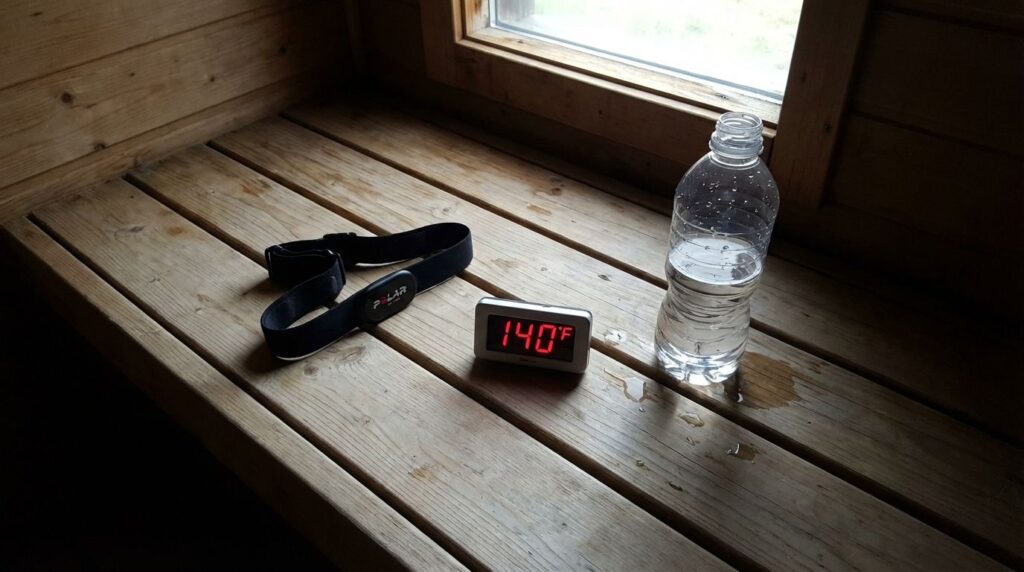
- Track heart rate. A chest strap like the Polar H10 tends to be more stable than a wrist sensor in high heat, and it gives you a better view of your real effort.
- Measure the real cabin temperature. Use an independent thermometer near where you sit, especially if your sauna is in a cold room or has lots of glass.
- Hydrate like you mean it. The American College of Sports Medicine’s fluid replacement guidance for heat and exercise includes drinking about 500 ml roughly 2 hours before activity, which is a useful starting point for sauna days too. Then replace what you sweat out afterward.
- Use electrolytes when you sweat heavily. Sweat is mostly water, but it includes electrolytes, so plain water is not always enough after a heavy session.
- Keep it clean. Wipe sweat off benches and surfaces after sessions, and follow your manufacturer’s care instructions for wood, heaters, and filters.
- Pair sauna time with physical activity. Light stretching or gentle yoga before or after can support muscle recovery and keeps your overall calorie burn anchored in real movement.
- Get medical clearance if you’re unsure. If you have cardiovascular disease, blood pressure issues, are pregnant, or have a history of fainting with heat, talk with a clinician before pushing longer or hotter sessions.
Ready to Design Your Own Sauna Routine?
The best way to maximize your health goals is with a sauna designed for consistent, high-performance use. A red light infrared sauna can support weight loss goals, but it does it in a very specific way: by raising heart rate and energy expenditure during heat exposure.
When you use an infrared sauna as a consistent recovery habit alongside exercise and healthy eating, it becomes a practical part of weight management instead of a confusing numbers game.
Whether you are looking for fat loss support, muscle recovery, or cardiovascular health, I can help you find the right fit for your home. If you see claims like 250 to 600 calories in 30 minutes, treat them as an upper-end scenario—and if you want a sauna that actually delivers the heat levels required to see real results, let’s talk.
Have a question about which model fits your space, or want a custom quote?
— Christopher Kiggins
People Also Ask
Most people burn about 50 to 300 calories in a 30-minute red light infrared sauna session, estimates vary by study. Your body burns more when your heart rate rises, and when the session is hotter or longer.
It can help a little, by raising calorie burn and causing water loss, but it is not a magic diet fix. You lose water weight fast, but real fat loss needs steady exercise, and fewer calories. Think of the sauna as a helpful tool, not the whole plan.
Body size and metabolism matter, bigger people often burn more. Heart rate, session length, and temperature change the calories burned. Moving, or doing light activity in the room, will raise the count.
Use a wearable device to track pulse and get a rough calorie estimate, treat the number as a guide.